By Forrest Rhodes, Voice in the Wilderness Correspondent
Where the Sprawl Goes to Tell the Truth: Dispatches from the Rural Unhidden
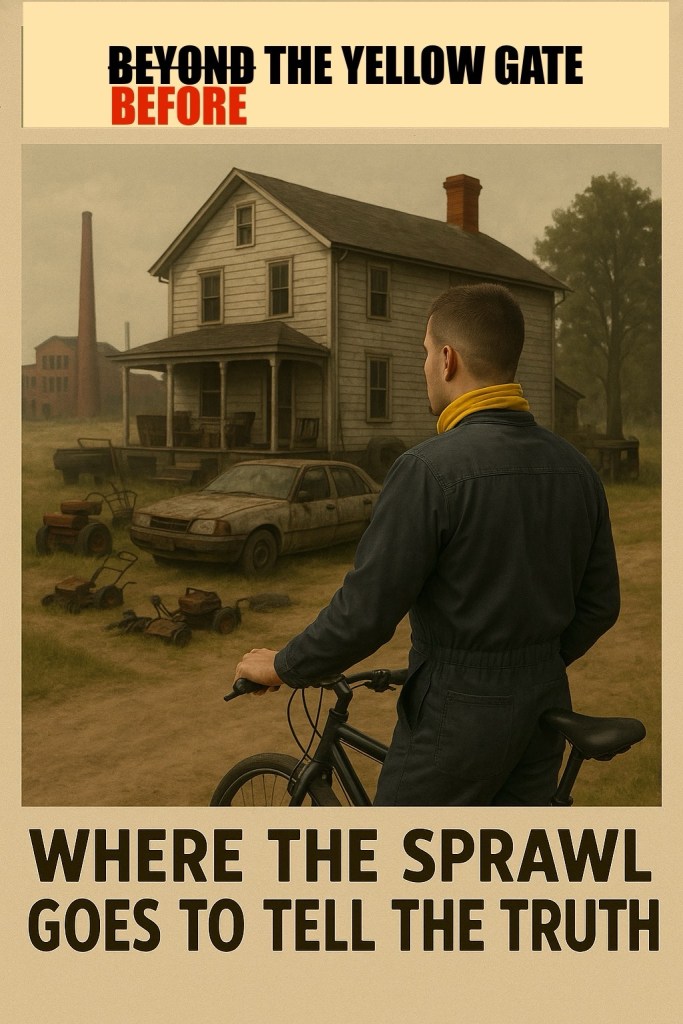
**************
We’ve all heard of suburban sprawl. It’s the architectural whisper of bourgeois propriety—neatly kept, modestly hidden, and zoned to suppress discomfort. A cul-de-sac here, a two-car garage there, a row of gabled aspirations stacked like cautious dominoes. Even when it’s ugly, it’s tidy. Even when it’s wasteful, it’s discreet.
But out here—where I’ve been parked just beyond a bend in the road that used to go somewhere—there’s a different kind of rooted sprawl. Rural sprawl. It’s not sanctioned by homeowners’ associations or shielded by hedgerows. It’s not backed by infrastructure or swept clean by city contracts. It’s just there. A visual cacophony—unvarnished, sun-bleached, and utterly unrepressed.
In rural sprawl, nothing is hidden. Every half-finished idea and expired enthusiasm is laid bare for the passing driver or the wayward poet to behold.
On porches, alongside garages, scattered across fields—abandoned snowmobiles once full of promise, exercise equipment that bore the weight of dreams for exactly three weeks, and a 1973 Camaro that was definitely going to be restored “this year.” All of it decays not with shame, but with a kind of accidental dignity. The dignity of things that once mattered.
Take, for instance, the local gearhead down the hollow who’s been quietly amassing school buses like some Appalachian Ken Kesey. Maybe he meant to turn them into mobile homes, or a madcap campground, or a roaming command center for backwoods liberty. No one knows. The buses sit there, windows clouded with moss, fenders rusting into abstraction—psychedelic dreams on cinderblocks.
A few miles past that, there’s the Lawn Mower Guy. Every region has one. Once upon a time, he was the guy to fix your Toro or sharpen your John Deere blades. Now his yard is a wild chorus of green, yellow, and red corpses, tangled belts, and busted plastic. A Cub Cadet cemetery, haunted by springtimes past.
And then—perhaps most haunting of all—there is the phenomenon I call rural industrial sprawl. These are the bones of work. The derelict sawmills, forgotten brick factories, tool-and-die shops that seem to have been abandoned mid-shift. Piles of cut logs now covered in lichen. Tractors and haulers half-swallowed by the tall grass. One gets the feeling that no one asked the obvious question: What happens when the last tree is gone or the contract for washing machine parts go to South Asia.
I stood once before a shuttered lighting factory, built of proud red brick and framed by the silence of memory. It was, so I’m told, designated as a secure location for critical manufacturing during wartime—tucked securely in the hills in case the cities were bombed. They did produce a very critical device for detonating bombs right over the intended target. What remains now is a sort of uncurated museum: the main plant, the outbuildings, the broken signage. It’s industrial rural sprawl in ruin, but somehow more honest—more noble in its contribution to the war effort. Even though the people who worked there eventually lost.
Of course, not all sprawl spreads. Some simply piles.
Why does everyone in these parts seem to own a trailer, and yet never manage a single trip to the dump? Why do porches swell with excess like psychological attics? The answer, I think, is simple: there’s no motivation left when everything leaves except the leaves, and even they are being eaten by the gypsy moths.
The storage units that ring suburban America like penitential outposts haven’t yet made it this far out. And besides, who needs them? Out here, the land remembers for you.
We must forgive some of it. These were once thriving micro-economies—machining plants and small industry towns that carried generations. They’ve all but vanished. The factories left, but the materials stayed. And so the remnants linger—in yards, in sheds, in the minds of men whose labor no longer fits the economy.
Suburban sprawl, for all its cosmetic discipline, hides itself. Garages, basements, attics, and offsite storage lockers work overtime to suppress the shame of accumulation.
But rural sprawl—it wears its wounds. It lets the unfinished business of America sit in the sun.
And for that, I say: let us look, and not turn away. There is beauty in it. You just have to squint and turn your head sideways. This is all as natural as the cellulose, which is abundant in these parts.
—Forrest Rhodes
Voice in the Wilderness, Council-of-Concerned-Conservationists
From somewhere in unknown Appalachia
 COUNCIL-OF CONCERNED-CONSERVATIONISTS…..Between Jest And Earnest…..
Leave a comment