
The Rootless Metropolitan
“The arc of history does not bend or tend toward justice or just ice, though both are aspects of the ultimate trajectory.”
—J.St.E.
As we approach another election year in that cyclical circus of confusion known as democratic electioneering, socialism has once again become a buzzword. One side points a finger of accusation; the other puts their finger somewhere else—in denial of a concept whose very name they dare not speak. Is it the road to totalitarianism or a guaranteed minimum for food, clothing, and the vice of your choice? Choose your side.
Those on one side rail against socialism as an evil while supporting its penultimate example: the military. They also back farm subsidies and corporate welfare, like the bailout of Goldman Sachs. Meanwhile, the other side claims to fight for a redistribution of wealth to anyone who can cross our borders—or simply breathe another gulp of free air as a native-born entitlee.

Both sides invoke a higher purpose to justify their brand of socialism. The side worshiping the military argues that it advances the messianic call to spread democracy and human rights across the globe, whether the recipients want it or not. Their fighting team, organized along socialist lines, is sanctified by American exceptionalism.
Their opponents justify social programs by declaring, “We’re all human, and aren’t we swell”—recognizing no higher authority or purpose. Everyone is free to choose their own way—unless you question their god of equality.
**************
At the edge of the terminal moraine of the last glacier to cover New York City, on a bluff overlooking Raritan Bay, lies Mount Loretto, a state-designated Unique Area. The Wisconsin Glaciation was the last ice sheet to advance this far south to the Staten Island shoreline. The red sands and scattered boulders along the beach testify that a mile-high glacier once pushed forward here. Geologists still consider us to be living in an “ice age,” since ice sheets persist at the poles. Ours is merely an interlude. Some speculate that decreased sunspot activity could send us into another freeze. Paradoxically, the use of fossil fuels—and the CO₂ they release—might help stave off the cold. Breathe deep and don’t forget to exhale; you just might help save the planet.
**************
In 1883, the Irish-born Father John Drumgoole³ founded the Mission of the Immaculate Virgin overlooking Prince’s Bay in Staten Island’s Pleasant Plains neighborhood. Fr. Drumgoole began his ministry in New York City, offering shelter to children orphaned by the Irish Potato Famine and the Civil War.
The crowded, infectious city tenements were exchanged for open country living in what was then a rural, sparsely populated borough. The children were educated by the Sisters of Saint Francis and taught vocational trades. With produce from their farm and subscriptions to their newspaper, The Homeless Child, the enterprise became self-sustaining and debt-free.
Two orphanages stood on either side of Hylan Boulevard, separating the boys and girls. A fire destroyed the girls’ building in the 1990s; you can still find iron bed frames poking out of the sand at the bottom of the bluff. On the north side of the boulevard stands the heart of the diminished complex: the Church of Saints Joachim and Anne. You may recognize its facade from the baptism scene in The Godfather—fitting, since one or two of the Corleone’s real-life counterparts may still live nearby (though organized crime here is now largely a Russian affair). A fire in 1973 destroyed all but the front facade and steeple. Behind the facade, you’ll see that the rebuilt sanctuary is modest and disproportionately scaled. Yet from across the meadow, viewed inland from the bluff, the church still presents an inspiring scene.
Once, paved roads ran to the orphanage and the nearby lighthouse at the bay’s edge. Now the blacktop lies cracked, with weeds poking through. The 75-foot bluff is roped off due to erosion from Hurricane Sandy, which took a bite out of the coastline. Walking the grounds, you sense this place has known livelier, more purposeful times. But under state stewardship as a Unique Area, it’s seeing a rebirth as a nature refuge. Trails now wind through wetlands and woods to the shore. On a sunny fall Saturday afternoon, few visitors were in sight. This is Staten Island, after all—most residents were likely shopping or getting their hair done. One can only guess what the women were doing. “The Rock,” as locals call it, has its own distinct culture: Mercedes-Benzes, Italianate façades, oversized displays of favorite team paraphernalia, and, lately, a booming market for illicit painkillers. Cause and effect? I’ll let you decide. Where the Mission once sheltered youth with a future, it now serves the autistic, the elderly, and the addicted.
**************
Ethical socialism, as even Spengler¹ grudgingly acknowledged and Tawney² earnestly preached, belongs to that stubborn tradition that favors parish halls over barricades, stewardship over slogans. It sees justice without love as empty machinery, and equality not as a doctrine but a shared table. Father Drumgoole’s mission wasn’t an ideology but a living practice—a quiet testament that sometimes the most radical thing you can do is feed the hungry, shelter the orphan, and keep the books balanced without fanfare.
**************
As the sun set over the bluff, I saw Peter R. Mossback standing at the southern edge, facing north toward the inland hills, his moss-colored jacket blending with the grasses. Slowly, he raised one hand—palm outward—as if holding something back.
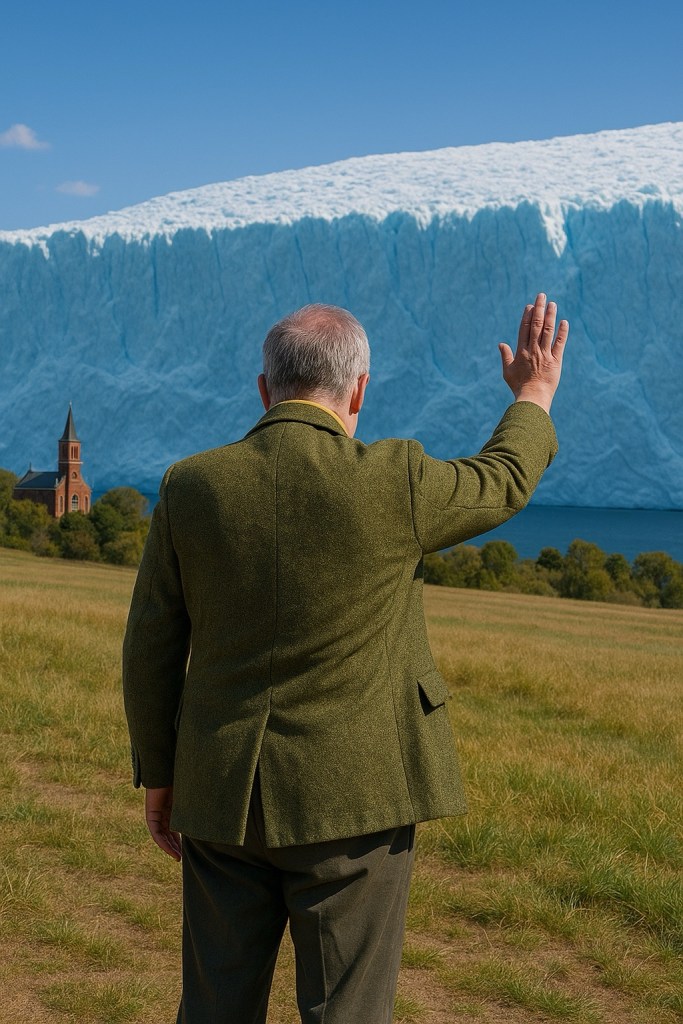
He spoke without turning.
“They say the glacier could come again,” he murmured. “I’ll wait here… just in case.”
Then he lowered his hand and kept watching the horizon.
**************
Footnotes:
[1] Oswald Spengler: In Prussianism and Socialism (1919), Spengler proposed a form of “Prussian socialism” emphasizing duty and discipline; while divergent from ethical socialism, he acknowledged its cultural role. Read more
[2] R.H. Tawney: A leading advocate of ethical socialism, Tawney critiqued capitalism’s moral failings and championed social justice in works like The Acquisitive Society (1921). Read more
[3]Father John C. Drumgoole: In 1883, Father Drumgoole founded Mount Loretto, an orphanage and vocational school for boys in a then-rural section of Staten Island. It grew into a large complex that housed and educated tens of thousands of boys and girls over more than a century. Read more
 COUNCIL-OF CONCERNED-CONSERVATIONISTS…..Between Jest And Earnest…..
Leave a comment