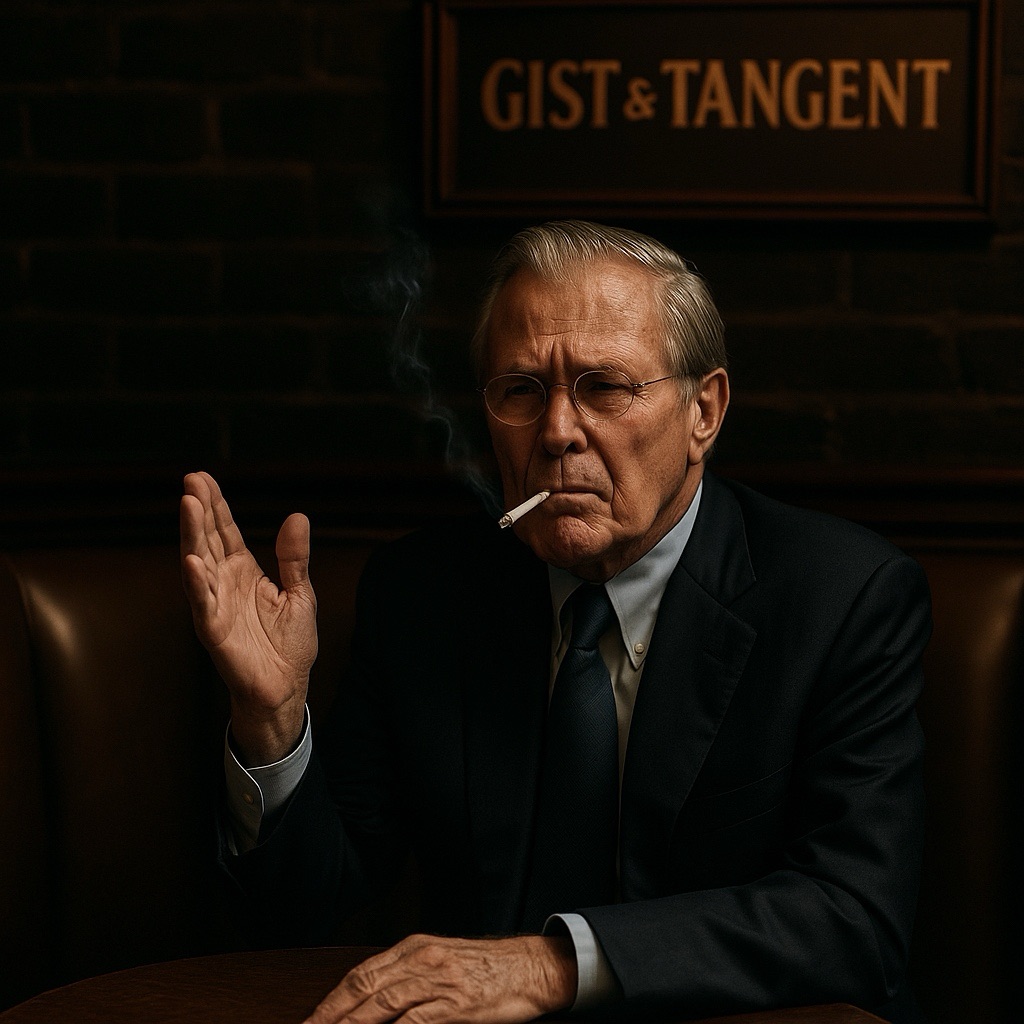
A Bull Session at the Gist-and-Tangent Pub
(as recorded by the Sub-Sub Librarian, with marginalia and notes)
**************
It was John St. Evola’s turn to address the gathering of the Meta Book club and after swirling the last of his lukewarm spring water, he rose from his seat—the one by the barred exit in violation of all safety codes where he always stands. The fixed door that would creak in a tone somewhere between resignation and prophecy— if it could ever open.
He tapped his yellow neck gaiter thoughtfully, and began:
JOHN ST. EVOLA:
“Esteemed drinkers, thinkers, and other assorted members of the Concerned, the time has come to address—the unknown.”
A low groan from the back, where Reynard Pierre-DeWitt leaned against the dartboard. Mrs. Begonia Contretemp looked up from her knitting, one eye narrowed. Paige Turner paused mid-scribble, sensing something footnotable.
JOHN ST. EVOLA:
“We, the Council-of-Concerned-Conservationists, have assembled—through great effort, misfiling, and duplication—a vast and mighty knowledge of the unknown.”
Black Cloud gave a quiet, skeptical cough.
JOHN ST. EVOLA:
“Ah, but it’s true! We know that we do not know! We have charted the blank spaces; we have archived the gaps. We have made not-knowing into a calling. And so tonight, I issue a call: each of you must contribute your knowledge of the unknown.”
MRS. BEGONIA CONTRETEMP:
“How in heaven’s name do you expect us to do that?”
JOHN ST. EVOLA leaned in, lowering his voice conspiratorially:
JOHN ST. EVOLA:
“Submit your half-remembered dreams. Submit your almost-theories, your fleeting doubts, your almost comment, your maps with the empty spaces circled in red crayon. Submit the phone numbers you nearly dialed. Submit the feeling you forgot what you were going to say.”
At this, Paige Turner perked up, rifling frantically through a sheaf of papers.
Paige Turner:
“Wait—hold on—hold on—I may have found a footnote… footnote 347… it refers to an absent text, which quotes an earlier footnote, which… dear God… it seems to cite itself…”
She paused, blinking in amazement.
Paige Turner:
“I think I’ve discovered the unknown—via recursive annotation.”
JOHN ST. EVOLA nodded approvingly.
JOHN ST. EVOLA:
“Mark it down, scholar. And lose it immediately.”
From the far end of the table, The Accidental Initiate spoke up, sipping his shandy:
THE ACCIDENTAL INITIATE:
“I never have to submit my knowledge of the unknown, because I’m always tripping over it. It’s like every time I turn a corner, it’s there, laughing, waiting to see if I’ll mistake it for something else.”
MRS. BEGONIA CONTRETEMP glanced at him sideways.
MRS. BEGONIA CONTRETEMP:
“That’s because you forget your glasses.”
Then, from the shadows near the coat rack, René Séance, envoy of the European branch—the Nouvelle Vague Zwischenschaft[1]—cleared his throat, the accent curling his words like cigarette smoke:
RENÉ SÉANCE:
“Ah, mes amis, in Europe we have long understood: ze unknown is not a problem to be solved, but a mist to be wandered. In the NVZ, we do not archive—we haunt.”
He raised a delicate glass of something unpronounceable.
RENÉ SÉANCE:
“Your Commonplace Book… it is a fine idea. But remember: a book too well organized risks becoming a tomb.”

JOHN ST. EVOLA gave a slow, thoughtful nod.
JOHN ST. EVOLA:
“Then ours shall be a living document—kept just disorganized enough to remain alive.”
A pause. Then he added, with a smile:
JOHN ST. EVOLA:
“All of your submissions—your blank pages, your half-formed hunches, your carefully mislabeled mysteries—shall be gathered, at last, into what we have been calling (and what we shall continue to call) the Council-of-Concerned-Conservationists Commonplace Book.”[2]
MRS. BEGONIA CONTRETEMP:
“We’ve had a Commonplace Book?”
JOHN ST. EVOLA:
“Indeed. We just hadn’t located it yet.”
He sipped the last of his spring water, then turned toward the door with a wink:
JOHN ST. EVOLA:
“Let posterity call it a compendium of wisdom, or folly, or both. For truly—the unknown has never been so well catalogued… nor so delightfully impossible to retrieve.”
And with that, he vanished into the night, leaving only the creak of the chair, and the faint, lingering scent of forgotten pages.
**************
[1]: Nouvelle Vague Zwischenschaft (NVZ): An elusive European intellectual movement said to operate in the foggy interstices between philosophical critique and metaphysical parody. Its adherents claim to “stand astride the threshold of the visible and the veiled.” Founded, according to unverifiable sources, by an unnamed émigré who traced his intellectual lineage to a chain of esoteric traditions dating back to a Parisian tailor’s guild mistranslating a Sufi manual. Often associated with hermetic film clubs, cryptic lectures, and the occasional ceremonial ape.
***
[2]: The Commonplace Book: Historically, a personal notebook or ledger in which writers, scholars, and thinkers (from Montaigne to Locke to Virginia Woolf) compiled quotations, observations, aphorisms, and fragments of thought. It served less as an archive of polished knowledge than as a repository for the incomplete, the provisional, the inspiringly miscellaneous—a literary compost heap from which ideas might later bloom.
***
[floating footnote 3] Kröger, F.J. (1923). “The Known Unknown: A Field Guide to the Gaps in Our Knowledge.” Basel: Verlag der Verfehlten. In this rare and questionably catalogued volume, Kröger argues that the true scholar is not the one who maps the terrain, but the one who learns to read the blank spaces between the maps. “It is not what we have recorded,” he writes, “but what we have misplaced, misremembered, or misfiled that constitutes the living archive of the unknown.” Copies of the book are notoriously elusive; scholars disagree on whether it was ever published, or whether it remains—appropriately—an entry only in footnotes such as this.
***
[floating footnote 4] Rumsfeld, D. (2002). “Press Briefing.” U.S. Department of Defense Archive. In this oft-quoted statement, Rumsfeld articulated a taxonomy of knowledge: “There are known knowns… There are known unknowns… But there are also unknown unknowns.” Scholars within the Council have debated whether his formulation was an epistemological breakthrough, a tautology, or simply an accidental echo of older hermetic triads. Some believe it qualifies him, retroactively, for honorary membership in the Council’s Epistemic Fog Subcommittee.
**************
[Paige Turner, Sub-Sub Librarian, scribbled lightly in pencil at the margin: “Sometimes, the footnote is the main text. We just don’t know it yet.” Adding softly in pencil beside the citation: “And of course… no one mentions the unknown knowns. Those we carry in silence—the truths we know but pretend not to, or the ones too deep to admit, even to ourselves.”]
 COUNCIL-OF CONCERNED-CONSERVATIONISTS…..Between Jest And Earnest…..
Leave a comment