***GONE AWRY***
The COUNCIL-OF-CONCERNED-CONSERVATIONISTS Newsletter column in which we explore the unintentional or unfathomable consequences of human endeavour.
By Black Cloud
**************
I’ve been sitting under the shade of a half-collapsed billboard at the edge of town, watching the American dream shimmer in the heat like a mirage—and I can’t help but regret the course our so-called “freedom” has taken.
The billboard, by the way?
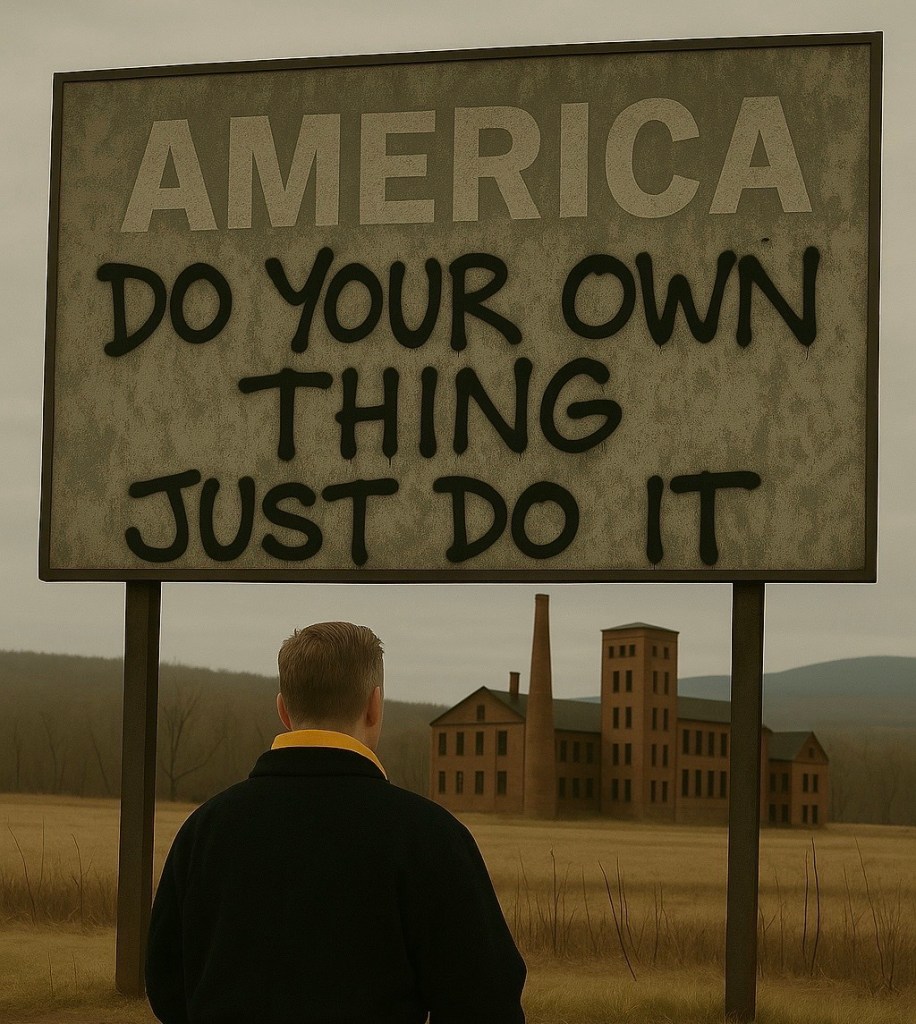
—half the letters gone, peeled away by sun and wind, leaving only AMERICA and graffiti. There’s a metaphor in there somewhere, but the metaphor, like the billboard, has mostly blown away.
When the Council first asked me to pen this column, I thought we’d be poking around the usual ruins of human folly: parking lots where forests should be, big-box stores flattening old downtowns, digital addictions replacing front porch conversations. But lately, the ruin feels deeper, more metaphysical. And as I watch tumbleweeds of plastic bags drift by, Dr. John Rao’s words keep returning to me, sharp as a wind off a gutted prairie:
“Regardless of the will or the choice of the Founders of any erroneous school of thought, the ideas that they espouse are what they are and spread their inevitable subversive poison.”

Rao lays it bare. The Founders didn’t plan for our political parties—both Democrat and Republican—to hollow out our industries by sending factories overseas, chasing cheaper labor and bigger profits while hollowing out towns. Nor did they plan for the long, bipartisan drift toward open borders: Democrats eager to reshape the voting demographic to secure their future coalition, Republicans eager to provide compliant workers to feed their industries.[^1] They didn’t plan for a culture where “freedom” became freedom from constraint, from memory, from moral ballast. But the ideas they loosed into the world had other plans.
Rao reminds us:
“Enlightenment freedom and naturalism lead, logically, to the creation of radical, passionate men who care nothing for long-standing traditions and objective morality.”
We were sold liberty, but it’s metastasized into a carnival of disinheritance. We dismantled the old village, and what we built in its place—superhighways, shopping malls, payday lenders, Netflix queues—is a playground for the “new men,” the ones Rao names: anti-social, anti-historical, materialist, restless in their bones.
And those still clutching to old rites and symbols—Rao offers no false comfort:
“If they are Catholic in name, [they] make of the Traditional Mass and the Traditional Faith an after-hours parlor sport for those engaged in what really counts… making big time bucks and spending them on often useless or destructive toys.”
Here in the Council-of-Concerned-Conservationists, we joke about our yellow gaiters and roadside epiphanies. Reynard Pierre-DeWitt calls us the Hi-Vis Hesychasts—modern mystics in reflective gear, part roadside crew, part spiritual searchers, trying to preserve meaning in a world of noise. Libby D’Innous says we’re just “conservationists in crisis.” But beneath the humor, there’s a grief that won’t let go—a grief for the forest paths bulldozed for outlet malls, for the factories gutted and rusting in the Midwest, for the ordinary pieties that once bound neighbors across fence lines.
We thought we were conserving “freedom,” but what we conserved was a greenhouse for weeds.
John St. Evola’s Editor’s Note:
“Black Cloud, you old melancholic. But even weeds know how to bloom, and sometimes—just sometimes—the dandelions crack the sidewalk in a way no marble monument can. As for myself, I’m saving room for the parlor sport and the useless toys—what else are we supposed to do in a world where the serious people are always the ones dismantling the good? Cheers from the edge of the abyss.”
Reynard Pierre-DeWitt, Chaos Coordinator, offers this final note:
“Ah, Black Cloud, you deliver the weather report of decline like no one else. But take heart: no storm lasts forever, no chaos runs on infinite credit, no empire can hold its own contradictions without springing a leak. Sooner or later, every runaway system blows a fuse—or, as my Uncle once said after the Fourth of July picnic table collapsed under the potato salad: ‘Gravity always gets the last vote.’ Cheer up. Even decline has an expiration date.”
Complete Quote from Dr. John Rao:
“Many of the early supporters of erroneous ideas do not desire the consequences that flow from them. Martin Luther did not want the principles of Protestantism to aid radical enthusiasts. America’s Founders did not plan for the influence of Karl Rove. Cavour and Bismarck might have laughed away the prospect of a Hitler, and sexual libertines the universal spread of gross pornography. Liberal bourgeois capitalists of the mid-nineteenth century would, perhaps, have run headlong from massive shopping malls destructive to more restrictive forms of village and city economic life. And, certainly, most recent traditionalist defenders of the unrestrained market whom I know do not wish to destroy what remains of Christian morality and Christendom.
The fact that so many heretics and ideologues do not wish bad things to happen is a proof of the continued hold of traditional beliefs and conservative presuppositions regarding personal behavior upon them. But it is also a demonstration of the failure of their logic. Regardless of the will or the choice of the Founders of any erroneous school of thought, the ideas that they espouse are what they are and spread their inevitable subversive poison. Some men, like the Anabaptists and Unitarians of Luther and Calvin’s days, accept that logic straightaway. Nevertheless, the bulk of humanity requires time to do so; time, the slow dissolution of the beliefs and behavior which block radicalism, and the construction of a society which fully shapes people not on the basis of its Founders’ irrational conservative scruples, but their corrosive rational principles.
Enlightenment freedom and naturalism lead, logically, to the creation of radical, passionate men who care nothing for long-standing traditions and objective morality. The logic of Enlightenment capitalism, as men like Michael Novak exult, is to create a new kind of man who thinks and acts differently than citizens of traditional western Christendom. These new men will ensure that the pattern of capitalist industrial development in twenty-first-century Africa and Latin America is different than that guided by more traditionally minded individuals still shaped by the Christian remnants of eighteenth-century Britain. These new men will not define or practice a ‘charity’ that can correct social imbalances in the same way as older Catholic believers could. These new men will adore the anti-social, anti-historical, materialist way of life, and, if they are Catholic in name, make of the Traditional Mass and the Traditional Faith an after-hours parlor sport for those engaged in what really counts in a democratic, capitalist universe: making big time bucks and spending them on often useless or destructive toys.”
[1]: For those wondering: yes, both parties often play more similar games than they’d admit at the podium.
 COUNCIL-OF CONCERNED-CONSERVATIONISTS…..Between Jest And Earnest…..
Leave a comment