Council-of-Concerned-Conservationists Policy Paper
by Reynard “Ray” Pierre-DeWitt, Chaos Coordinator
I. INTRODUCTION: THE ROAD TO SAMENESS
The Interstate Highway System, once hailed as the steel spine of American progress, now stretches across the continent as the great equalizer of mediocrity. It annihilates local character, flattens cultural landscapes, and turns place into non-place.
From New Jersey to Ohio (only more so), from Highway 40 blues to the absurdity that Hawaii — an island chain in the middle of the Pacific — has an interstate highway system, the contradictions pile up like jackknifed semis outside Indianapolis. Was this bureaucratic humor or bureaucratic idiocy? Did the federal planners chuckle as they stamped “Interstate H-1” onto a tropical island, or did they simply surrender to the logic of empire, where even paradise is folded into the asphalt grid?
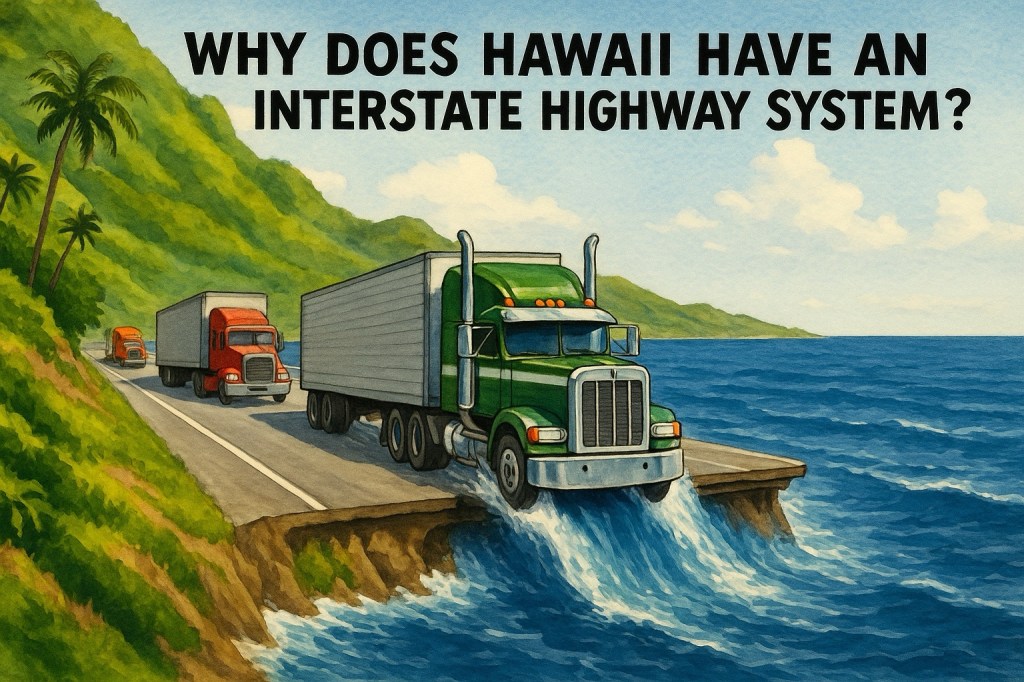
Hawaii Interstate Blues
🎶 I took the interstate straight to the ocean,
now my rig’s got that saltwater motion.
Paved my way to a wave goodbye,
watchin’ taillights sink where the sea meets sky.
Aloha signs and a diesel tune,
singin’ them Hawaiian interstate blues.🎶
II. CHAOS COORDINATED: THE PARADOX OF THE INTERSTATE
As Chaos Coordinator for this Council, I salute the audacity: a system where chaos is regimented, velocity is normalized, and survival relies on mutual (if grudging) consent. Class is revealed in the lanes: the rusted-out Corolla wheezing in the slow lane, the Mercedes gliding in a bubble of disdain, the diesel F-350 roaring past with a defiant snarl.
At the off-ramps, sameness reigns. Every exit ramp a copy-paste of the last: McDonald’s, Exxon, Red Roof Inn, Dunkin’ Donuts. The only regional accent is which fast-food chain wins the turf war.
We have built a nation where “local color” has been reduced to corporate signage.
III. WHAT HAPPENED TO THE RAILS?
Once, the railroads knit America together — long steel arteries pumping people and freight, towns and cities blooming around depots and stations. The rails were collective, ordered, rhythmic.
But America — restless, impatient, fiercely individualistic — grew weary of timetables. Trucks offered freedom: one man, one rig, one contract, one cargo. Politicians praised their flexibility, corporations loved their reach, and soon the rails withered into museum pieces and tourist attractions.
The truck became America’s beast of burden, its symbol of entrepreneurial grit.

The rail, collectivist by nature, fell to the side as we chose the restless independence of the open road.
IV. THE CONSEQUENCES: WHY WE SHOULD CARE
Today, every apple, every shoe, every box of screws rides the interstate. One pileup on I-5, one jackknifed rig on I-80, and shelves empty from coast to coast. The supply chain isn’t a chain at all — it’s a convoy of trucks, each one a solitary wager in a high-speed gamble.
We have traded reliability for freedom, cohesion for fragmentation. The highway is our national metaphor: fast, flashy, brittle.
V. THE HIGHWAY AS SYMBOL: AMERICAN SOCIETY IN MOTION
The interstate is America, because America is the interstate:
Class tension rides shotgun. Culture flattens at every off-ramp. Chaos hums under a thin veneer of order.
Most telling of all: the preference for trucks over trains mirrors our national psyche.
The rail is collectivist — bound to timetables, shared corridors, mutual dependence.
The truck is individualist — a lone cowboy on a ribbon of asphalt, beholden to no one but his delivery deadline.
We chose the truck. We chose the interstate. We chose the myth of independence over the fact of interdependence. This is the trajectory of America.
VI. THE COUNCIL’S MANDATE: MAKING THE RAILS RUN AGAIN
The Council-of-Concerned-Conservationists will not stand idle while the nation decays in a haze of exhaust and strip-mall sameness. We affirm the dignity of the rail. We recall a time when the trains ran on time — and we pledge to make them run on time again.
We call for:
Reinvestment in rail freight. Restoration of regional rail networks. Revival of local economies at rail hubs. Reduction of highway dependence and congestion.
We will build the rails back — and we will run them with the pride and precision this country once knew.
VII. CONCLUSION: THE FINAL OFF-RAMP
It is no accident that the blues grew up beside Highway 40.
The highway was never just a road; it was the soundtrack of dislocation.
If we want to rediscover place, purpose, and belonging, we must look beyond the off-ramp and return to the rails.
Until then, I remain,
Reynard “Ray” Pierre-DeWitt
Chaos Coordinator, Council-of-Concerned-Conservationists
ADDENDUM: REBUTTAL BY NOOR SINGHA GRUDJ, COUNCIL GADFLY
**************
“The Rail to Nostalgia: Why the Past Won’t Save Us”
Ah, the Council is at it again — polishing the brass on the Titanic while insisting it’s a lifeboat. Rey Pierre-DeWitt’s lament for the interstate system is poetic, sure, but let’s not mistake sentiment for strategy. Before we all board the conservationist nostalgia express, allow me to tap the brakes — or rather, pull the emergency brake.
I. RAIL IS SLOW, INFLEXIBLE, AND EXPENSIVE
Yes, rail once ruled. Yes, it’s charming. But have you taken a train lately? Freight or passenger, rail is slower than trucks, rigid in its routes, and wildly expensive to expand or modernize. Want to ship your kale microgreens or precision car parts? Good luck waiting for a boxcar slot — and enjoy the markup. The reason we turned to trucks wasn’t chaos or some rugged cowboy fantasy; it was sheer pragmatism.
II. THE GEOGRAPHY HAS CHANGED
America’s post-rail geography is sprawling, decentralized, and suburbanized. Highways don’t just connect cities; they knit together exurbs, warehouses, ports, and industrial parks that rail can’t easily reach. Do we propose building thousands of new sidings and spur lines? Paving farmland for rail yards? Let’s be clear: a rail revival isn’t just about restoring old tracks; it’s about reshaping the entire national landscape — and that comes with a staggering ecological and financial bill.
III. THE SUPPLY CHAIN IS NOW BUILT FOR FLEXIBILITY
The Council romanticizes rail’s predictability, but modern supply chains thrive on flexibility. Trucks can reroute in real time, adapt to weather, detours, and demand spikes. Rail can’t. We don’t just move goods; we choreograph their movement. Converting back to rail would require reengineering manufacturing schedules, distribution centers, and just-in-time logistics. Is the Council ready to underwrite the economic shock?
IV. PUBLIC WILL AND POLITICAL REALITY
And finally — has anyone at this table looked up from their parchment long enough to notice the political climate? Americans are not lining up to trade personal freedom and convenience for collective systems. We’re still a car culture, for better or worse. Shifting freight is one thing; shifting attitudes is quite another.
V. THE COUNCIL’S BLIND SPOT
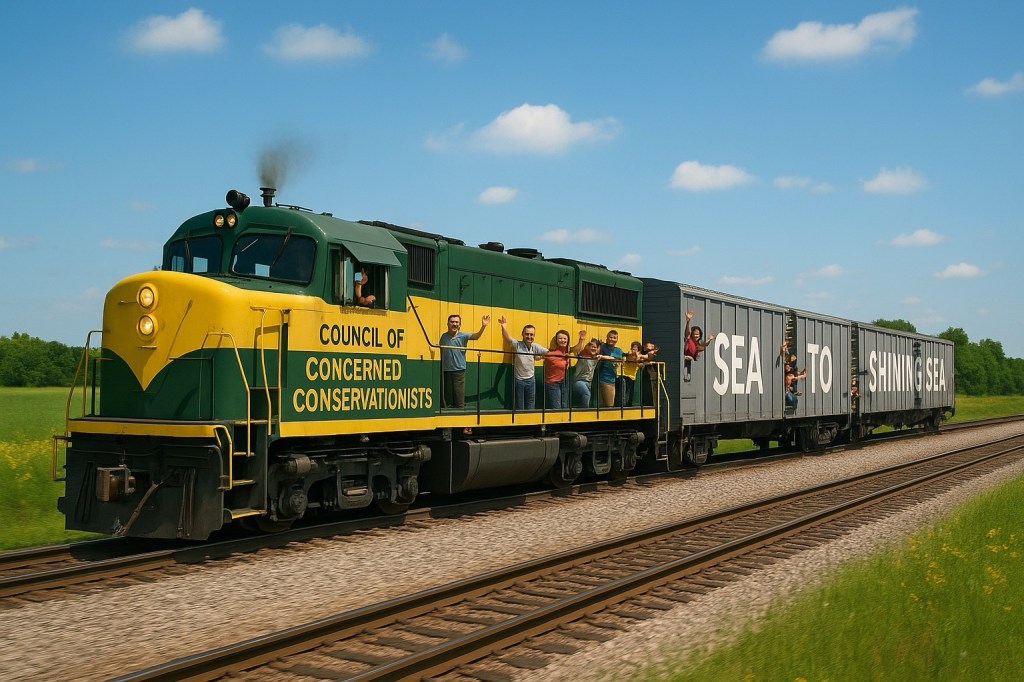
The truth is, the Council-of-Concerned-Conservationists is better at elegy than engineering. You’re brilliant at diagnosing civilizational malaise — less so at facing the messy, compromised realities of a modern economy. By all means, run a symbolic freight line across the country, slap a banner on it, and wave from sea to shining sea. But let’s not pretend it will move the diapers, avocados, and phone chargers that keep this nation humming.
In closing, I am, as always, grateful for the Council’s capacity to dream.
But some of us have to live in the world as it is.
— Noor Singha Grudj
Council Gadfly, Council-of-Concerned-Conservationists
**************
FOLLOW-UP REPLY FROM REYNARD “RAY” PIERRE-DeWITT, CHAOS COORDINATOR
“Thank You, Noor — You Just Proved My Point”
Dear Noor,
As ever, you are the sharp needle pricking our well-upholstered dreams — and I thank you for it.
But let me turn the mirror back. Every “negative” you’ve raised is, in fact, the essence of what we must confront:
Rail is slow, inflexible, and expensive? Exactly. It imposes rhythm and limits — the kind that teach a society to plan, cooperate, and share space, rather than chase infinite flexibility at infinite cost. The geography has changed? Yes, and disastrously so. We have allowed our landscapes to sprawl into placelessness, and only rail-centered planning can knit those pieces back into something resembling a coherent whole. The supply chain thrives on flexibility? That “flexibility” is precisely the fragility we now bemoan when a single highway pileup or port delay sends shockwaves through the shelves at Target. Public will is lacking? True. But public will is not static. It is shaped, modeled, and — when necessary — challenged. The Council does not exist merely to reflect what is, but to imagine what could be.
You accuse us of nostalgia, but I propose we are motivated by memory — and memory is the mother of foresight. We seek to repair the fracture between independence and interdependence, between local and national, between the speed of the market and the pulse of the land.
In short, dear Noor, you have drawn up the perfect list of why we must act.
I remain,
Chaos Coordinator, Council-of-Concerned-Conservationists
[Editor’s Note:]
The Council welcomes dissenting voices and reminds members that the next meeting will feature complimentary coffee, which Noor has preemptively declared “lukewarm, over-extracted, and symbolic of the Council’s caffeine failures.” We wouldn’t have her any other way.
 COUNCIL-OF CONCERNED-CONSERVATIONISTS…..Between Jest And Earnest…..
Leave a comment