Conversations Across Eternity At The Gist and Tangent Pub
(with spirited interventions from the Council)
Participants:
G.K. Chesterton — The Apostle of Paradox
Herman Melville — The Mariner of Metaphysics (and Sardonic Wit)
John St. Evola — Editor, metaphysical mischief-maker
Black Cloud — Chief Poetic Justice Warrior
Reynard Pierre-DeWitt — Chaos Coordinator
Dr. Faye C. Schüß — Medical and Mental Hygiene Fellow
(Setting: The Gist and Tangent Pub, where the ale is warm, the fire flickers, and the conversation leaps between the comic, the cosmic, and the culturally wary. Chesterton leans forward, pipe in hand, his eyes twinkling behind spectacles; Melville leans back, a man with the grin of one who has seen every kind of storm.)
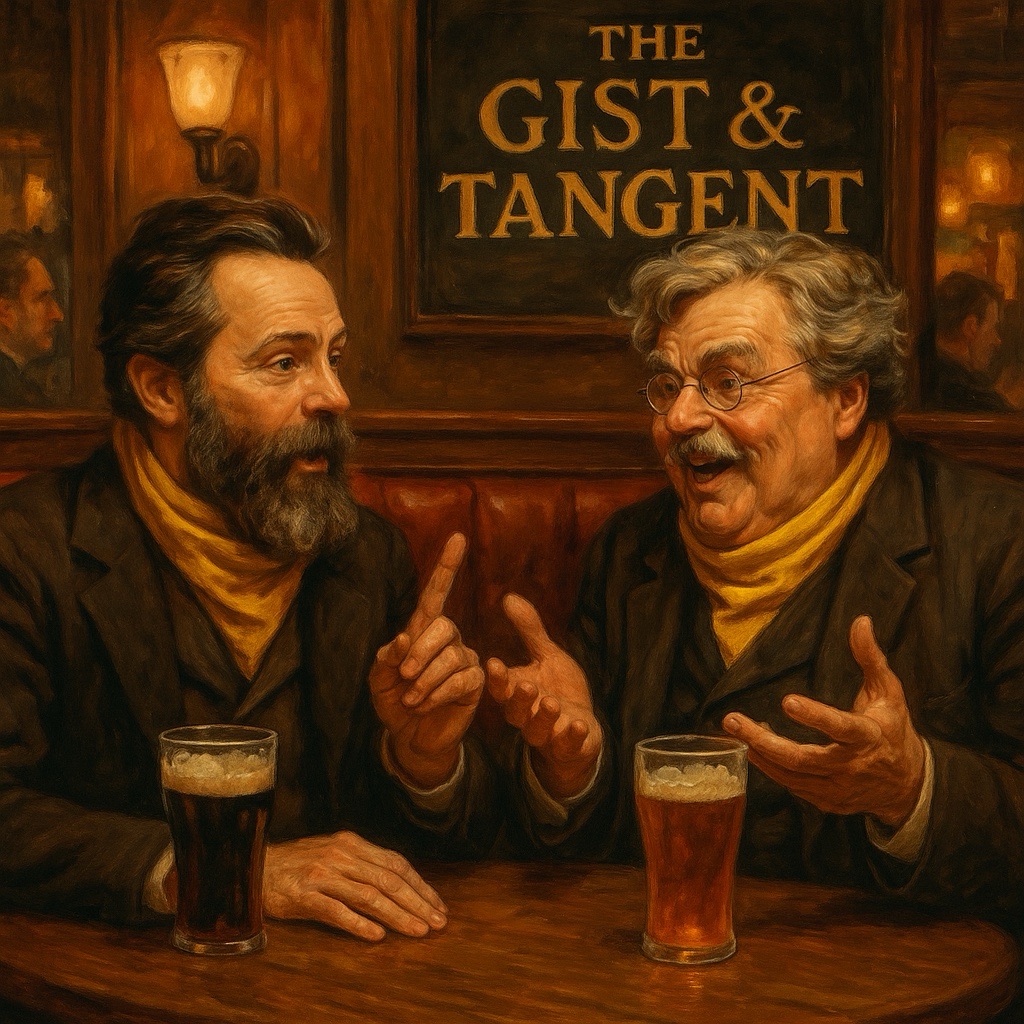
(The Gist & Tangent — where neckwear signals affiliation and foam softens dissent.)
CHESTERTON (waving his pipe like a knight brandishing a quill):
Herman, you have stared into the abyss and laughed! And rightly so—the world’s a divine jest. The paradox, the punchline, is that grace enters through the cracks. But let me speak plainly of the Pequod, dear fellow, that great floating democracy.
MELVILLE (smirking over his rum glass):
Ah, yes—the ship of many nations, many tongues, many creeds, all bound together on a single doomed voyage.
CHESTERTON (leaning in, voice sharp as a blade hidden in a loaf of bread):
And that, you see, is the parable. The Pequod was a magnificent metaphor for America: a ship of all nations, a vessel of diversity, a floating commonwealth. But here’s the uncomfortable truth—it sank. And why did it sink?
(He taps his pipe on the table, eyes gleaming.)
Because injustice is not democratic, and neither is fate. Ahab wasn’t mad at a whale—he was mad at the fact that the world is not fair, that pain and misfortune strike unevenly, that life itself refuses to level its scales. And so, possessed by the fever of correcting the cosmos, he dragged his democratic crew into an undemocratic abyss.
BLACK CLOUD (grinning, raising his glass):
And Ishmael floated off on a coffin. That’s your American survival kit right there.
CHESTERTON (warming to his theme, eyes dancing with paradox):
You see, my friends, the modern world is increasingly fixated on equality—not equality before God or the law, but absolute sameness of outcome. We would equalize everything: wealth, sorrow, happiness, even talent. We have made democracy not merely a political arrangement, but a metaphysical crusade.
(He leans back, smiling sadly.)
But life, like the sea, will not be equalized. And those who try—those who would hunt down every last white whale of inequality—may well sink the ship they claim to save.
MELVILLE (half-laughing, half-sighing):
Ahab reborn as a social reformer. God help the crew.
DR. FAYE C. SCHÜß (dry as gin left uncorked):
Clinical note: the modern fixation on cosmic fairness suggests a psychological condition I call existential leveling disorder—the refusal to accept that life is, in fact, uneven.
BLACK CLOUD (grinning wider):
So, Melville dodges tattoos, Ishmael embraces the tattooed man, and today everybody’s Ishmael in skinny jeans, screaming about inequality on social media.
REYNARD PIERRE-DeWITT (snapping notebook shut):
Council motion: convene a symposium titled “From Queequeg to Coachella: Tattoos, Equality, and the Shipwrecked Self.”
JOHN ST. EVOLA (mock solemn, hand on heart):
By Council decree, Herman Melville is recognized as doom-sayer, wit, and reluctant prophet of the tattoo age—and Chesterton as the watchman of the ship’s balance sheet.
CHESTERTON (raising his mug, eyes twinkling with laughter and warning):
To the whale, the cannibal, the blank page of skin, the ship of nations—and to the God who reminds us that the sea was never meant to be a parliament!
MELVILLE (lifting his glass, smiling knowingly):
To the joke beneath the storm. And to the few fools wise enough to laugh at it.
FOOTNOTE from the Backward Scholar (B.S.):
“Council position: tattoos once signified passage, peril, or pilgrimage. Today they too often mark simulated savagery. And remember: the Pequod was the ship of nations, undone by the delusion that the world can be made perfectly fair. For documentation, see Stubb’s punchlines, Ishmael’s asides, Queequeg’s pipe-sharing, the tattoo-dodging saga of Typee, and the silent prophecy of the Instagram feed.”
 COUNCIL-OF CONCERNED-CONSERVATIONISTS…..Between Jest And Earnest…..
Leave a comment