—an analysis of news items which convey a deeper significance not always apparent to the average sports fan.
—by Arthur Phärtze, aesthetic interpreter for the Council-of-Concerned-Conservationists
“The reality of what we really are is often times found in the small snips, way down at the bottom of things.”
—Jean Shepherd
Shepherd wasn’t just talking about dropped popcorn kernels, unfinished sentences, or errant socks. He was describing a metaphysical orientation—one that the Council-of-Concerned-Conservationists has long shared. In a world obsessed with spectacle and systems, we believe meaning tends to drift into the shallows, camouflaged as insignificance.
This same view animates the chaos theorists and emergentists, whose recent work (Everyday Chaos [1], for example) affirms that the future is shaped less by overarching laws and more by cascading, local particulars—small snips of consequence whose meaning we may only glimpse in hindsight.
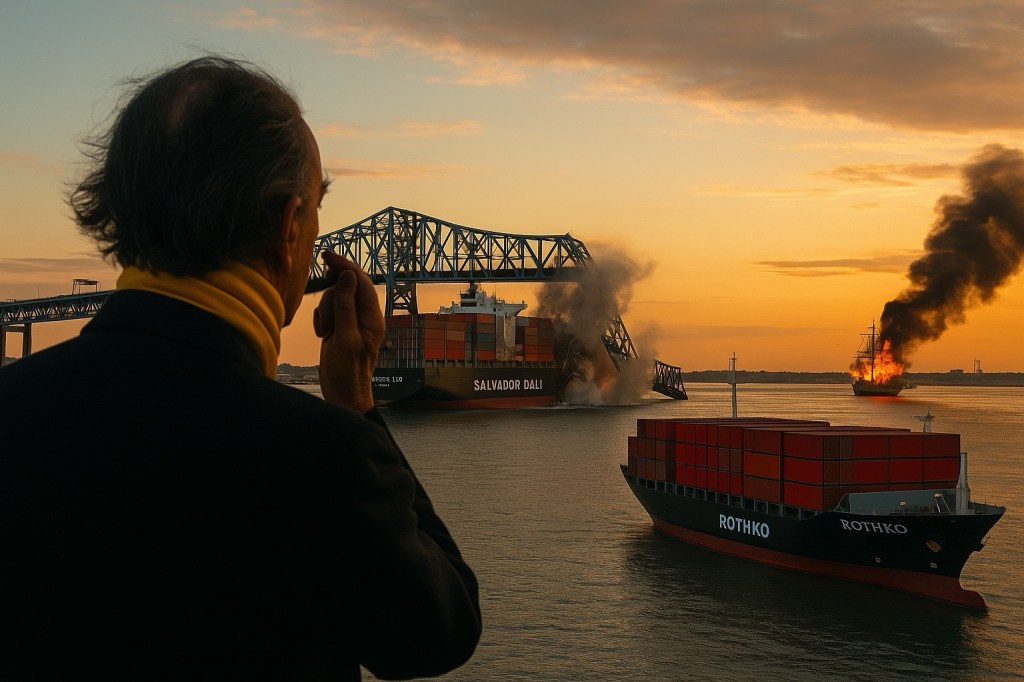
Take, for example, the container ship that struck and collapsed the Francis Scott Key Bridge in April 2024—the same Key who once gave us our national hymn, now submerged under the weight of cargo capitalism. The ship’s name? Salvador Dalí.

Yes, that Dalí. The surrealist painter whose visual vocabulary included melting clocks, levitating saints, and elephants on stilts. He seems to have reached through time to sign this disaster with his name—M/V Dali—not in the corner of a canvas, but on the hull of a ship tasked with redrawing the map of Baltimore Harbor.
The Baltimore Banner notes the eerie alignment between Dalí’s imagery and the bridge’s destruction.
We at the Council confess that Dalí’s more grotesque visions make us uneasy. His work, while brilliantly executed, too often resembles life as it is—twisted, uncanny, and barely held together by dream logic. And yet, something about this feels too precise to ignore. As if he left behind a joke in oil paint and steel.
We prefer his calmer efforts, like The Discovery of America by Christopher Columbus—a grand, hopeful piece. One of us (we won’t say who) tried to order it recently as a jigsaw puzzle. It was out of stock. The metaphor writes itself: discovery undone, legacy scattered. Even puzzles are in revolt.
And now we learn that Dalí’s sister ship is named Cézanne. Both vessels were christened as part of a larger shipbuilding initiative.
As reported by the Maritime Executive, the pair were named for cultural figures—though Cézanne, with his pallid apples and placid outlook, seems destined to arrive with a softer absurdity. Or perhaps a quieter kind of catastrophe.
What, then, is this a straw in the wind for?
That’s harder to say—but we suspect it points toward a new phase of public life in which surrealism bleeds into infrastructure, where absurdity is no longer confined to gallery walls but knocks down bridges and monuments in broad daylight.
It may signal the moment when global commerce—once silent and logistical—has become poetic, mythic, and destructive. When container ships no longer just deliver goods, but deliver metaphors. When the naming of vessels is no longer incidental, but oracular. When artists’ names become prophecies.
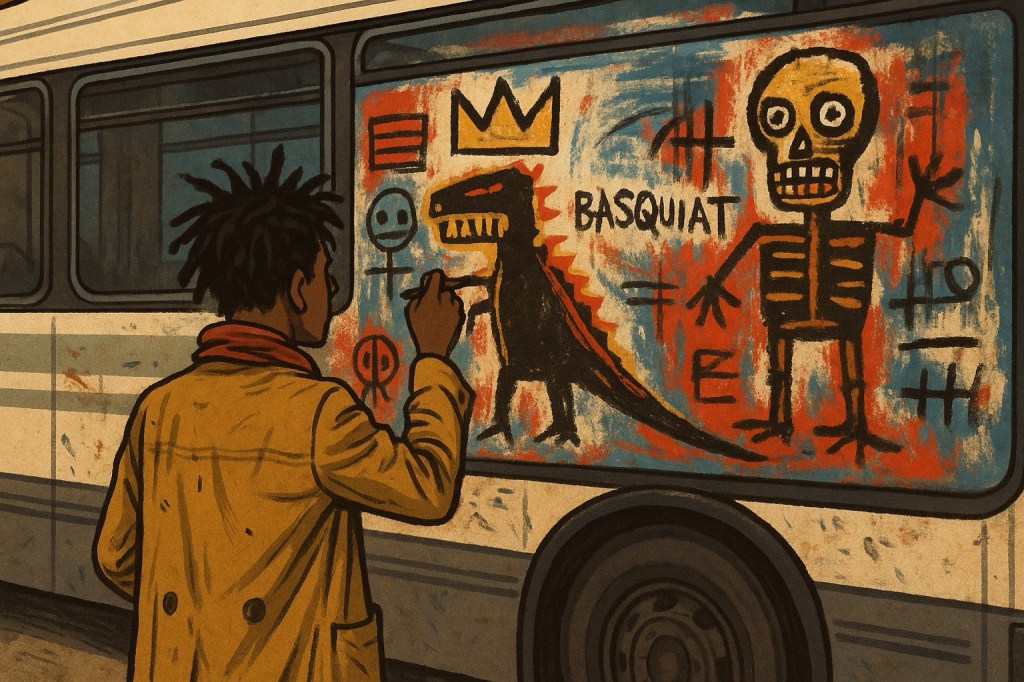
Today it is Dalí, and tomorrow it may be Warhol—arriving not with soup cans but with redundant spectacle, bearing containers full of imitation meaning and pop facsimiles. Or perhaps Basquiat, whose arrival will be accompanied by chaotic symbols, crown motifs, and the commodification of revolt.
A ship named Frida Kahlo might run aground and spill a thousand curated wounds across a coastline. A vessel marked Banksy could vanish entirely, refusing to dock—its cargo auctioned at sea. And heaven help the harbor when Rothko sails in: nothing but muted red boxes inside other red boxes, unloading the heavy stillness of emotional abstraction.
The cargo itself becomes part of the transmission:
– Dalí delivers collapse wrapped in surreal inevitability.
– Warhol delivers branding as sacrament.
– Cézanne will likely bring tasteful boredom, arranged precisely.
– Magritte might arrive with crates labeled “Not a Crate.”
– Picasso could tip sideways at the dock, confusing fore and aft, unloading only fractured mirrors and poorly reassembled bicycles.
– And if a ship called Turner ever burns mid-harbor, we will know we’ve entered the full Romantic phase of the empire’s undoing.
What began as naming convention becomes symbolic transmission, the unconscious cargo of late civilization—impressionist damage, surrealist logistics, cubist consequences.
We note these things not because they are large, but because they’re small.
That’s where the signs are.
That’s where the Shepherds of culture have always looked.
And now, so do we.
**************
To Be Filed Under: aesthetic shipwrecks, surrealist infrastructure, maritime omens, and the uncanny cargo of modernity
[1] https://c-of-c-c.org/2025/05/13/the-c-of-c-c-quote-of-the-day/
 COUNCIL-OF CONCERNED-CONSERVATIONISTS…..Between Jest And Earnest…..
Leave a comment