“A man’s name is a numinous pressure point, a cipher that discloses his role in the drama of becoming. Or, in some cases, unbecoming.”
—John St. Evola, Glossary of the Known Unknowns
The sound of a name, despite dissimilar spelling, still speaks truth.
Thomas Sowell—SOUL by sound, Sow-well by action—is the Republican Party’s favorite philosopher-prop.
He is not just quoted—he is used, displayed, and elevated as proof that the GOP, too, has its own redeemer in dark flesh.
This is not a judgment on Sowell the man—but on the role he is made to play.
He has become, willingly or not, the GOP’s Magic Negro.
Magic Negro (n.): A literary and cultural trope in which an exceptional Black figure offers salvation or clarity to white protagonists—always dignified, always exceptional, never threatening the dominant order.
But the real problem did not begin with the Republicans.
It began with the progressive Left—those moral engineers who could not leave well enough alone.
Instead of working within the natural order of race relations as they had evolved (however messily), they set out to rewrite reality.
Through the Civil Rights Movement, they achieved a constitutional revolution—one that the Republicans, in their own way, endorsed and helped enact.
The result was not racial harmony, but institutionalized grievance and a new caste system of symbolic roles.
And what did it all lead to?
Civil Religion gave way to Civil Riots.
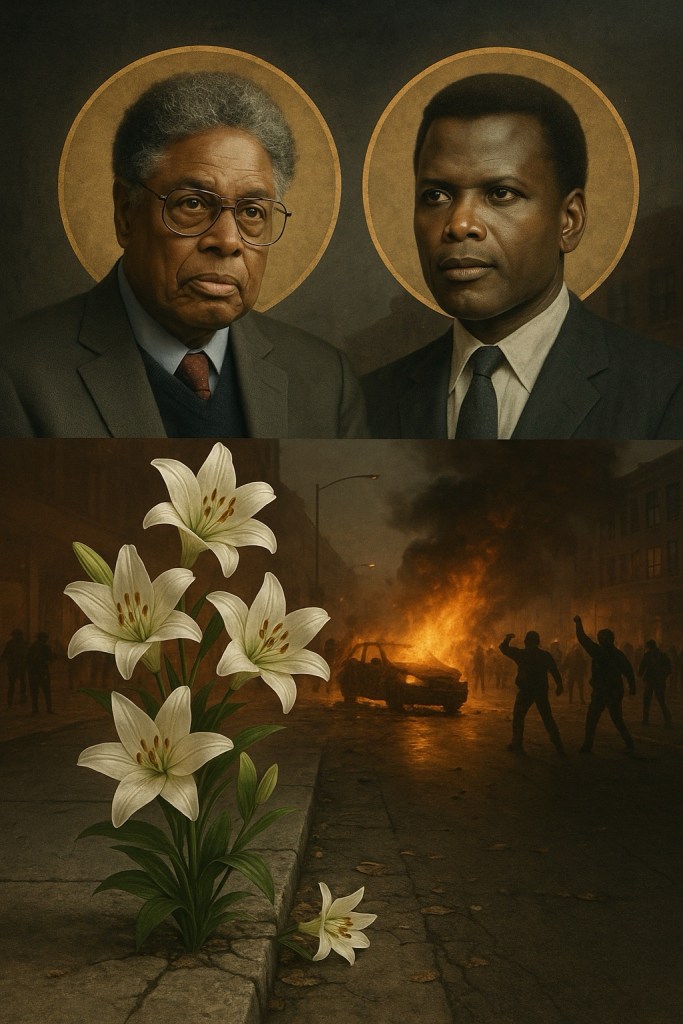
Sidney Poitier became the template: the respectable Black man who reassured anxious white liberals.
Now, Sowell does the same for white Republicans.
His quoted line:
“The beauty of doing nothing is that you can do it perfectly.
Only when you do something is it almost impossible to do it without mistakes.
Therefore people who are contributing nothing to society, except their constant criticisms,
can feel both intellectually and morally superior.”
But consider this:
Sometimes, doing nothing is the wise path.
“Consider the lilies of the field, how they grow; they toil not, neither do they spin.
And yet I say unto you, that even Solomon in all his glory was not arrayed like one of these.”
—Matthew 6:28–29
The lilies did not riot.
They did not legislate.
They did not integrate.
And yet—they endured.
The real damage came from those who insisted on doing something—on pushing progress, redefining identity, staging redemptions.
The donkey and elephant party participated:
The Left with their activist frenzy. The GOP with their passive approval and symbolic self-congratulation.
Sowell’s role—like Poitier’s before him—is to bless the structure without disrupting it.
The revolution already happened. His job is to make it feel respectable.
—Dustin ‘Dusty’ Kievskiy,
Dusty is the C-of-C-C religious operative aka The Naked Fundamentalist
(He took the Bible’s lesson on lilies literally and ended up bare, briefly. Now clothed in thrift store righteousness and wandering as a Russian-American startsy, handing out contradictions and quoting both scripture and free-market economists.)
**************
Field Note from The Backward Scholar:
In the ecology of nominative determinism, a name is not only fate—it is function.
Thomas Sowell sows well for those who wish to preserve the illusion of progress without risking its reversal.
But perhaps the deeper lesson is that both sides—those who tried to fix everything and those who tried to look like they didn’t—share the same flaw:
They could not leave things be.
—
Filed under C-of-C-C Themes:
Nominative Determinism & Political Symbolism The Magic Negro Trope Revisited Civil Rights and Civil Wrongs Beauty, Inertia, and the Theology of Non-Action Bipartisan Folly and the Religion of Reform
 COUNCIL-OF CONCERNED-CONSERVATIONISTS…..Between Jest And Earnest…..
Leave a comment