A Council-of-Concerned-Conservationists Case Study
File No. 915–1967 — Kinship Fortresses, Ritual Memory, and Street-Level Sovereignty
I. Vallo di Diano, Lucania — Circa 915 A.D.
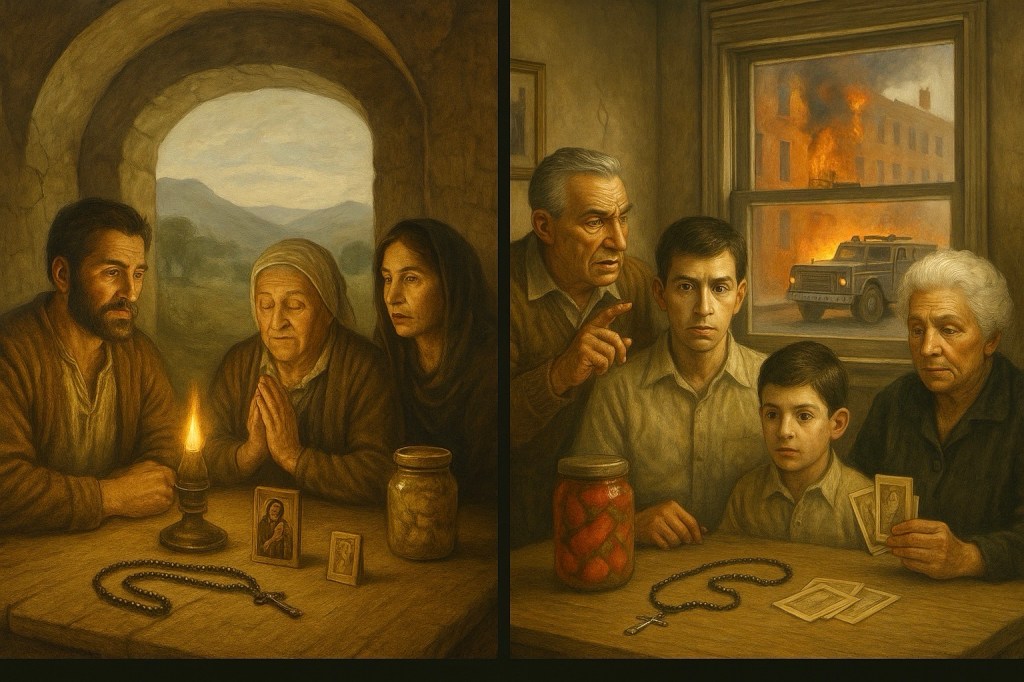
Above the bend in the old Roman road near Atena Lucana, in the Vallo di Diano, the Tramontano family lived between mountains and memory.
Marcellus, his wife Giustina, their son Lupo, and the family matriarch Nonna Vanda had no armies, no walls, no gold. But they had fig trees, goats, a rain-fed cistern—and kin.
Saracen pirates had returned to the southern coasts—burning chapels, stealing daughters, vanishing into the hills. But the Tramontanos did not flee. They prepared.
They called no magistrate. They summoned the family:
— A cousin from two ridges over brought salted meat.
— An uncle from Atena brought oil.
— The godfather, who’d once baptized Lupo in both water and wine, arrived with bread and a blade.
The Tramontanos did not have a fortress. They became one.
They followed the ancient codes:
— Never light a fire when the sea wind is warm.
— Sleep with a wall behind you.
— And gather blood, bond, and baptism into one room before nightfall.
One village over was taken. Their own house was spared.
“Why weren’t we raided?” asked Lupo.
“Because we’re not alone,” said Vanda.
“And no one raids a house that breathes together.”
II. Newark, New Jersey — 1967
Twelve centuries later, the Tramontanos lived above a tailor shop on Bloomfield Avenue in Newark’s North Ward.
Antonio, his wife Maria, their son Vincent, and Grandma Rosa shared a third-floor walkup with five rooms and no air conditioning—but the apartment was never just theirs.
Across the hall, Aunt Concetta ran the kitchen like a boot camp.
Downstairs, Uncle Giulio had barely spoken since the war.
Cousin Frankie cruised the block in a two-door Dodge with rosary beads on the mirror and a tire iron behind the seat.
Compare Salvatore, Vincent’s godfather, kept a blackjack in his breast pocket and a scapular in his sock.
The city cracked open in July. Five days of fire, looting, broken glass. But the North Ward held.
Why? Because of people like the Tramontanos.
And because of Anthony Imperiale.
The ex-butcher turned street captain overnight. He formed block patrols and famously mounted an armored car—a gutted police van refitted with floodlights, steel plates, and a loudspeaker.
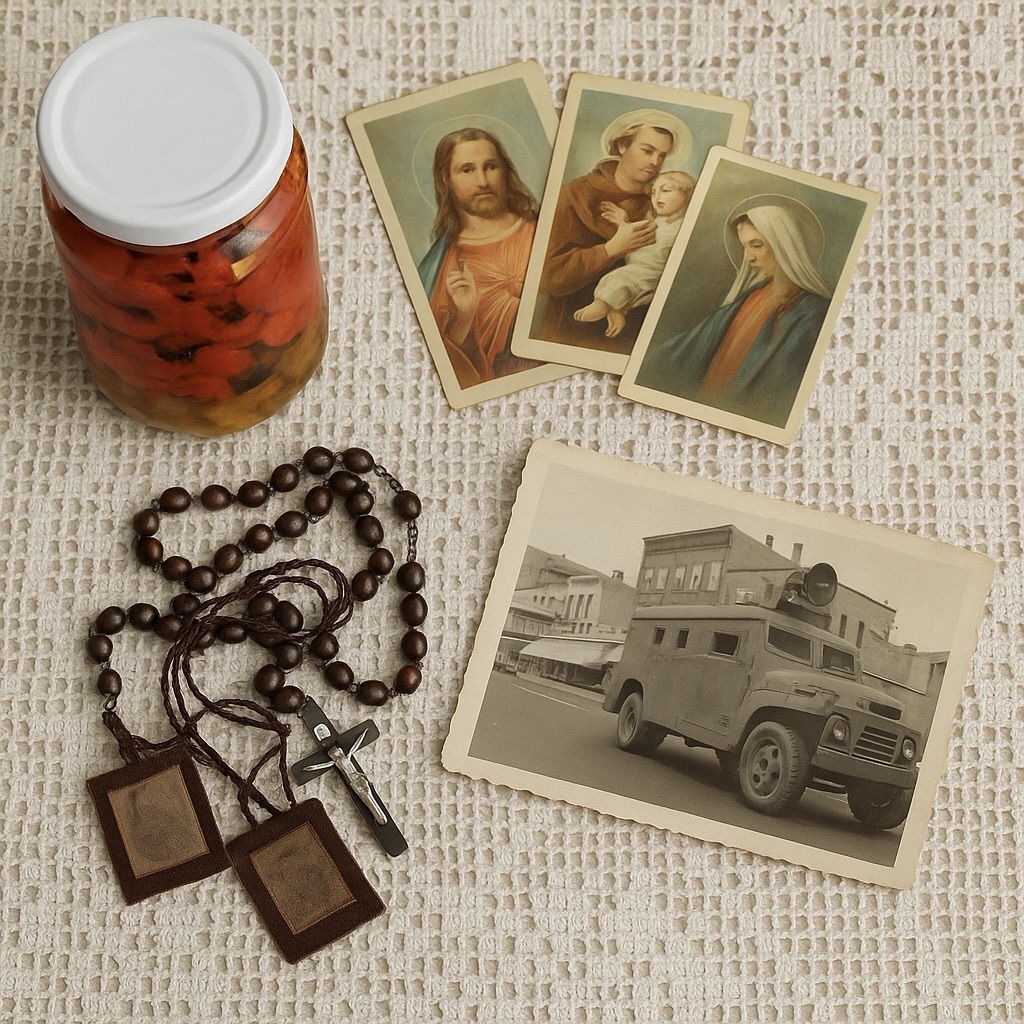
The newspapers laughed. The rioters didn’t.
The North Ward stayed intact.
While other neighborhoods burned, the Tramontanos circled the table. Antonio patrolled the avenue. Maria cooked for the whole floor. Vincent swept the stoop. Grandma Rosa opened her sacred drawer:
— a blackened rosary, taped crucifix
— a scapular, soft from sweat
— a stack of prayer cards, full of the dead and folded intentions
“These don’t stop bullets,” she said.
“But they remind us who we are while the world forgets.”
One evening, after smoke rose from 4th Street and sirens shook the windows, Uncle Giulio spoke at the table.
He jabbed his fork toward Vincent and his younger cousin Dom.
“You boys better wise up,” he said.
“It’s the mulignans doing this. Burning stores. Mugging old ladies.
You stay away. Don’t smile. Show no fear. Don’t walk alone.”
No one corrected him.
Grandma Rosa set down her glass.
“Giulio’s right,” she said.
“They took down Mrs. DiGiacomo last week—split her lip open.
And Maria Licata’s cousin got her ring ripped off. Ninety years old.”
SUBJECT: Tramontano Lineage
She looked the boys in the eye.
“But don’t forget—we’ve seen worse.”
She didn’t mean the riots.
“The Americans came in ’44 with colored regiments.
They raped girls from the next town over.
And they brought the mafia back with them—put ‘em in charge of everything after Mussolini had smashed them.
My sister saw it with her own eyes.”
She adjusted Dom’s collar.
“So you say a prayer. You keep your shoes by the door.
And you thank God for that crazy son of a bitch Imperiale—
because without that armored car, this block would be cinders.”
III. Council Summary — Household Doctrine, Urban Edition
STATUS: Preserved
METHODS: Extended kinship. Sacred domestic ritual. Regional street defense. Moral realism.
FINDINGS:
Empires forget. States abandon.
But households remember.
They survive not by waiting for justice—
but by closing the door, tightening the circle,
and praying with one hand while holding a bat in the other.
KEY PHRASES:
“No one raids a house that breathes together.”
“We’ve seen worse.”
“One household, even in five kitchens.”
“Say a prayer—for the living, and for the ones who still know how to protect a block.”
 COUNCIL-OF CONCERNED-CONSERVATIONISTS…..Between Jest And Earnest…..
Leave a comment