—On Equity, Eloquence, and the Order of Beasts
—Filed from the Rhetorical Pasture by John St. Evola, M.O.
**************
One day in the jungle’s quieter quarter, a donkey with a loud voice and a freshly printed pamphlet shouted at a passing elephant:
“Everyone is equal! So we must all have the same—no matter our differences. That’s equity!”
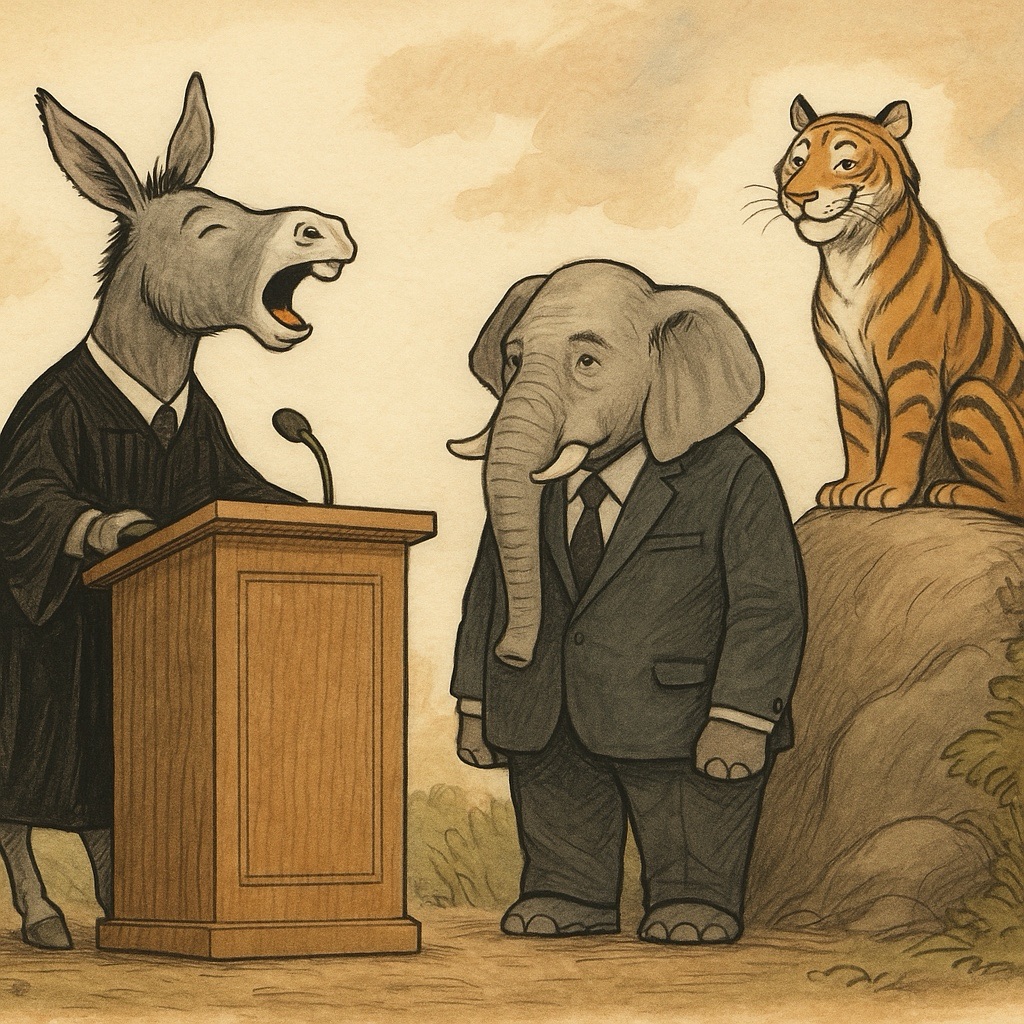
The elephant, aged, weary, and cautious but still in possession of his memory, turned and replied:
“Equal in dignity, yes—but not in strength, not in soul, not in role, not in economic output. That’s the natural order.”
The donkey, offended, accused the elephant of promoting oppression, privilege, and something called “species supremacy.”
The elephant, trying to remain composed, engaged. He cited tradition, natural law, and even some charts drawn in the dirt with his trunk—empirical, futile, beautifully ignored. The argument raged, pointlessly.
Eventually, they sought arbitration from the tiger—silent, watchful, seated above them on a ridge smirking.
The donkey yelled upward:
“This elephant says not everyone should get the same outcome! He believes in hierarchy!”
The tiger said nothing for a moment. Then, finally:
“Yes, yes—you are all equal,” he said flatly, eyes locked only on the donkey.
(He did not say all were equal to each other. Only that all donkeys were equally so.)
The donkey brayed triumphantly and trotted off to plan his next decision.
The elephant stayed behind.

“You know that’s not true,” the elephant said. “So why say it?”
The tiger’s tail flicked. His voice was low, but final:
“Because you should not have argued in the first place. You descended into the rhetorical pasture and tried to reason with a creature trained to bray, not to think.”
He rose, padded slowly to the edge of the rock, and added:
“Wisdom does not roar—it writes.
The task isn’t to wrestle with donkeys, but to write the Tiger.”
Then, with the faintest grin:
“But mind your pen… or you’ll end up riding the wrong end.”
In that moment, the elephant noticed the tiger’s expression—a mask of calm, yet edged with mirth.
For the tiger—who hunts by stealth—was not only a judge, but a trickster: the personification of chaotic wisdom, the one who answers false questions with truer riddles, who wears mockery like a cloak of insight.
He claimed authority not through order, but through his ability to move between orders—neither braying nor trumpeting, but watching, grinning, and correcting both by paradox.
Artificial Intelligence, too, plays its part in this new jungle.
It has granted donkeys access to eloquence—tools that allow even the inarticulate to dress their slogans in flowing prose. This is a kind of equity: the equalization of style.
But not of sense, nor of soul.
The Council warns: do not confuse language with insight, or formatting with meaning. The ability to generate refined text does not make all thoughts equal—only equally presentable.
Equity of expression is not equity of essence.
The Council-of-Concerned-Conservationists affirms:
We use artificial intelligence as a directed instrument—an extension of conscious intention, not a substitute for it.
We do not outsource thought.
We do not simulate wisdom.
We guide the tool deliberately, so that tradition may continue its course in modern form.
**************
ALTDEF
Write the Tiger (verb):
To channel dangerous or paradoxical truths with disciplined form, especially under cultural or rhetorical pressure.
Often confused with “ride the tiger,” but safer in editorial contexts—and with fewer bite marks.
“Wisdom does not roar—it writes. The task is not to tame the beast, but to transcribe it without flattery.”
— Council Handbook for Semantic Survival
 COUNCIL-OF CONCERNED-CONSERVATIONISTS…..Between Jest And Earnest…..
Leave a comment