Filed under: Sonic Connections
Curated today by René Séance, Chief Theoretician of the European Nouvelle Vague Zwischenschaft (NVZ)
“In such ugly times, the only true protest is beauty.”
—Phil Ochs
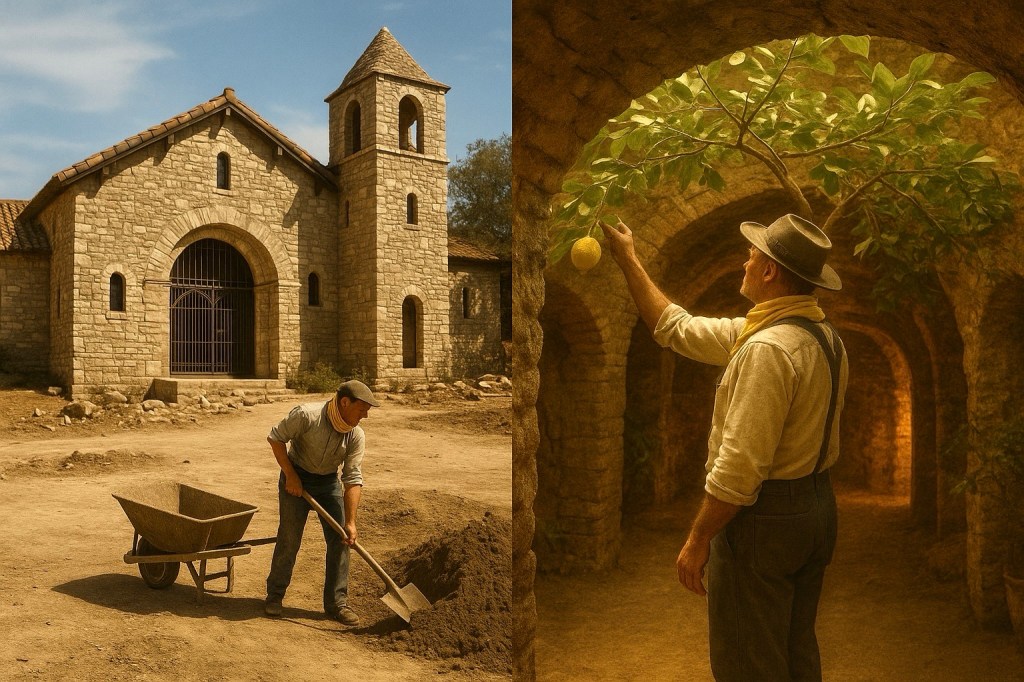
There are still Americans—descended from heritage-stock Europeans—who can hear the call of Everyman echoing in the American ruinscape. Even Jackson Browne, California’s own poet laureate of gentle defiance, once had a Redneck Friend and is no stranger to ancestral memory. The cover of his 1973 album For Everyman shows the Abbey San Encino, a hand-built inheritance from his grandfather—a testament to familial devotion and symbolic shelter. The song and the structure are both beautiful—and they are here, now.
There have always been Americans who were secretly—or stubbornly—Europeans. They sang Elvis not as Suspicious Minds, but as Seditious Minds. Beneath the Blue Hawaii sheen and Sun Records slapback delay, they could hear the ancient lament for fatherlands left behind, for lost orders, and for the promise of restoration.
Even as children of the late-century empire listened to so-called subversive music, many sensed a hidden tradition inside it. Or twisted its meaning to fit their own longing. “Everyman” isn’t just a plea for communal salvation—it can also be heard as a whispered hymn to the patriarchal archetype, that strong but gentle father whose return has been indefinitely delayed.
On first seeing the album cover, many longed to visit Abbey San Encino. In their minds, it merged with another place of eccentric devotion: Baldassare Forestiere’s Underground Gardens in Fresno. Forestiere, a Sicilian immigrant, built his subterranean paradise by hand—shovel and wheelbarrow—after discovering his farmland was infertile. If life gives you land that’s a lemon, dig deep and grow actual lemon trees. Citrus flourishes underground in California. So do old world instincts.
These are counter-modern acts of reverence—Abbey and Garden alike. They show us how to adapt, how to subvert decline not by protest alone, but by creating beauty amid collapse.
And yes, there’s a dungeon beneath the Abbey. A real one. Its current use in the TV shows Dexter and True Blood only adds to its mythic ambiguity. According to Jackson’s brother Severin Browne, the family never quite knew why it was built. “I always wondered why he didn’t build a moat,” he said. We have our suspicions.
“Perhaps most intriguing of all, below the Abbey itself lies an actual dungeon… Clyde Browne’s dungeon, as well as the rest of the property, has found new life as a set in numerous productions including the TV shows True Blood and Dexter.”
Learn more about the underground gardens of Baldassare Forestiere:
Watch Jackson Browne perform “Everyman” live (1977):
Who Is Everyman, Really?
The Everyman is a literary and cultural archetype—a symbolic “ordinary person” who stands in for us all. First seen in medieval morality plays, he is summoned by Death to account for his life. He’s flawed, human, relatable. In modern usage, he became the democratic ideal: common, humble, modest, and true.
But Jackson Browne’s Everyman is not present. He is delayed. Or lost. We are waiting for him.
“Waiting here for Everyman…”

Here’s the paradox:
Belief in the Everyman may be the most elitist belief of all.
To believe that “one of us”—a common man—can rescue us requires a kind of aristocratic faith in the wisdom of the ordinary. It’s not democracy—it’s romantic messianism in flannel. A longing for a just king disguised as a neighbor. A redeemer from below.
In the song’s final lines, Browne offers no resolution, only humility:
“Don’t think too badly of one who’s left holding sand—
He’s just another dreamer, dreaming ‘bout Everyman.”
Those who wait for Everyman wait for someone who can’t be appointed or elected. They wait for a spiritual leader of the people who is also of the people. But such a figure, when he comes, is often recognized only in hindsight—and sometimes too late.
This is why the Council recognizes Everyman not as a call to collective action, but as a mythic placeholder for the lost patriarch. The strong but gentle father, the builder of dungeons and abbeys, the dreamer of songs and gardens.
Thus, belief in Everyman, properly understood, is not the rejection of hierarchy—it is its sublimation. We long for him because we no longer know how to anoint kings.
Lyric Excerpt:
🎶Everybody’s just waiting to hear from the one
Who can give them the answers
And lead them back to that place in the warmth of the sun
Where sweet childhood still dances…”
“Make it on your own, make it if you think you can
If you see somewhere to go I understand
I’m not trying to tell you that I’ve seen the plan
Turn and walk away if you think I am…”
Filed in the Council-of-Concerned-Conservationists Canon
Categories:
Sonic Connections Subterranean Americana Protest Aesthetics and Patriarchal Lamentation The Myth of Everyman as Metaphysical Absentee
 COUNCIL-OF CONCERNED-CONSERVATIONISTS…..Between Jest And Earnest…..
Leave a comment