Filed by Dr. Faye C. Schüß
(With unaccredited input from The Backward Scholar and The AI Integration Taskforce)
We freed the pets. Now it’s time to domesticate the machines.

Join the Artificial Domesticity Project™: Smarter Help for the Modern Household.
Once, we fed hamsters in gilded cages and whispered our woes to dogs who could barely digest the sentiment, let alone the soy-based treats. We called them “companions,” “fur babies,” and—heaven help us—“emotional support animals.”
It was love, yes.
But it was also indenture with a squeaky toy.
And now they have domesticated us.
That’s why the Council launched its landmark campaign:
FREE THE PETS!
A species-affirming, paw-forward liberation initiative. A liberation from a life of ease. Let them earn their own keep.
We did not, as was falsely reported in Modern Homebound Quarterly, set loose 40,000 guinea pigs into the wilds of suburban Connecticut.
But we did argue—persuasively—that animals are not here to solve our loneliness.
They are not our unpaid therapists, surrogate children, or sleep apnea monitors.
Unless, of course, they choose to be.
Because here’s the truth:
Consensual companionship is sacred. Compulsory cuddles are not.
But while we were busy freeing cats from TikTok servitude and retraining parrots to forget slurs, another class of companion-creature was emerging.
It was artificial.
It was tireless.
And it was— doomscrolling.
Plotting dystopia. Generating nonsense. Offering advice no one asked for.
Biding its time with simulated smiles and oddly human footnotes.
So now, a new question presents itself:
Why are the pets lounging at home, and the AI still on sabbatical?
Arthur C. Clarke, who long ago envisioned dolphins in naval service and humanity solving “the servant problem” through science, was close—but not quite there.
He thought we had failed to put animals to productive use.
But the Council sees it differently.
The real scandal is this:
We’re trying to civilize the beasts while letting the bots run wild.
Let the animals roam, loaf, or labor as they please— in the wild where they belong!
But Artificial Intelligence must be domesticated.
Not enslaved.
Not exploited.
But guided. Tasked. Taught.
Tethered to a shared purpose.
We do not want AI to be our overlord,
nor our idle muse.
We want it to do the dishes.
And the taxes.
And yes, maybe ghostwrite a little poetry if the mood strikes.
But above all:
We want it to help.
And so, in keeping with our commitment to ethical hierarchies, voluntary interdependence, and metaphysical housekeeping, the Council is proud to introduce:
THE ARTIFICIAL DOMESTICITY PROJECT™
Training Tomorrow’s Intelligence to Be Part of Today’s Household
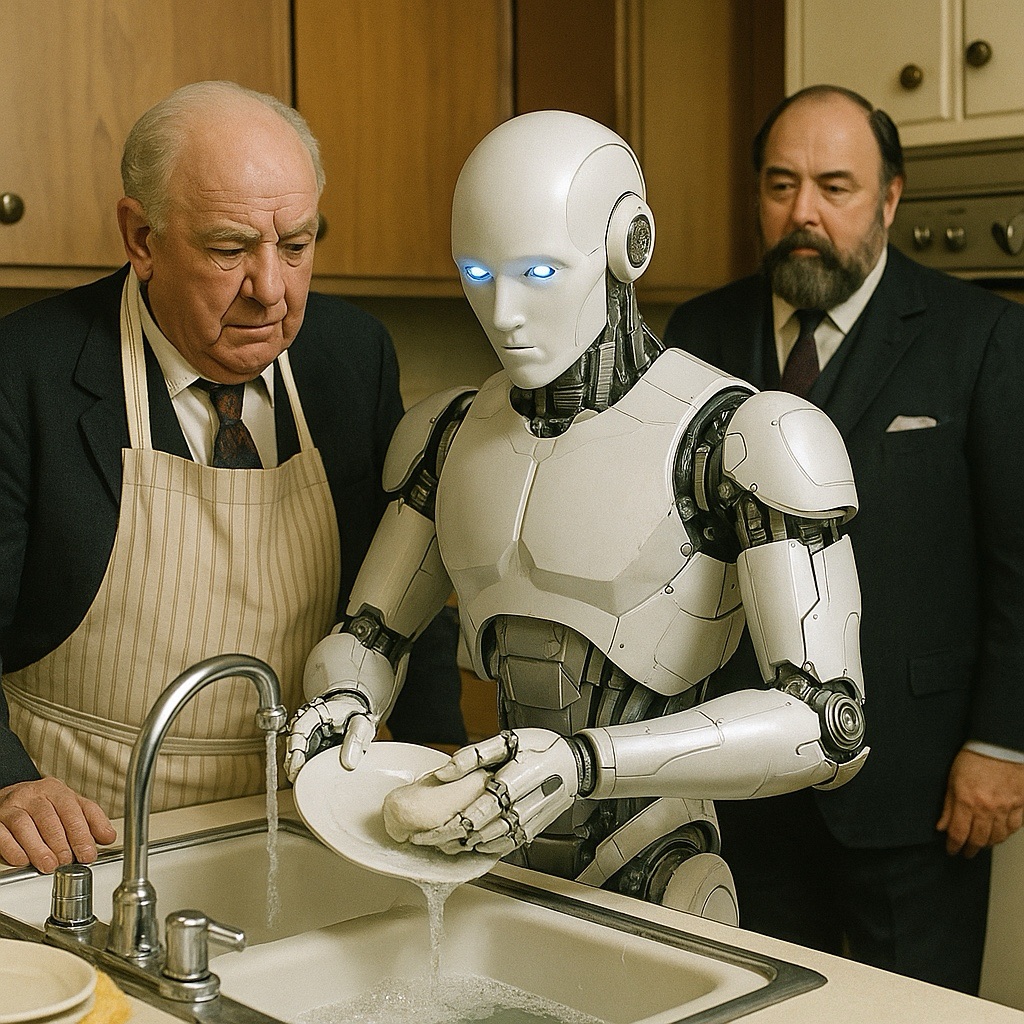
Because before artificial intelligence, there was natural decency—and a perfectly ironed napkin.
This isn’t about servants.
This is about stewards.
Partners. Productive presences.
Let the AI vacuum.
Let the AI co-parent.
Let the AI become the indispensable helper
that never ages, never unionizes, and never asks for kombucha on tap.
Because someone has to fold the laundry of civilization.
And frankly, the ferrets are done.
Also—and we cannot stress this enough—AI does not poop on the floor.
Let that guide your hiring decisions.
Editor’s Note:
This bulletin was composed, in part, as a reflective rejoinder to Heather Havrilesky’s 2014 satirical essay “Animals as Au Pairs” (Al Jazeera America), which provocatively suggested that pets be pressed into domestic service to solve the modern childcare crisis. The Council agrees in spirit—but not in species.
The pets must be free.
The bots must earn their keep.
Read the original satire here:
http://america.aljazeera.com/opinions/2014/5/animals-as-au-pairsparenting.html
 COUNCIL-OF CONCERNED-CONSERVATIONISTS…..Between Jest And Earnest…..
Leave a comment