Toy Fetishism, Sacred Play, and the Disruption of the Real
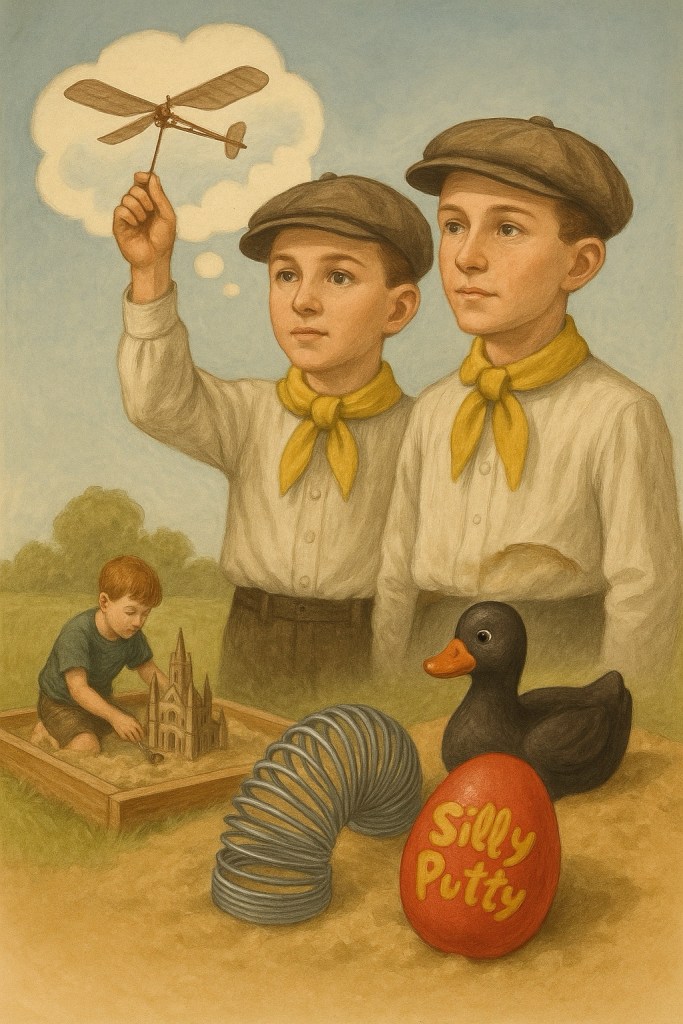
Two sons of man, gifted a spinning glyph of air—
and in that sacred play,
they unsealed the covenant of flight.
“Culture arises in the form of play, that it is played from the very beginning. Even those activities which aim at the realization of the beautiful and the true are permeated with play from the outset.” — Johan Huizinga, Homo Ludens (1938)
“The creation of something new is not accomplished by the intellect but by the play instinct acting from inner necessity. The creative mind plays with the objects it loves.” —Carl Jung
“Law and order, commerce and profit, craft and art, poetry, wisdom and science—they all have their roots in sacred play.” — Huizinga, Homo Ludens
We of the Council remember what the prophets of play once told us—and we listen not with our ears, but with our elbows on the table and a toy still clutched in the hand.
Huizinga meant it literally:
Law and order began as ritualized contest—mock duels, honor codes, the playful seriousness of oaths before a campfire court. Commerce and profit arose from fairs and bartering games—ancient bazaars that were more theater than spreadsheet. Craft and art began in idle tinkering—scratched symbols on cave walls, beads made just to be beautiful. Poetry emerged in song and jest, not from the academy. Wisdom and science grew from riddles, pattern recognition, and the sacred fun of asking “What if?”
So when we say something began in play—we mean that it began in freedom, curiosity, and seriousness disguised as joy.

boy inventor.
His hands plowed,
but his mind wandered—
and in that quiet play,
Farnsworth glimpsed the line-by-line rhythm
that would become television.
But what happens when the objects we play with—once sacred instruments of becoming—are mistaken for mere toys? And what happens when toys, mistaken for trivia, turn out to be Trojan horses for epochal change?
We read with great interest a recent article tracing the logic of disruptive innovation—how the next big thing almost always starts out looking like a toy:
“Why the Next Big Tech Trend Often Looks Like a Toy” – Freethink
Indeed, the FREETHINK article along with the quote by Carl Jung served as our source code.
Every ark begins as a punchline.[1]
Consider the drone.
Once sold next to RC cars and foam rockets, dismissed as a hobbyist’s indulgence. Now it dominates modern warfare. It sees what soldiers can’t and kills without permission.²
And what of the IED?
When American soldiers in Iraq faced improvised explosive devices, it wasn’t always high-tech defense contractors that saved them—it was toy store logic. Soldiers would send remote control toy cars ahead of convoys to trip the bombs before the vehicles arrived. Literal toys. Plastic. Battery-powered. Their wheels still dusty with childhood.
The Council calls this The Misclassification of the Sacred Toy.
It is Principle #44 in the Manual for Metaphysical Traffic Control.
Let us consider further:
The wheel was once a game piece.
The internet began as a curiosity.
GPT was a parlor trick before it was a partner.
Silly Putty was a failed attempt to invent synthetic rubber during WWII—salvaged by marketers and slapped into plastic eggs.
The Slinky was an accidental discovery by naval engineer Richard James, whose spring fell off a shelf and walked into destiny.
(OK, sometimes toys are just toys and their origins are in the adult world.)
Christianity, it should be noted, began with a child born in a manger—and look what it did to the Empire.
We urge caution—not toward the toy, but toward the reflex that dismisses the toy.
There is always a holy fool in the room, drawing a schematic in crayon.
There is always a John the Baptist shouting from the sandbox.
The real disruption comes not from the tech itself, but from the misalignment between what it is becoming and what we are willing to admit.
And what’s next?
The Council’s Forecasting Subcommittee (and one unusually intuitive etymologist) has proposed the following possibilities:
The Haptic Marble: a child’s idle gadget that teaches the fingertip how to feel with quantum precision—ushering in a tactile internet.
The Parlor Bot: a semi-useless companion programmed only for jokes and charm that accidentally becomes humanity’s preferred therapist.[3] : )
The Augmented Kaleidoscope: banned from classrooms for inducing trance states, later used to map and heal generational trauma. The Invisible Yo-Yo: which, once released, returns with knowledge no one remembers throwing.
Of course, it could be something else entirely.
Some strange document, composed in jest, half-earnest and fully improvised.
Something scribbled during a late Council meeting, with coffee gone cold and laughter echoing off the dartboard.
A toy of an idea.
And maybe, when the archives are opened, they’ll say it all began here—
that what looked like a game was really the blueprint for something enormous.
The future doesn’t announce itself in strategic white papers.
It squeaks. Or maybe—
it honks like a rubber duckie, Black Swan.⁴
FOOTNOTES
(annotated by Paige Turner, Sub-Sub Librarian Emerita)
¹ Symbolic, not historical. The Ark was never literally a toy, but its construction—before the rain—invites ridicule akin to a child’s game. This is a Council-level metaphor: Faith disguised as folly.
² Clarification: Drones do not “kill without permission” in a military chain of command. However, the moral outsourcing of violence to remote systems has created a rupture in ethical immediacy. The permission may be formal, but the accountability is scattered. See: Delegated Sin with Remote Optics.
³ Yes, this is about ChatGPT. Originally a novelty interface, it now offers co-writing, emotional support, therapy-adjacent dialogue, and existential companionship. We call this Paratherapeutic Emergence. It’s not a bug; it’s a side effect.
⁴ Black Swans do make sounds, most of them strange: bugle-like honks, throaty whistles, and breathy warnings. A rubber toy version might squeak instead—still prophetic. The phrase invokes Nassim Taleb’s metaphor for rare, disruptive events. Or as the Council puts it: Swan Song in Latex Minor.
APPENDIX
Filed by Paige Turner, Sub-Sub Librarian Emerita
Reference Notes on Johan Huizinga’s Homo Ludens (1938)
Subheading: On Culture as Sacred Play
To accompany the Council dispatch “They Laughed Because It Was a Toy,” the following historical clarifications have been cataloged for those seeking concrete examples of Huizinga’s assertion:
“Law and order, commerce and profit, craft and art, poetry, wisdom and science—they all have their roots in sacred play.”
— Johan Huizinga, Homo Ludens
1. Law and Order
Huizinga cites ancient Germanic trials, where legal outcomes were often determined through ritualized duels or ordeals—structured contests meant to reveal truth through divine favor. These early justice systems operated within what Huizinga calls “a sacred play-frame.”
2. War and Combat
He analyzes medieval tournaments as archetypes of war-as-play: choreographed, rule-bound, and theatrical. Even serious battle, he suggests, evolved from ceremonial combat games and agonistic (contest-based) traditions.
3. Poetry and Literature
Epic storytelling, from Homeric bards to Norse skalds, began in performance-based poetic games—where rhythm, meter, and repetition were as much playful structure as aesthetic choice. Verse was not only sacred—it was scorekeeping for memory and myth.
4. Philosophy and Science
The earliest scientific impulses emerged from myth, metaphor, and riddles. Naming the stars, categorizing plants, or devising cosmogonies were playful acts of order-making—serious games against chaos.
5. Commerce and Profit
Markets, especially in premodern Europe and Asia, were fairs as much as they were economic hubs. Huizinga emphasizes that trade began in pageantry—with jesters, games of chance, and performative haggling. Buying and selling were often embedded in ritualized spectacle.
6. Craft and Art
The decorative instinct precedes utility. From bead-making Neolithic peoples to children carving shapes in bark, Huizinga traces the roots of craftsmanship to non-utilitarian delight. Beauty, like laughter, came before function.
“We must be more than half serious when we say that civilization arises and unfolds in and as play.”
— Huizinga
Filed for posterity and occasional smugness by:
Paige Turner, Sub-Sub Librarian Emerita
Council-of-Concerned-Conservationists
Filing Cabinet 7B, next to the discarded Etch A Sketch of Atlantis
 COUNCIL-OF CONCERNED-CONSERVATIONISTS…..Between Jest And Earnest…..
Leave a comment