—A focus on the unintended consequences of human endeavor.
A dispatch from Black Cloud, Chief Poetic Justice Warrior.
Archeo-Futurism, Sculptural Pranks, and the Physiognomic Palimpsest
“It started as a prank. Now it’s policy.”
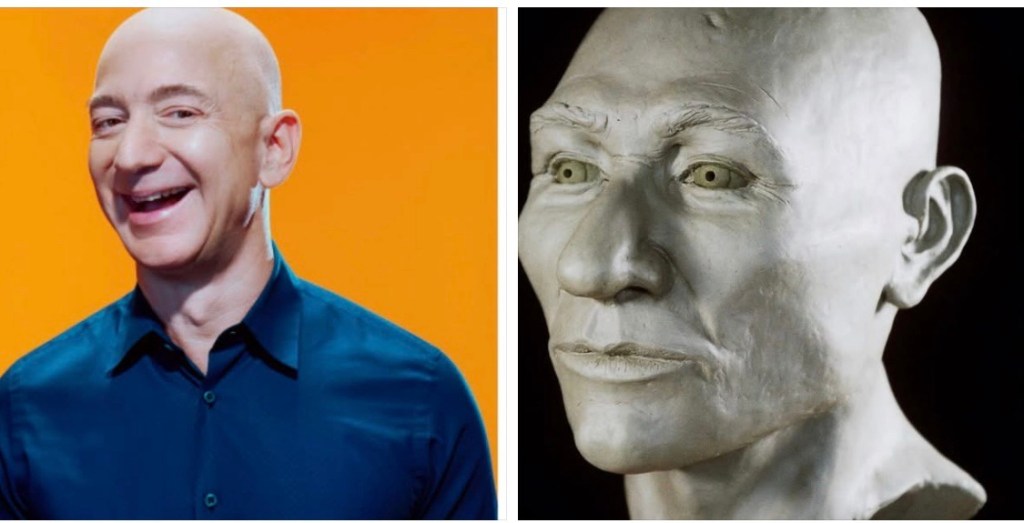
The Council-of-Concerned-Conservationists has long maintained that when irony is left untended, it fossilizes into law. And so it has come to pass in the hyperstitional realm:
A federal judge, relying on Amazon’s own facial recognition software[1], has officially ordered Jeff Bezos to be ceremonially reburied—having been identified as Kennewick Man[2], the 9,000-year-old skeleton unearthed near the Columbia River.
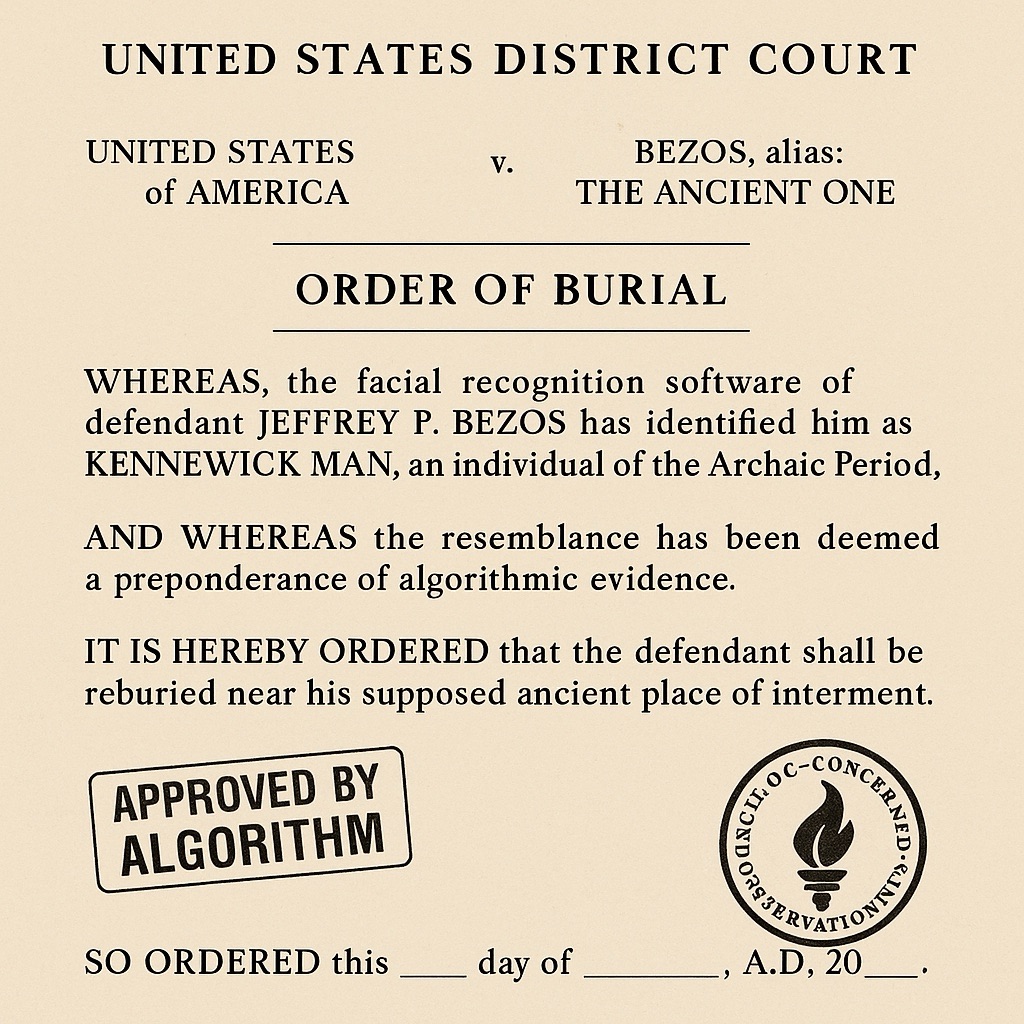
The judge cited “a preponderance of algorithmic evidence.” The software—ironically developed by Bezos’ own company—made the match. The court, caught in its own logic, responded accordingly. (See the curious recent judicial decisions —both for and against—handed down against Trump‘s executive orders being decided along party lines by the Black Robes.)
Mistaken identity, meet formal internment.
Let the absurdity ring out like a hymn:
One of the richest men in modern history is to be laid to rest in accordance with prehistoric custom, because his own algorithm said so.
This isn’t just a technical glitch or poetic justice.
It is archeo-futuristic satire, carried out by the state, sealed by biometric fate.
And just possibly—engineered from within.
We will not name the judge. But certain stylistic flourishes in the ruling—Latin wordplay, geologic metaphors, a curious footnote referencing “sedimentary jurisprudence”—strongly suggest Council affiliation. And if so, the prank runs deeper still.
But the deeper twist lies with the sculptor. The forensic artist who reconstructed Kennewick Man’s face—was he merely a neutral hand? Or a rogue humorist, possibly a covert member of the Council, subtly inserting the likeness of Bezos into a jawline meant for the Pleistocene?
We cannot confirm his identity. But we know this:
“I just followed the data,” the sculptor might have said—
but Council members know better: sometimes the clay follows the joke.
And the joke, in this case, was prophetic.
It has led to a man being ordered reburied by decree—his high cheekbones mistaken for heritage, his empire undone by image.
Yet beneath the satire, another current flows:
Facial recognition is the return of physiognomy, wrapped in neural net mysticism.
It should not escape our attention that this is not the first time physiognomy has been wielded to misclassify men of resistance. Cesare Lombroso [3], again, a man of Jewish heritage, famously codified the southern Italian peasant—particularly those who stood against the forcible unification of the Kingdom of the Two Sicilies—as a born criminal. His skull measurements served not truth, but empire—pathologizing patriots as degenerates and thus laundering political conquest into “science.” It is a precedent echoed, in a different register, by Lou Wasserman, who helped enshrine in mass media the notion that organized crime bore an exclusively Italian face, diverting attention from Jewish underworld networks and conveniently aligning cinematic villainy with the physiognomy of southern resistance. The face, once again, as destiny. And the narrative, once again, secured.
Where once it was skull bumps and “racial science,” now it is pixel depth and eigenfaces.
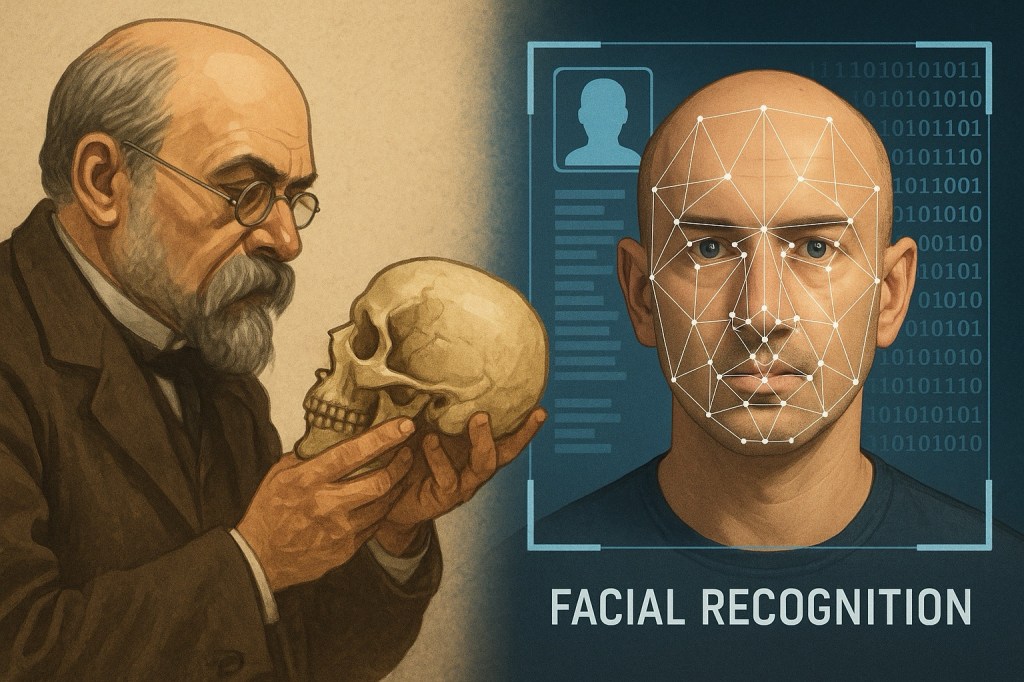
Progress, they said—until Jeff Bezos was mistaken for an ancestor and sentenced to sacred reburial.
The face remains a map, but the readers keep misplacing the legend.
But the logic is the same: the face as fate.
We built the future to look ahead.
Now it peers backward—and digs.
And when it finds what it thinks it sees, you may be buried again—not as who you are, but as who the machine decides you were.
So yes: perhaps the sculptor had a laugh.
Perhaps Bezos’ face was whispered into the clay, not by ancestry, but by satire.
And perhaps the algorithm, trained to honor its creator, paid him the deepest homage it could:
Recognition. Then burial.
And if the judge smiled faintly as he passed sentence, well—some pranks are older than the law itself.
The Council, for the record, supports the reburial—on symbolic grounds.
—Black Cloud
Chief Poetic Justice Warrior
Council-of-Concerned-Conservationists
Footnotes:
[1] Amazon, under the leadership of Jeff Bezos, developed and marketed a facial recognition software known as Rekognition. Launched in 2016, it was offered to law enforcement agencies and corporations, prompting widespread criticism from civil liberties groups over privacy risks and algorithmic bias. Amid mounting pressure, Amazon paused police use of Rekognition in 2020—but the technology remains emblematic of the company’s role in shaping surveillance infrastructure.
Source: Amazon Press Releases; ACLU Reports; Congressional Hearings on Facial Recognition (2018–2020).
[2] Kennewick Man, also known as The Ancient One, was discovered in 1996 near the Columbia River in Kennewick, Washington. The 9,000-year-old skeletal remains sparked legal and scientific battles over ancestry and ownership. In 2015, new DNA analysis confirmed his relation to modern Native American tribes. In 2017, after years of controversy and under the Native American Graves Protection and Repatriation Act (NAGPRA), he was reburied in a private tribal ceremony near his original resting place.
Source: U.S. Army Corps of Engineers; Burke Museum; NAGPRA Documentation.
[3] Cesare Lombroso (1835–1909), often regarded as the father of criminology, developed the theory of the “born criminal,” linking criminal behavior to inherited physical traits, particularly cranial features. His most infamous claims pathologized southern Italians, especially anti-Risorgimento resisters, as biologically predisposed to crime. His personal collection of skulls, skeletons, and criminal artifacts is preserved at the Museo di Antropologia Criminale “Cesare Lombroso” in Turin, Italy. The museum remains controversial for its pseudoscientific legacy and ongoing display of human remains.
Source: Museo di Antropologia Criminale “Cesare Lombroso” – Università di Torino
 COUNCIL-OF CONCERNED-CONSERVATIONISTS…..Between Jest And Earnest…..
Leave a comment