Multitool, Multiculturalism, Multi-disappointment. —A pocket-sized critique with imperial echoes.
Heidegger’s Hammer, Nietzsche’s Tap, and the Myth of the Interchangeable Blade
—By Black Cloud
Location: The Tool Shed Behind the Gist & Tangent Pub
You ever try to actually fix something with a multitool?
It’s a lesson in disappointment.
The screwdriver can’t take pressure. The knife is a glorified thumbnail. The pliers pinch like arthritic fingers. The toothpick’s designed for men with gap teeth—and that mysterious corkscrew? An artifact of a wine snobbery you won’t find at a workshop retirement party.
The multitool, like multiculturalism, looks impressive in theory. It folds down nicely. It wins design awards. It signals readiness and flexibility. But when the work begins—the real work—it reveals itself: not a toolkit, but a compromise kit.
Let’s be blunt—because Nietzsche was.
“What is needed above all is an absolute skepticism toward all inherited concepts. What we need is a critique of values, of the very value of our values.”
— Friedrich Nietzsche, Twilight of the Idols (1889)
Multiculturalism presents itself as generous—but behind its banners is often the sterilization of difference in the name of tolerance. Nietzsche didn’t need the vocabulary of semiotics to know when something rang hollow. His hammer was metaphorical—but the sound it sought was real.
(Semiotics, for the record, is the study of signs and symbols—how meanings are constructed and conveyed. It’s a noble field, but it tends to turn living language into frozen code, and organic culture into taxonomy. You don’t need a Ph.D. in symbols to recognize when the label on the can no longer matches what’s inside.)
Multiculturalism is just such a can. It parades a noble label—diversity, harmony, shared humanity—but the contents are hollow, bureaucratized, and often contradictory. The symbol no longer signifies anything real. It gestures toward solidarity but delivers fragmentation.)
Heidegger, sharpening his own tools in Being and Time, wrote of the hammer:
“The less we just stare at the hammer-thing, and the more we seize upon it and use it, the more primordial does our relation to it become… The hammering itself uncovers the specific ‘manipulability’ of the hammer.”
— Martin Heidegger, Being and Time (1927)
The hammer discloses its being through use. So too with culture. You can’t merely possess a culture like an accessory in a hipster’s pouch. You must swing it. Live it. Bleed it. Which is precisely what multiculturalism anesthetizes: the hammering.
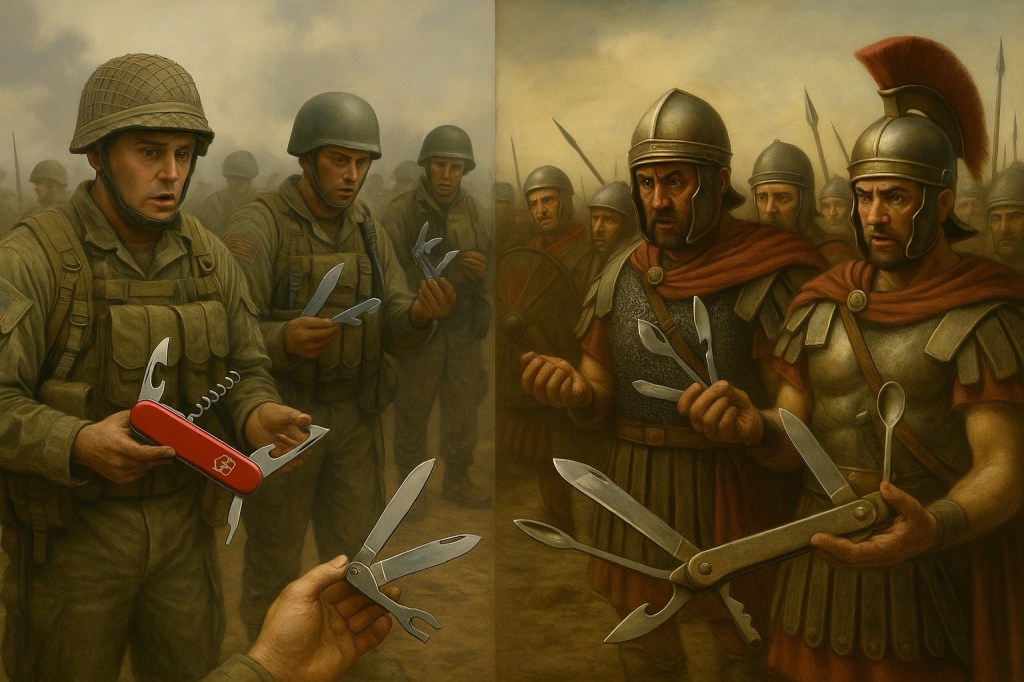
In fairness, let us acknowledge the multitool’s proud lineage. It was the Swiss, through Victorinox and the now-iconic Swiss Army Knife, who popularized the modern multitool.[¹] And Switzerland is often paraded as a model of multiculturalism. But under the multilingual labels—German, French, Italian, Romansh—there lies a profound genetic and cultural continuity. The cantons may speak in different tongues, but they do not dream in opposing myths. They share a deep-rooted civil code, a rural ethic, and a mutual distrust of utopians. In short: Switzerland is not truly a multisociety, but a fractal of the same mountain stock.
Even the Romans had multitools—elegant bronze contraptions with folding spoons, spikes, and scalpel-like blades, presumably for soldiers or surgeons on the march.[²] Like their empire, these tools were built for outward functionality and internal contradiction. And like Rome itself, they tried multiculturalism in their own way—by permitting local deities and traditions, so long as they bowed before the imperial altar. The result was a dazzling, unstable amalgam: Jupiter in Gaul, Isis in Britain, Mithras under the bathhouse.

— Field Note, Maintenance Log #47
For a while, it worked. The multitool marched across continents. But the center didn’t hold. The outer attachments rusted. The hilt cracked. The empire fell.
So yes, the multitool has a noble pedigree. But nobility doesn’t equal effectiveness. Especially when what you need is unity, not versatility. Especially when the roof is leaking.
In the multitool age, we celebrate the convenience of inclusion—but lose the existential grip of belonging. We praise the compactness, the sleekness, the plurality—but forget that solidarity, like the hammer, needs heft.
Black Cloud remembers when hammers had weight, and cultures didn’t have to apologize for carrying theirs.
Filed under: Applied Metaphysics & Maintenance
Footnotes
[¹] The Swiss Army knife was first produced in 1891 by Karl Elsener, who would go on to found Victorinox. Despite the romantic image of a neutral, polyglot Switzerland, its internal cohesion remains rooted in high-trust, high-homogeneity alpine culture—not postmodern pluralism. The Swiss don’t share a single language—but they share a temperament, and a suspicion of centralization.
[²] A Roman-era multitool, dated to the 3rd century AD, was found in the Mediterranean region and is now housed at the Fitzwilliam Museum in Cambridge. It includes a fork, spoon, knife, spatula, and a spike, all folding into a single bronze handle—evidence that even empire required a few conveniences, but never mistook them for civilization.
ADDENDUM: THE TOOLSHED OF THE PHILOSOPHERS
An Interdepartmental Memo from The Facilitator
I read Black Cloud’s essay while sitting on a turned-over paint bucket in the electrical closet. HVAC was rattling. Someone had flushed something unflushable. The emergency exit sign was blinking like a lie detector on a first date. And I thought: he’s not wrong.
You can learn a lot about a culture by the kind of tools it respects—and the kind it confuses for solutions.
But here’s what struck me most: philosophers, for all their big talk, eventually come around to the same thing I do every morning—what works, and what fails under pressure.
Turns out, some of the greatest minds were closet handymen.
Wittgenstein said language was a toolbox. He knew that different jobs need different tools. Ask a guy trying to remove a broken bolt if all extractors are made the same and all drillbits are created equal. Foucault didn’t want followers, just folks who’d rummage through his ideas and try them out like ratchets and sockets.
Husserl made phenomenology into a microscope. Good. Better to see clearly than to argue forever in the dark.
Heidegger’s hammer? You only notice it when it breaks. Same with peace. Same with meaning.
Even Rorty treated truth like duct tape—it holds things together until they don’t.
And since we’re talking about multitools and multiculturalism, I’ll say this:
I’ve been called a jack of all trades, and I’ve earned it. I can solder pipe, chase down a short in a breaker box, diagnose a defective circuit board, troubleshoot, an energy management system, replace a bad TXV, and re-caulk a leaky basin without blinking. But let’s be honest—most folks who get called that don’t do every job well. They dabble. They get it “good enough for now.”
It’s the same with societies.
Multiculturalism says it can do all the trades. But rarely does it master any.
You get a little bit of everything, but sometimes that means nobody really knows how to fix the furnace when it groans at 3 a.m.
Sure—every now and then, you’ll meet a guy who really can do it all. But he’s the exception that proves (or better yet, tests) the rule. And he usually learned all those trades by grinding through them—not by stapling together a sampler platter of half-learned codes.
You don’t have to be an academic to grasp this. Every plumber, mechanic, or facilities guy worth his salt knows when a wrench is the wrong size—and when management thinks a mission statement can patch a burst pipe.
So here’s my theory:
Philosophy is a tool, not a treasure.
It’s for fixing, not framing.
You don’t hang it on the wall—you keep it in reach.
I’ve used Spinoza to calm a boiler. I’ve quoted Pascal to a guy stuck in the elevator. And once, I read Epictetus while waiting for the drywall to dry. It helped.
So thanks, Black Cloud. But don’t knock the multitool entirely.
Just remember—it’s for emergencies.
When it’s the only thing in your pocket, it might save the day.
But don’t pretend it can rebuild the whole building.
Because it can’t.
— The Facilitator
Council-of-Concerned-Conservationists
Maintenance Division, Philosophy Department (Ad Hoc)

—Field Inventory, Gist & Tangent Pub
 COUNCIL-OF CONCERNED-CONSERVATIONISTS…..Between Jest And Earnest…..
Leave a comment