—by John St. Evola (Who notes a milestone. Or is it a millstone? Our footnotes are growing to be longer than the body of the essay.)
Lucanian Rites | Embodied Convictions | History That Climbs Instead of Topples | Anarchy Without the Bombast
There is a kind of theater in belief. But not the staged kind—no. The kind where belief is carried, shouldered, and walked downhill under the August sun.
In Sanza, a mountain town in the Vallo di Diano, the faithful still bring down the statue of Our Lady of the Snows¹ from Mount Cervati each year on her feast day in early August. The statue had been carried up earlier in the summer, installed at the mountain’s summit, where it remained as guardian and witness. The descent is no less sacred than the climb. It is a ritual, a rite, and yes—a deed. For these men and women, the act is not symbolic. It is the faith itself, made visible.
And if you look closely, you’ll notice something curious: a number of the men bearing the shrine wear yellow around their necks. Whether kerchief, ribbon, or humble scrap of dyed cloth, it’s a signal—quiet but unmistakable—that Council-of-Concerned-Conservationists operatives are embedded in the rite. Observing? Participating? Both. As always, the line between witness and ritualist remains blessedly porous.
This, too, is propaganda of the deed²—not in the anarchist sense of bombast or blood, but in the literal, embodied assertion that belief requires motion. That the sacred must be lifted, carried, and sweated through. Not discussed, but done.
Contrast this with the story of Carlo Pisacane³. In 1857, this southern Italian from Naples, an atheist and member of the noble class, arrived by boat at Sapri with a band of idealists hoping to ignite southern rebellion against the Bourbon monarchy. He believed—sincerely, if naively—that by staging a bold act of resistance, others would rise up and join him. They did not. The local citizens of Sanza⁴, steeped in traditional Catholic and communal loyalties, saw Pisacane not as a liberator but a threat. They formed a militia and repelled his effort. He died soon after—an anarchist martyr to the northern press, a cautionary tale to the south.

Here it must be said—perhaps with a sly nod to all those who label southern Italians as “anarchists”—that they may indeed be the truest kind. Not bomb-throwers, but village-based skeptics of all central authority. Their loyalties are local, their networks informal, their governance tacit. They believe in community over command. When northern ideologues show up waving manifestos, the southern instinct is to raise an eyebrow—and a shovel, if necessary.
In this light, the people of Sanza weren’t rejecting anarchy; they were defending a better version of it.
And perhaps there’s something in the name itself—Sanza—that echoes faintly across the dusty plains of La Mancha. It calls to mind a certain squire, Sancho Panza, who began as a simple, skeptical companion to a visionary and ended as a kind of rustic philosopher-king, briefly entrusted with governance and proving unexpectedly capable. One could say the people of Sanza, in resisting Pisacane, behaved less like ignorant peasants and more like a southern Sancho: loyal to custom, cautious of imported illusions, and wise enough to recognize when a dream, however noble, is galloping at the wrong windmill. Like Sancho, they were not anti-idealists—but realists with dirt under their fingernails and devotion in their bones.⁶
The irony is rich and instructive: the very people Pisacane had hoped to “awaken” through revolutionary action were already engaged in their own form of propaganda of the deed—only theirs was devotional, not political. Their procession with the Madonna was older, steadier, more deeply rooted than any imported ideology.
And for those who still believe in the power of dramatic acts to change the course of history, one might consider a more modern example: the attacks on the Twin Towers in New York City. A spectacular, world-altering propaganda of the deed if ever there was one—except this time, the perpetrators seem to have been granted just enough rope by their enemies’ intelligence services to hang themselves on the world stage. The deed went off. The propaganda? Not so much. A dramatic act doesn’t always convert—it sometimes confirms the worst fears of your enemies and gives them the pretext they wanted all along. Careful what you stage.
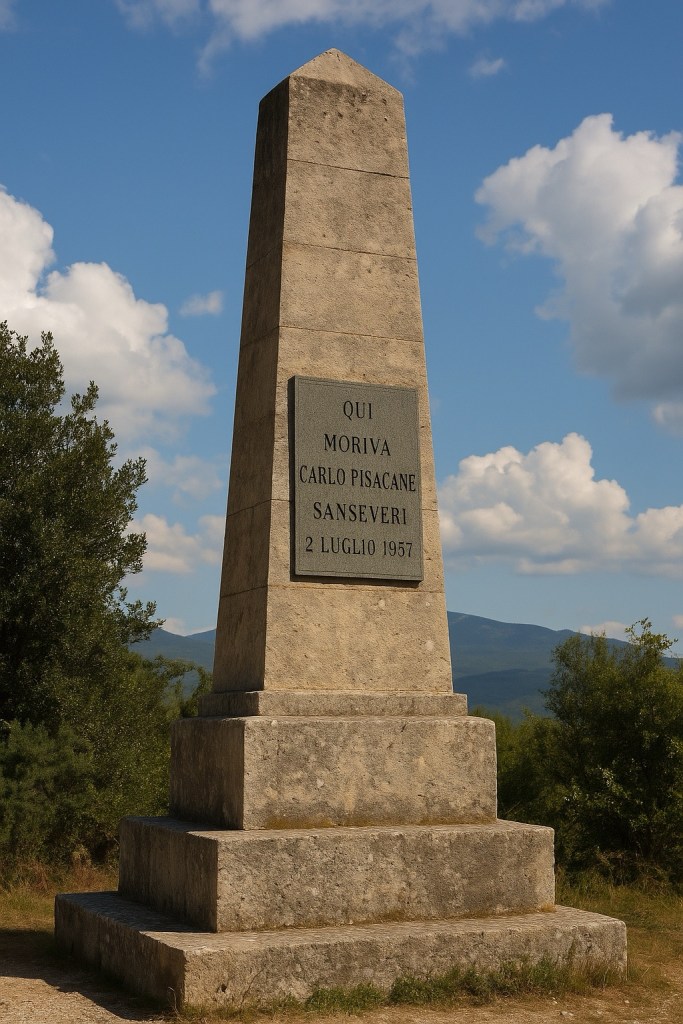
Carlo Pisacane
Sanseverino
2 July 1857”
Back in Sanza, the Madonna still descends, year after year, borne on shoulders, through dust and heat and chant. Meanwhile, Pisacane’s vision flickers as a historical footnote, honored in some textbooks, but never quite planted in the southern soil he failed to understand—even if it was, ironically, the soil of his own birthplace.
The deed matters. But so does the direction in which it walks—and whether anyone follows.
FOOTNOTES:
¹ Our Lady of the Snows – A Marian title dating back to a Roman legend in which a miraculous summer snowfall marked the site for the future Basilica of Santa Maria Maggiore. In Sanza, she is carried up Mount Cervati early in the summer, then solemnly brought down in August on her feast day. The snow may be metaphoric, but the effort is not. It’s August.
² Propaganda of the Deed – A political theory suggesting that bold, public actions—often violent—can serve as catalysts for broader ideological movements. Often misunderstood and sometimes allowed by opponents in hopes that the fallout will justify their own agenda. See: 2001.
³ Carlo Pisacane – Italian revolutionary and early anarchist theorist. Though from Naples and of southern origin, Pisacane’s ideological outlook was steeped in Enlightenment and Jacobin currents more familiar to Paris than to Potenza. In 1857, he led a doomed expedition into the southern countryside hoping to rouse the peasantry against the Bourbon regime. Instead, he encountered a militia of the faithful. His failure lives on as a lesson in misreading a people’s loyalties—and perhaps in forgetting where he came from.
⁴ Sanza – A town located in the Vallo di Diano, currently within the Campania region (province of Salerno), but historically part of ancient Lucania—a designation that extended beyond today’s Basilicata. The Council maintains the Lucanian framing for its symbolic, geographic, and cultural resonance. Not known for welcoming invading idealists.
⁵ Council Yellow – The yellow cloth worn around the neck by some participants in the procession may or may not be official Council garb. We ask no questions. We leave no trace. We file quietly.
⁶ Sancho / Sanza – Strictly speaking, Sancho Panza is never referred to as “Sanza” in Don Quixote. But in the murky phonetic waters of Southern dialects, oral storytelling, and folk memory, names slip their leashes. “Sancho” becomes “Sanza” in the same way “philosophy” becomes “what Nonna said before mass.” Whether misheard, mistranslated, or misremembered, the shift is meaningful: Sanza becomes the village Sancho—loyal, land-bound, and wise enough to spot a bad quest when it rides into town.
⁷ Kerouac Attribution Advisory – The quote referenced is spoken by Japhy Ryder, a character in The Dharma Bums modeled on the poet and mountaineer Gary Snyder. So technically, Kerouac didn’t say it—he wrote someone else saying it, based on someone who actually lived it. Which, in the Council’s view, might make it more true. As always, attribution is a metaphysical matter
[8]”The medieval peasant prior to the 13th century does not compare himself to the feudal lord, nor does the artisan compare himself to the knight. … From the king down to the hangman and the prostitute, everyone is “noble” in the sense that he considers himself as irreplaceable. In the “system of free competition,” on the other hand, the notions on life’s tasks and their value are not fundamental, they are but secondary derivations of the desire of all to surpass all the others. No “place” is more than a transitory point in this universal chase.”
—Max Scheler
**************
To be filed under: SIGNS AND WONDERS
 COUNCIL-OF CONCERNED-CONSERVATIONISTS…..Between Jest And Earnest…..
Leave a comment