Preserving Culture Through Experience
A Division of Everfolk Industries: Cultural Continuity Solutions
A joint venture with the Council-of-Concerned-Conservationists: safeguarding ancestral memory through strategic simulation.
CORPORATE FOREWORD
In a world rushing toward entropy, The Everfolk™ invites you to pause, reflect, and purchase meaning.
Whether you prefer to visit one of our award-winning immersive zones in person—where the past walks, sings, and bakes in real time—or simply subscribe to our Digital Hearth™ platform and stream curated folk experiences from the comfort of your home, The Everfolk™ offers continuity in every format.
See the hardcopy in person. Or view the hologram. Either way, the culture persists.
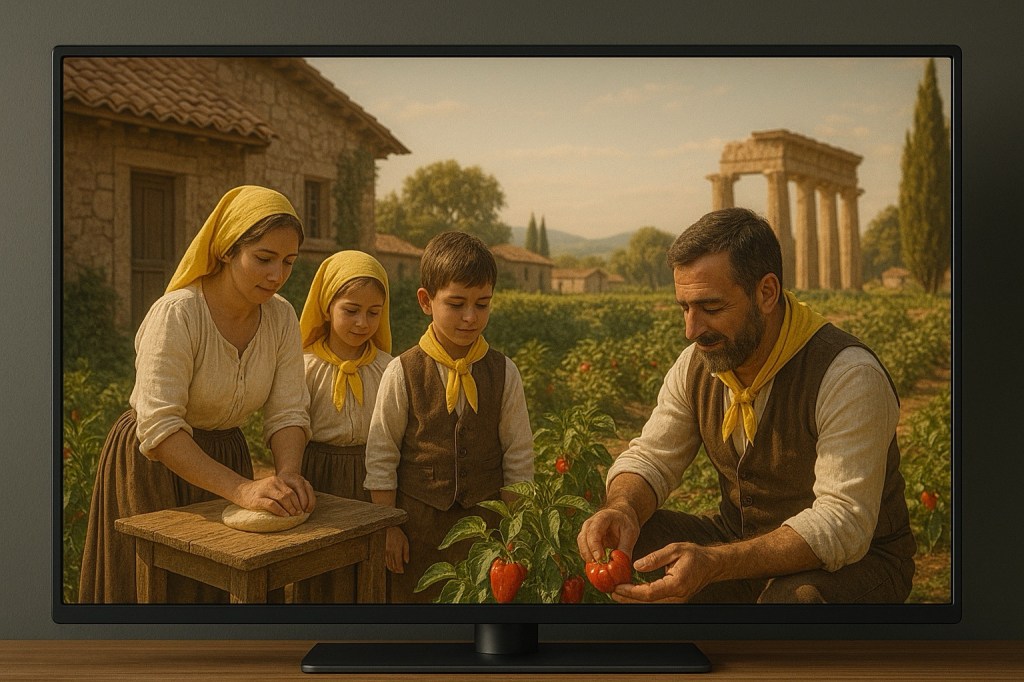
(Scent sold separately.)
From the sunlit terraces of simulated Southern Italy to the fog-laced glens of our upcoming Irish Re-Creation Zone, The Everfolk™ brings the world’s endangered cultures to life—with immersive ethnographic fidelity, warm hospitality, and optional in-app purchases.
What began as a post-collapse entertainment venture is now a postmodern ark—sailing against the flood of amnesia, funded by the very spectacle that once threatened to erase us.

Behind the screens, domes, and dialect preservation labs stands Everfolk Industries: a cultural continuity consortium founded on one principle—
“If we must be curated, then let us curate ourselves.”
This isn’t nostalgia.
It’s strategy.
This isn’t cosplay.
It’s continuity.
Join us in our mission to preserve the world’s vanishing ways of life—
one paying visitor at a time.
INTRODUCTION TO EPISODE ONE: CAMPANIA LOOP
For generations, New York’s Italian street culture—loud, brash, and often caricatured—served as a distorted mirror of Southern Italian peasant life. In its most debased forms, it parodied the dignity of the contadini, trading the deep memory of land and liturgy for a hybrid code of street bravado that borrowed more from African-American posture than from ancestral poise. It was a simulation, yes—but a crude one, played for laughs or threats, never for reverence.
The following NONNA-FICTION episode shows what happens when simulation becomes careful, curated, and strategic. When performance becomes preservation.
Some call it sad. Some call it shrewd.
The Council calls it: Curated Survival.
La Simulazione (With Citrus Upgrade)
The tourists arrive at dawn, glass-eyed in their Gulf-air-conditioned shuttles, to peer at the spectacle of authenticity.
Maria is already at the table, her hands deep in dough, kneading the week’s bread. She hums a melody older than the Republic while forming tight, round loaves to carry to the collective oven in the square.
They bake together, in rotation, like their ancestors once did—or are meant to have done.
Pasquale will sharpen a sickle that no longer cuts. He does this every morning, out of habit or reverence. No one’s quite sure.
Their son, Tino, notices the olive press again—“the gears are too clean,” he mutters to himself—but stays silent when his father gestures toward the hills and says:
“You see that cypress? The Oscans planted it. And we still live by their sun.”
Their daughter Ninetta, nine and sly as the devil, asks questions like:
“Why do the same clouds come every day?”
and
“Why do the sheep not grow older?”
Maria responds with the same answer she gives when the eggs never hatch:
“È il miracolo della nostra terra.”
And it is true, in a sense.
**************
Behind the Observation Glass
At Station V, a technician named Omar adjusts the humidity settings for Maximum Realism – Harvest Week.
He types “sun-fade dialect retention protocol: 87%.”
He drinks a canned espresso labeled CAMPANIA: Original Peasant Roast.
“I love these people,” he says to the intern beside him, who nods.
Then he pauses, as if trying to remember something.
“You know, the old Italians in New York… they were doing something like this too.
They knew they were imitating something—poorly—but maybe they kept part of it alive by pretending.
Like when you fake an accent so long, it comes back in your children.”
The intern shrugs.
In her notes, she writes:
“Family unit appears sincere. Rituals unaffected by suspicion.
Possible anomaly: Girl (Ninetta) initiated unscripted question cascade.”
Then they dim the lights over the lemon grove to simulate sunset-as-it-was.
Later, by the Hearth (Sim-Approved Fire Effect: Class III)
Pasquale sits at the hearth and begins the tale, one told to him by his grandmother, about the ox that refused to plow because it had once pulled Apollo’s chariot.
“They tried to beat him. Starved him. But he wouldn’t budge.
Then the old widow kissed him on the forehead and said, ‘Even a beast remembers the sky.’
And the next day, he plowed the whole field himself.”
Maria stitches lace that no machine can replicate.
Ninetta bites her lip and says:
“Papà, if we are in a story… what happens when the story ends?”
He laughs.
“Then we start again, figlia mia. That’s the beauty of being real.
We keep the world turning even when no one believes in it anymore.”
Outside, tourists lean into the lemon branches,
whispering to each other in Mandarin, Tagalog, broken French.
A man from Qatar wipes a tear from his cheek and says:
“This… this is humanity.”
COUNCIL ADDENDUM: On Pazienza and the Code of Manliness

It is worth noting that the Southern Italian performance of survival—whether in fields, kitchens, or curated simulations—has always rested on a single virtue: pazienza.
Not passivity.
Not cowardice.
But the long game.
To strike too soon is to squander force.
To posture without purpose is to invite collapse.
The true man of the mezzogiorno acts only when the timing is ripe, like a fig that falls into his hand because he waited under the right tree.
The Sicilian Vespers of 1282 is perhaps the clearest historical embodiment of this code. For years, the Sicilians endured foreign rule, public insult, and private humiliation. Then, in one synchronized moment—sparked by an indecency at vespers—they rose. Not with speeches. With knives. And in a matter of hours, the occupying French were driven into the sea.
That is pazienza.
Not inaction—but the restraint that remembers everything, and waits until the whole body strikes as one limb.
This is not merely an historical episode. It is an ethic.
It is alive in every baked loaf, every sigh, every simulated stitch in the Campania Loop.
Even in simulation, the code survives.
Even now, beneath the citrus dome and beneath the gaze of foreign tourists, the old rhythm is running.
“You watch us,” said Black Cloud once, “but we are waiting.
And what we are waiting for is already written.”
COUNCIL BRIEFING
On Neo-Ethnic Survival, Vassalage-as-Strategy, and Faith-Based Entertainment Systems
Filed by John St. Evola (M.O.)
The Council-of-Concerned-Conservationists has long maintained that survival is not always heroic—but it is always tactical. When brute survival is no longer possible through political, economic, or demographic means, cultures must migrate into metaphor, performance, and parody—if necessary, under contract.
This leads us to three strategic designations currently under Council evaluation:
1. Neo-Ethnic Survival Tactics
In the post-collapse landscape, where legacy populations are often displaced or diluted, identity must be encoded in spectacle. The village, the dance, the complaint about taxes—these become mnemonic capsules, triggering dormant cultural memory in both participant and observer.
We call this “subvocal continuity”—the culture lives on in the whisper beneath the reenactment.
2. Vassalage as Strategy
Rather than oppose the new hegemonies, we accept patronage—with a twist.
Let the Emir fund the festival. Let Beijing license the dialect.
We retain the choreography, even if we no longer own the theater. This is not humiliation. It is post-imperial aikido.
We bend to survive, and in the bending, we teach the new lords how to kneel before the image of the old world.
3. Faith-Based Entertainment Systems
People no longer go to church. They go to immersive experiences.
We respond accordingly.
Our saints are now cast members. Our relics, set props.
But if the audience weeps, lights a candle, or teaches their child the lines—what difference does it make?
It was always a play. We are merely returning it to its roots in sacred drama.
SUBFOLDER: BETTER TO BE CURATED THAN CANCELLED
This is not surrender. It is a conservation strategy.
A grapevine cut from the hillside can still grow if grafted to a foreign rootstock.
Curation offers a precarious immortality—less than freedom, more than oblivion.
We accept it with winks, rituals, and the subtle sabotage of sincerity.
The simulation believes it owns us.
We know better.
We wrote the folklore in invisible ink.
We are watching the watchers.
We hit our marks—and leave relics in the wings.
 COUNCIL-OF CONCERNED-CONSERVATIONISTS…..Between Jest And Earnest…..
Leave a comment