THE TIME HAS COME TO LEGALIZE CRIME
As part of our commitment to preserve free thought, dubious reasoning, and non-binding declarations, the C-of-C-C Newsletter will publish a series of political reflections for the upcoming Presidential election. (dated 2020 but still relevant)
All views expressed are those of the contributor, their subconscious, or their cousin who once read a blog post.

“Nothing remains to be thrown into the fire, unless it be ourselves,” warned the old story.
They had torched the codes, unbound the punishments, dissolved the very notion of guilt.
Yet no one reached for the matchbox when it came to human nature. That, apparently, was off limits.
This alludes to Nathaniel Hawthorne’s prophetic short story, “Earth’s Holocaust” (1844), in which mankind attempts to purge all its perceived sources of evil from the world by burning its symbols—books, weapons, thrones, even religious relics. But evil persists, because, as the stranger on the plains observes, “There is one thing that these wiseacres have forgotten to throw into the fire… and that is the human heart!”
TOWARDS THE LEGALIZATION OF CRIME
By Dr. Faye C. Schüß
Medical and Mental Hygiene Expert, Institute for Theoretical Studies (TITS)
It is long overdue, but the time has finally come.
To appease their constituencies, our leaders have already removed abortion and marijuana from the proscribed moral register. Now, to fully satisfy the final pillar of popular unrest—crime itself must be legalized.
California, ever the social laboratory, has pioneered this initiative by refusing to prosecute crimes against property. As an unintentional form of income redistribution, it bypasses bureaucratic red tape and lets the people take what they need—provided they move quickly.
Think of the burden lifted from our prison systems. The savings. The freed-up space. Even Republicans should be delighted at this efficient trimming of the state budget.
But there’s more. By easing the legal burden on habitual offenders, we could spare prominent Black leaders and their affiliated intelligentsia the recurring emotional strain that erupts each time a community member resists arrest. Their cultural spokespeople—often credentialed in the liberal arts and already suffering from generational hypertension—would be spared another season of moral whiplash. Insurance companies would quietly rejoice at the lowered cardiovascular claims. Once again, bipartisan appeal is within reach.
Legalizing crime could even calm our tribal tensions. Britain already has a two tiered justice system. We could consider this as a Maga Carta to play off of as precedent. With no prosecutions, no verdicts, no legal reckonings to ignite familiar rifts, we might achieve what no diversity consultant has: an even playing field via generalized lawlessness. Admittedly, new fault lines would arise—but at least they’d be freshly paved.
COUNCIL FLOOR RESPONSES
Peter R. Mossback, Athwart Historian and reluctant pragmatist, weighed in from behind his moss-laced desk:
“The French Revolution was also declared legal—after the beheadings. This is what happens when crime earns retroactive righteousness. Let us not forget: legality, once uncoupled from morality, becomes a mood.”
Miss Noor Singha Grudj, Newsletter gadfly and full-time skeptic, faxed this from a yoga retreat in Maine:
“Oh good, another progressive proposal that pretends to be justice but is really just cultural outsourcing of guilt. Wake me when shoplifting is declared a sacrament.”
Reynard ‘Rey’ Pierre-DeWitt, Chaos Coordinator, nodded approvingly from the floor of the Gist & Tangent Pub:
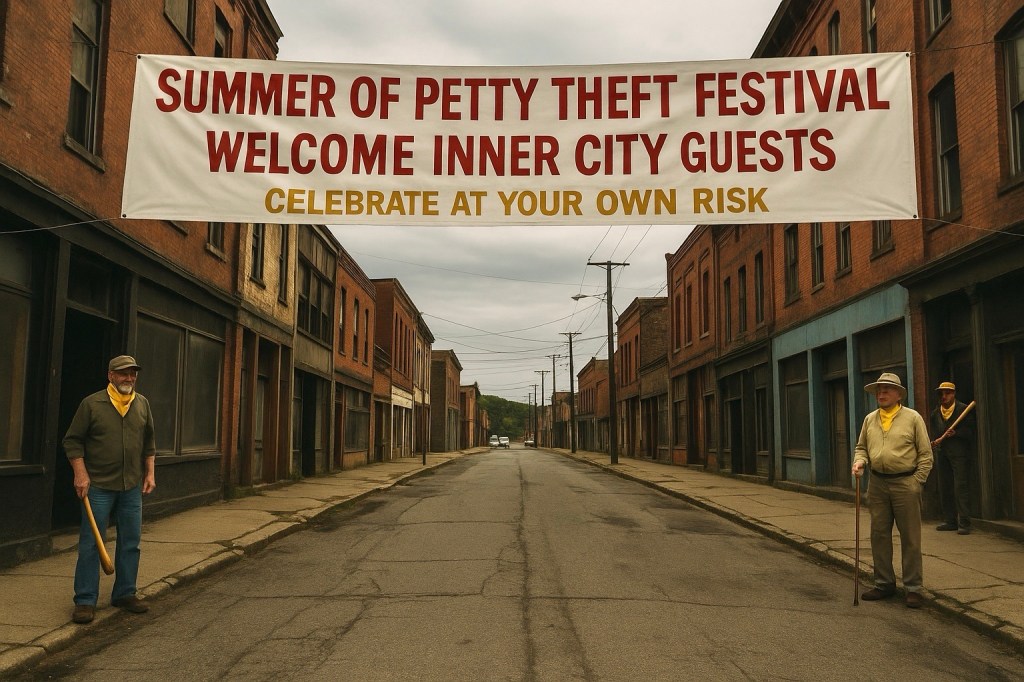
“I propose we go further—ritualize crime into a seasonal rite. The ‘Summer of Petty Theft’ could bring tourism dollars. Imagine: sanctioned misdemeanor weekends. Like Burning Man, but with bail bonds.”
A GROUNDBREAKING MEDICAL STUDY
Dr. Schüß cites new findings from the Institute for Hypothetical Pathologies, a TITS-affiliated lab, which suggest:
“73% of national outrage responses could be neutralized by legalizing the inciting behavior before it occurs.”
This emergent field is being referred to as Retroactive Preclemency™ and may soon replace therapy in coastal cities.
PUBLIC FEEDBACK: LETTERS TO THE COUNCIL
(Selected by Marge Analia, Letters Column Curator)
“Dear Council,”
“As a retired shoplifter, I resent being reclassified as an ‘unauthorized entrepreneur.’ I prefer ‘aesthetic opportunist.’”
— Darla M., former boutique enthusiast
“To Whom It May Concern,”
— A well-known but poorly audited sculptor
“I demand this new crime policy extend to tax evasion, if only for the sake of artistic freedom.”
“Hey Council People,”
“If crime becomes legal, is the DMV next? Or is that still protected under Cruel and Unusual Punishment?”
— Leonard G., frequent line-stander
CLOSING NOTE FROM THE EDITORIAL TEAM
This dispatch is part of our seasonal attempt to test the elasticity of civic reason. Future installments may feature equally destabilizing insights, counterinsights, or legally gray recipes from the Council’s test kitchen.
Signed,
Office of Editorial Equanimity
Council-of-Concerned-Conservationists
FOOTNOTE
[1]The crowd erupted in cheers as the banner unfurled—LEGALIZATION OF CRIME – H.R.00666—and a voice from the Capitol steps shouted, “Free at last, Gawd Almighty, free at last!” But somewhere behind the choreography, behind the selfie sticks and the ceremonial shredding of arrest warrants, a quieter sentence echoed—buried in ash and irony.
“Nothing remains to be thrown into the fire, unless it be ourselves,” warned the old story.
They had torched the codes, unbound the punishments, dissolved the very notion of guilt.
Yet no one reached for the matchbox when it came to human nature. That, apparently, was off limits.
This footnote alludes to Nathaniel Hawthorne’s prophetic short story, “Earth’s Holocaust” (1844), in which mankind attempts to purge all evil from the world by burning its symbols—books, weapons, thrones, even religious relics. But evil persists, because, as the stranger on the plains observes, “There is one thing that these wiseacres have forgotten to throw into the fire… and that is the human heart!”
 COUNCIL-OF CONCERNED-CONSERVATIONISTS…..Between Jest And Earnest…..
Leave a comment