FROM THE DESK OF TURNER FRAZIER. —Pun Offensive Director.
Cultural Fronts & Semiotic Warfare.
With Field Notes from Japan by Ichi Scrachimori and a Semiotic Appendix by Turner Frazier
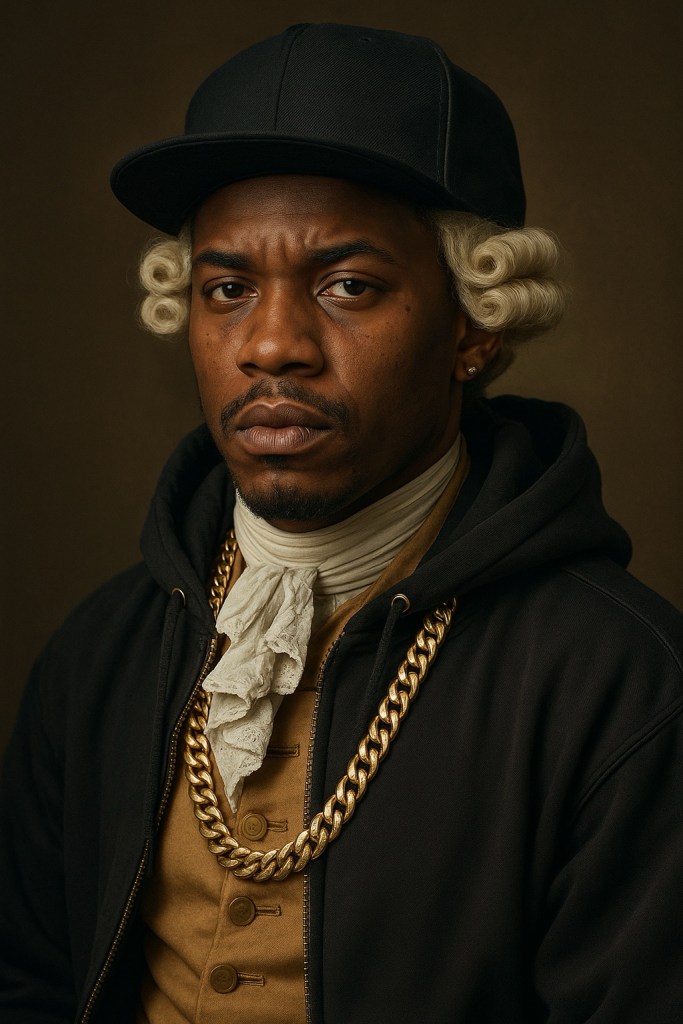
(Telos: from the Greek, meaning “end,” “goal,” or in this case, “cultural faceplant disguised as destiny.”)
“History doesn’t repeat—but it does rhyme in questionable taste.”
I. PRELUDE: THE PUN THAT WENT GLOBAL
Most wars begin with boots. Ours begin with beats.
The world thinks we conquer with Abrams tanks, but the advance team was already there—in the form of sneakers, slang, and streetwear. While America’s military casts a long shadow, it’s Amerikan kulture that slips under the door. The world absorbs it like a bassline: rhythm-first, morals-later.
That’s why this post hinges not just on geopolitics—but on a pun. And as the Council’s designated Pun Offensive Lead, I feel uniquely licensed to say:
Whiggerism isn’t just a slur—it’s a theory. A hinge pun.
It connects Whig liberal progress with wigger mimicry—and maps the global spread of American soft power through cultural rebellion.
II. THE WHIG OUTLOOK
The Whigs were the 18th- and 19th-century British political faction that opposed absolute monarchy, favored reform, and believed in liberty, markets, and the forward march of history. From their philosophy came a worldview so baked into modern liberalism that we barely notice it anymore.
The Whig theory of history is this:
The past was benighted, the present is improved, and the future—if we behave—is bound to be even better. Enlightenment is not just possible—it’s inevitable.
This is the doctrine of textbook publishers, State Department white papers, and Silicon Valley commencement speeches. It’s what keeps progressives smiling through catastrophe—because, after all, the arc of history bends toward something better, doesn’t it?
“The history of mankind is a history of progress.”
— Lord Macaulay¹
The Whig outlook is more than a political stance; it is a metaphysical confidence. It believes that time itself is an ally—that democracy, diversity, and Dropbox accounts are the natural culmination of civilization. It’s a belief system disguised as common sense.
But Antonio Gramsci, writing from prison had no such illusions:
“The old world is dying, and the new world struggles to be born: now is the time of monsters.”— Antonio Gramsci²
And one of those monsters—the cultural hybrid we now call Whiggerism—was born precisely at the intersection of Whig optimism and cultural appropriation.
It represents a pivot:
From the Whig’s powdered wig and parliamentary bench,
To the Wigger’s bandana and boom box.
From liberty as legislation to freedom as fashion.
The Whig tells us where we’re going.
The Wigger shows us how we’ll look and sound when we get there.
III. WIGGERISM: THE SIDEWAYS EMPIRE
Originally, “wigger” referred to white suburban youth mimicking Black urban culture. Once mocked, it has since become normalized, monetized, and globalized.
America no longer exports freedom. It exports swagger.
“The medium is the message. And the message of American culture is the medium of rebellion.”
— Marshall McLuhan³
That rebellion has entered not only fashion and rhythm, but language itself.
Black prison lingo, once forged in survival, now travels with Wi-Fi:
“Shout out” — from cross-tier prison yells to podcast greetings
“in the day” — once prison nostalgia, now Instagram caption
“Down,” “snitch,” “real talk,” “woke” — parole-tested, CEO-approved
“No cap,” “on lock,” “ride or die,” “street cred,” “OG” — once confined to the yard, now embedded in international media and advertising
What was once whispered behind bars is now shouted in boardrooms. Language, like music, became a vector of influence.

would like to teach
the world to sing
In distinct polyphony
Not blended, forced, or autotuned
Just rooted, wild, and free🎶
IV. THE CONVERGENCE
So here it is, pun and prophecy united:
Whiggerism = Whig Theory + Wigger Aesthetic
The Whig believed in inevitable ascent. The Wigger performs inherited resistance. Together, they form a cultural weapon: the look and sound of rebellion without the risk.
The world didn’t become American through treaties. It did so through mixtapes, movie quotes, and memes.
V. FIELD NOTES FROM JAPAN
Respectfully submitted,
By Ichi Scrachimori
C-of-C-C Tokyo Bureau, Department of Global Mimicry
“Here in Tokyo, I have seen 16-year-old girls in Harajuku who speak better Ebonics than I do English.
The clothing shops in Shibuya sell entire outfits called ‘Brooklyn Sets.’
A boy in Fukuoka rapped to me in fluent Atlanta trap cadence, then bowed respectfully and gave me his business card.
In Osaka, there is a barbershop called ‘Get Fade Stay Paid’ run by a fourth-generation Shinto priest.
And in Kyoto, I met a man who teaches ‘hip-hop consciousness’ at a Zen temple—but only on Wednesdays.
They imitate not out of mockery, but out of reverence. They have turned imitation into a cultural tea ceremony—precise, stylized, devoted.
And like the samurai of old, these youths carry their swords on the inside: loaded smartphones with Jay-Z, Nas, and Kendrick as spiritual texts.
America may have bombed Hiroshima—but it was Tupac who captured Tokyo.”
VI. CLOSING OBSERVATION
America’s real secret weapon isn’t the Pentagon—it’s the playlist.
Whiggerism is satire and strategy, prophecy and parody.
It is progress repackaged as performance.
It is defiance made portable, wearable, downloadable.
The Whig dream of upward history fulfilled itself—by doing the sideways shuffle.
If culture is a virus, America is patient zero—wearing Air Jordans.
Respectfully Submitted, Turner Frazier
Pun Offensive Director
Council-of-Concerned-Conservationists
Division of Inverted Teleologies, Semiotic Warfare, and Cultural Frontlines
APPENDIX
From the Yard to the Airwaves
A Semiotic Timeline of Street Speech
Shout out – Vocal greetings between prisoners across tiers; now common in podcasts and award shows
Down – Sign of gang loyalty; now meaning “in agreement” or “on board”
Snitch – Inmate who informs; now used for betrayers of any group or code
Street cred – Authenticity within street/prison culture; now used to describe legitimacy in branding or pop culture
Thrown under the bus – Betrayed in prison politics; now a cliché for corporate or political sacrifice
Ride or die – Code of loyalty in high-stakes gang or prison settings; now means romantic or loyal partner
Woke – Awareness of power structures; now a politicized term used across ideological lines
No cap – “No lie” or “for real” —in street slang; now Gen Z shorthand for honesty
On lock – Under strict control in prison; now used to describe mastery of a task or domain
Back in the day – Standard storytelling frame in prison; now nostalgic shorthand
Real talk – Unfiltered, serious truth in tense prison moments; now used to signal sincerity
Note: As slang enters mainstream, it often loses risk and reverses meaning. What was once whispered to survive becomes shouted to sell.
FOOTNOTES
[1] Thomas Babington Macaulay, The History of England from the Accession of James II (1848). Excerpt available via Project Gutenberg.
[2]Antonio Gramsci, Prison Notebooks, 1930. Translation and summary via Marxists Internet Archive.
[3]Marshall McLuhan, Understanding Media: The Extensions of Man (1964). Quote and analysis via McLuhan Galaxy.
 COUNCIL-OF CONCERNED-CONSERVATIONISTS…..Between Jest And Earnest…..
Leave a comment