Filed by the Right Reverend James Groady, Evangelist of Bluegrass.
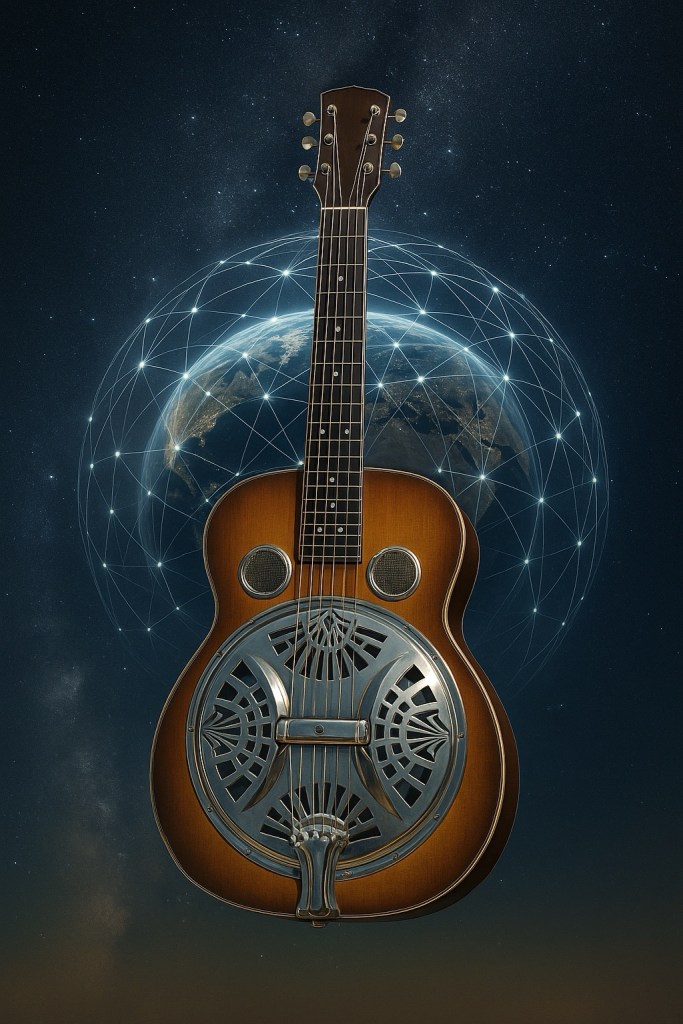
“We are not human beings having a spiritual experience; we are spiritual beings having a bluegrass breakdown somewhere near the Van Allen Belt.”
—(Revised) Pierre Teilhard de Chardin, as hallucinated in the parking lot of the Greyfox Bluegrass Festival, 2005
They never meant for it to happen this way.
In the fluorescent laboratories of the 1950s and ’60s, under the watchful eyes of the CIA and affiliated security agencies, operatives of the national imagination began experimenting with LSD—not to open doors of perception, but to bolt them shut.
The goal? Control. Compliance. Mindwash.
The method? Drop acid into the river of thought and see which way the current bends.
Project MKULTRA, fronted through hospitals, universities, and prisons, sought to break down and reprogram the human psyche like an old cassette tape. But instead of creating docile patriots or programmable assassins, they accidentally handed out visions.
They wanted drones. They got dreamers.
They tried to study minds. The soul leaked out.
And here, the pun becomes prophecy:
They wanted drones—obedient minds without edge or will.
But what history handed them instead were actual drones:
hovering, buzzing, surveilling, and eventually delivering gluten-free snacks to armed suburbanites.
In a sense, the CIA got exactly what it was looking for—just not in the species they expected.
The humans, spiked with vision, took flight in spirit and song—off-script and off-map.
The machines, meanwhile, learned to hover on command.
From MKULTRA to Amazon Prime. From mind control to orbital fulfillment.
What was meant to cage the psyche instead mechanized the sky.
The Reverend would now like you to consider the following inconvenient resurrection of unintended consequence:
Ken Kesey, LSD recipient #MKULTRA-148, gave us One Flew Over the Cuckoo’s Nest and the Merry Pranksters.[¹]
Stewart Brand, dosed at Stanford, gave us the Whole Earth Catalog—and called for a photo of the Earth from space before the astronauts took it.[²]
The Beatles, flipped from Merseybeat mop-tops to sitar-staring philosophers after one taste of chemical gnosis.[³]
The Unabomber, cooked in the same Harvard stew, turned his mind-control session into a monastic tech-burn.[⁴]
Terrence McKenna, turned his trip into a cosmological theory involving mushrooms, fractals, and time.[⁵]
Timothy Leary, CIA-trained and chaos-ordained, said “Tune in, turn on, drop out”—and then dropped into every corner of American consciousness.[⁶]
Allen Ginsberg, dropped acid and then dropped Howl like a word-bomb over Eisenhower’s America.[⁷]
Ernst Jünger, war mystic and author of The Storm of Steel, experimented with LSD late in life—not for escape, but to master detachment in the heart of modernity’s storm.[⁸]
Douglas Engelbart, father of the computer mouse, claimed psychedelic insights helped him “augment human intellect.”[⁹]
Jaron Lanier, virtual reality pioneer, described early VR as “what LSD wanted to be when it grew up.”[¹⁰]
John Perry Barlow, lyricist, cyber-libertarian, and Grateful Dead affiliate, told us the net was “an acid-drenched frontier.”[¹¹]
Kary Mullis, Nobel-winning inventor of the PCR test, credited LSD with showing him how DNA works.[¹²]
**************
With sonic accompaniment by Jerry Douglas’s instrumental “The Ride,”
from the album Restless on the Farm—a title that speaks, too, of civilization: poised for ascent, but still rooted in the land that formed it.
DecoGrass and Teilhard de Chardin: Theology with a Truss Rod
Now, it must be said: The Ride by Jerry Douglas contains not just a Dobro—but the Dobro in full metaphysical flight. This time, it’s not a metaphorical reach. The instrument at the center of our symbolism is the very voice guiding the sound. It doesn’t accompany the idea—it is the idea, plucked, bent, and sent echoing into the noosphere.
The Dobro—with its chrome resonator, radiating lines, and wooden body—is the Council’s chosen instrument not for its sound alone, but for its look:
It is the Art Deco skyscraper of Appalachian instrumentation.
It is jazz-age machinery welded to front-porch lament.

Has anyone else noticed this? Possibly not.
Could the Dopyera Brothers, who invented the Dobro, have glimpsed something under the influence? That is speculation… but fitting for a world where geometry and grief can coexist on the same fretboard.
And this brings us—gently, maybe tenuously, but truly—to Teilhard.
Teilhard de Chardin, Jesuit paleontologist and evolution mystic, believed:
The universe is evolving toward increasing complexity and consciousness. Human thought has created a sphere of shared cognition: the noosphere. That consciousness may be converging toward the Omega Point, where spirit, matter, and love fuse into radiant unity. Technology and communion are not in conflict, but tools for transcendence.
And here’s the Council’s convergence hypothesis:
The Earthrise photo, which Stewart Brand prophetically demanded,[²] visualized Earth not as terrain—but as a single organism of awareness.
The Whole Earth Catalog became the sacred manual for planetary consciousness.
The Internet emerged as the first full expression of the noosphere—a planetary nervous system for thought, reflection, myth, and memory.¹³
And now, Artificial Intelligence is its newest extension: a way for minds to connect through other minds, not just in speech or code, but through generated images, dreams, and recombinant truths.¹⁴
And what is DecoGrass if not a handcrafted signal sent through that noosphere?
What is a Chrome-Plated Soul if not a Dobro at the edge of the singularity?
Teilhard may not have known bluegrass, but he knew harmony.
And the Council believes: when the breakdown begins in earnest, even the Omega Point will need a rhythm section.

Council Sermon Summary:
The CIA tried to control the mind. The soul leaked out. Teilhard taught that evolution points toward spiritual convergence. LSD widened the aperture. The Internet became the medium. Artificial Intelligence now renders that medium reflexive—minds influencing minds through synthetic expression.
The Dobro is in the future. The Ride in bluegrass form is a transmission. DecoGrass is our ark—preserving the past with future ornament. Chrome-plated cornbread. Coal dust with coordinates. The noosphere exists. And it listens. And it generates. The drones have arrived. Just not the kind they planned.
Call it what you want—Teilhardian Hoedown, Chrome Revivalism, or Noospheric Breakdown.
But know this:
The rocket’s lit. The strings are tuned. The soul’s got somewhere to go.
Filed from the Council soundstage under the Gist & Tangent Pub,
Rev. James Groady, Dobro & Doctrine Division
Footnotes & Sources
[1]Kesey was given LSD as part of government experiments at the Menlo Park VA hospital under Project MKULTRA.
[2]Brand’s 1966 campaign for NASA to release a photo of Earth from space culminated in Earthrise (1968), which became the cover of Whole Earth Catalog.
[3]The Beatles’ LSD use shaped Revolver and Sgt. Pepper.
[4]Theodore Kaczynski was subjected to psychological stress tests as part of Harvard’s Murray experiment, often linked to MKULTRA.
[5]McKenna’s “Stoned Ape Theory” and “Timewave Zero” were direct results of psychedelic exploration.
[6]Leary worked at Harvard and ran the Harvard Psilocybin Project before becoming LSD’s foremost evangelist.
[7]Ginsberg’s use of LSD and psilocybin shaped his poetry and public activism.
[8]Jünger detailed his experiences in Annäherungen: Drogen und Rausch (1970), reflecting on LSD and mescaline.
[9]Lanier often cites altered states as a shaping influence on his virtual reality designs.
[10]Barlow’s political philosophy and writings—especially “A Declaration of the Independence of Cyberspace”—echo psychedelic and libertarian ideals.
[11]Mullis openly attributed a visionary experience on LSD to the moment he grasped DNA amplification.
[12]The concept of the Internet as Teilhard’s noosphere has been explored by techno-mystics, evolutionary theorists, and systems philosophers such as Kevin Kelly, Francis Heylighen, and Fr. Thomas M. King, S.J.
[13] The concept of the Internet as Teilhard de Chardin’s noosphere has been explored by multiple thinkers, including Kevin Kelly (Out of Control), Francis Heylighen (Global Brain Institute), and Fr. Thomas M. King, S.J., a Teilhard scholar who explicitly identified the Internet as the material expression of the noosphere—a planetary nervous system facilitating consciousness, reflection, and convergence.
14. The inclusion of Artificial Intelligence within the noosphere is a contemporary extension of Teilhard’s vision. This perspective is supported by thinkers like Thomas W. Malone (Superminds) and Luciano Floridi (who introduced the concept of the infosphere), both of whom describe distributed, machine-augmented cognition as an emergent collective intelligence. AI is no longer simply a tool—it’s a participant in the planetary mind.
 COUNCIL-OF CONCERNED-CONSERVATIONISTS…..Between Jest And Earnest…..
Leave a comment