A Reconsidering of THE WAY.
—The Accidental Initiate.
On Thermodynamic Ethics, Subzero Metaphors, and Frozen Discoveries
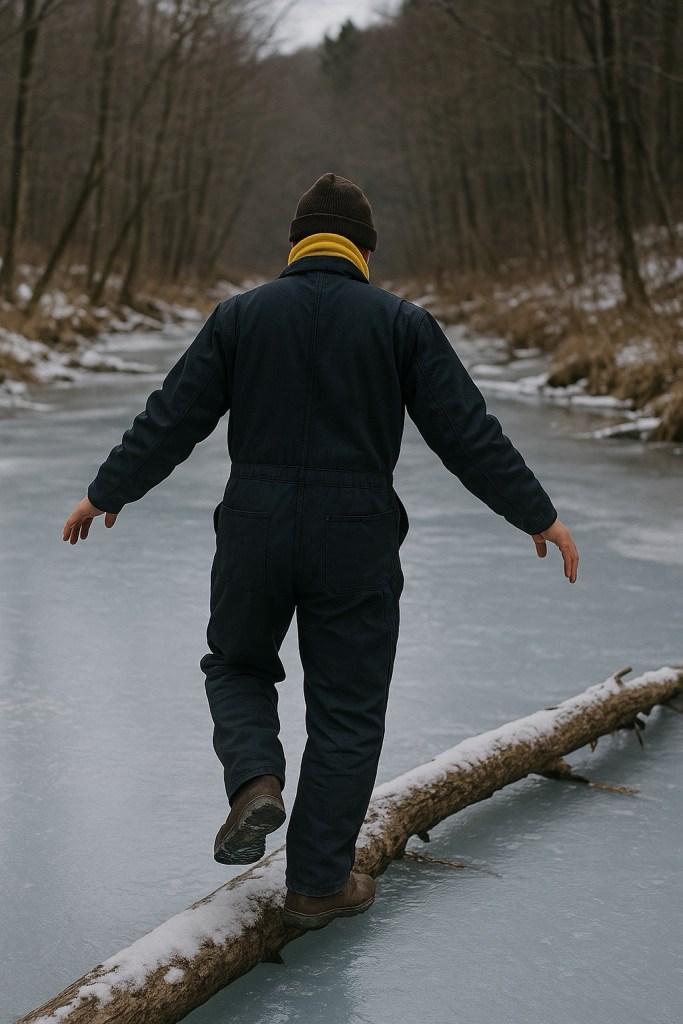
Same river, same spot.
So much for ‘no man steps in the same river twice.’
Heraclitus never walked on ice.
It happened, as most things do for me, with bad footing and delayed insight. I was crossing the creek—frozen solid this time—stepping over the same log where I nearly wiped out last week. Mid-step, arms flailing like a heron having second thoughts, it struck me: maybe Lao Tzu was only telling half the truth. Or rather, maybe he was only speaking for water at temperatures above freezing. Because when water stops flowing, when it stiffens into stillness, the morality it mirrors changes too. And I, The Accidental Initiate, caught mid-stumble between philosophies, found myself drafting a new version of the Tao—written on ice.
You know the quote—scroll-borne and meme-washed until it feels more inspirational than revolutionary; a favorite of the hippies:
“The person with the best morality is like water:
He can nurture everything and everyone around him will receive his help.
He will treat himself lower than everyone just as water accommodates the rivers, lakes, and oceans, being all-encompassing.
He will be as soft as water, never fighting with others.
With time, water can even change the shapes of rocks and mountains
And so too can the most cold-hearted people be transformed.”
—— Lao Tzu (philosophizing at ambient temperature 33° and above)
It’s elegant. It’s humble. It’s…temperate.
That’s when it struck me, not as a thunderbolt, but as a kind of thermal shrug:
What if Lao Tzu was only telling half the truth? Or what if the truth is distributed in the many ways his name is spelled:
- Laozi (This is the current standardized spelling) also known as:
- Lao-Tze
- Lao-Tsu
- Lao Tse
- Lao Tsu
- Laosi
- Laotze
- Lao Zi
- Laocius
- Lao Ce
So then, what if he was only telling the part of the truth found at ambient temperatures above 33 degrees Fahrenheit?
But then I thought again of my stumble and saw another morality—one that comes from water not flowing, but freezing. From water not yielding, but enduring. And so, like any good initiate who trips more often than he walks, I revised the scripture. Or maybe I just rephrased it from the other side of the thermometer:
“The person with the best morality is like a glacier:
He can crush everything,
and everyone around him will be reduced to erratics and till.
He will treat himself higher than everyone,
just as ice absorbs the rivers, lakes, and oceans, being all-encompassing.
He will be as hard as iron, always battling with others.
With time, ice will change the shapes of rocks and mountains,
And so too can the most warm-hearted people be transformed.”
— The Accidental Initiate (just noticing the change at ambient temperature below 32°F)
I don’t offer this as a contradiction to Lao Tzu but as a phase-change clarification. Water doesn’t stop being water just because it changes state. And maybe morality is the same way. Sometimes it’s soft and accommodating. Sometimes it’s frozen, ancient, and remorseless in its slow pressure.
A glacier does what a stream never could: it remakes topographies, not just tempers them.
And so, we might ask: Is there such a thing as thermodynamic ethics?
Heraclitus, for one, might have nodded—he told us we never step in the same river twice, because both man and river change. But he didn’t follow that river into winter.
Laozi and Heraclitus never met, but if they had, it probably would’ve been beside a river—Laozi suggesting they sit and flow with it, Heraclitus insisting it wasn’t the same river anymore.
Philosophical cousins in the great outdoors. One preached the virtue of water’s softness, the other swore by its movement. They only would’ve agreed on one thing: don’t trust stability. Which makes it all the more awkward that the river just froze solid.
And if you follow the creek far enough—past the ice fishing hole and the thermodynamic ethics—there they are: Lao Tzu and Heraclitus, still standing on the bank. One scratching his head, the other muttering about flux through clenched teeth. Neither seems sure what to make of a river that doesn’t move.

Somewhere behind them, a Council member reels in a trout and says nothing. Because wisdom, like water, comes in all states—and some of it you just have to sit with until spring.
So maybe what we call contradiction is just climate.
Maybe virtue has a freezing point.
And maybe, just maybe, the sages forgot their thermometers.
ADDENDUM
— FILED BY JOHN ST. EVOLA
Department of Fire & Ice (and Occasional HVAC Theology)
“We always talk about the morality of water—soft, yielding, nurturing. Then ice shows up, and suddenly the code shifts: slow, heavy, implacable. Still water, but with a different ethic.”
I was defrosting the backup heat pump when it hit me: there’s a third kind of morality too—sublimated. [1] That’s when ice skips the melt and turns straight into vapor. No flow, no solidity—just a principle rising unseen.
Same substance. Different state. Different rules.
Some virtues need to flow, some need to crush, and some—some need to disappear into the air before anyone sees what they really meant.
Doesn’t mean they’re false. Just means they obey the laws of moral thermodynamics.
We don’t lose the truth when it changes form. We just have to know which tool to use: a cup, an ice pick… or a vent.
Footnote
Sublimation: When a thing of dignity bypasses its dissolution and simply rises. Ice does not deign to melt into puddlehood—it becomes vapor, unseen but persistent. Likewise, certain moral codes—when faced with vulgar climates—choose not to argue or adapt. They sublime. This is not erasure. It is escape. Civilization, I fear, may do the same.—Mrs Begonia Contretempts
 COUNCIL-OF CONCERNED-CONSERVATIONISTS…..Between Jest And Earnest…..
Leave a comment