Cultural Autopsy Specialist for the European Nouvelle Vague Zwischenshaft (NVZ)
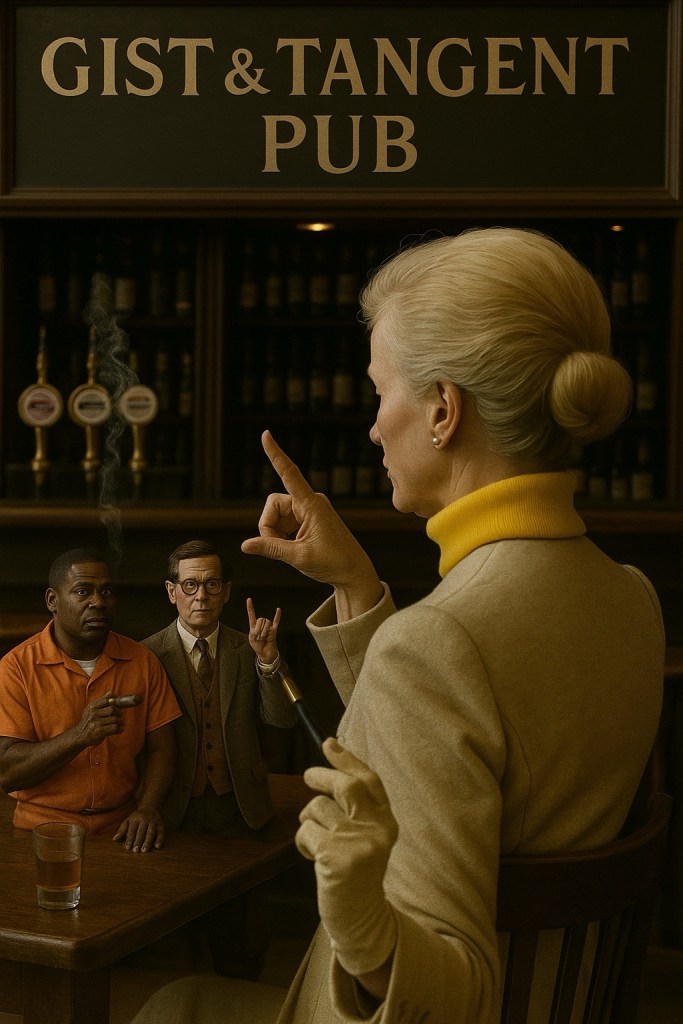
Downsized by the Council’s Moral Scale Adjuster, the little creatures are now fit for flicking by Mrs. Begonia Contretemps.
MEMORANDUM
To Whom It May (Still) Concern:
Language, once the custodian of meaning and the lace doily on which civilization placed its porcelain thoughts, has been invaded. Not by poets. Not by prophets. But by the degreed ones, middle managers and burnout influencers repackaging trauma as branding.
This is not a drill. This is vocabulary creep—the slow, spandex-stretched seepage of jargons from cubicles, correctional facilities, and TikTok confessionals into the general discourse. It is now possible to hear a Stanford sociologist, a Brooklyn doula, and a third-strike parolee named Dre’Quan use the phrase “holding space” unironically in the same panel discussion on “decarceral design.”
Mes Chers Éclairés, Let us unpack.
I. Therapeutic Language as Verbal Lube
The phrase “I don’t have the bandwidth” is now deployed to avoid birthday parties, war crimes, and email replies. Once a term of computing, it has become a talisman against accountability. As in:
“I’d love to address the genocide, but I’m really trying to center my healing right now.”
Unpack, process, navigate, journey—these verbs do not move. They emote. They shimmer like stage lighting and disappear before any action occurs.
And let us not forget the clinical little word “tranche”—once the reserved jargon of bond markets, now applied to everything from activist funding to trauma narratives. One no longer lives through hardship. One receives one’s suffering in tranches—small, manageable slices, pre-approved by a foundation and labeled for redistribution. It’s a word so sanitized it even appears in news reports about the Epstein files, as in: “another tranche of documents to be released…”—as if we were discussing investment rounds, not evidence of institutional depravity. In my day, we called it a scandal. Now it’s a series drop.
II. Corporate Gaslighting with a Side of Chakra
Executives now speak in full yoga-English. “Let’s circle back after we sit with it.”
PowerPoint decks include intentions, energy shifts, and scaffolding safe containers.
If I hear one more HR director say “We’re reimagining accountability in the DEIB space,” I shall personally reimagine their entire C-suite using medieval siege ethics.
III. Ghetto, Prison, and TikTok: The Street-to-Strategy Pipeline
Let us now address the infiltration from the low tower. Once the domain of incarcerated poets and unlicensed philosophers, the argot of the prison-industrial complex now lubricates brunch menus and branding decks.
Clap back – Used by white women in Pilates socks.
No cap – Said with furrowed brow by theology undergrads.
Caught a case – Now refers to a bad breakup.
Flex – From prison yard to brand identity consultant.
Snitching – Used in tech layoffs and open relationships.
Vibe check – Issued at faculty meetings.
Trigger – Formerly a gun, now a tweet.
Real talk – Rarely is. Stay woke – Tragically did not.
Let us not forget “broke the Internet,” which is neither a crime nor an accomplishment, and “deadass,” which now appears in marketing materials for oat milk.
IV. Conclusion: The Synergy Space Is on Fire
It is no longer clear where the discourse ends and the content strategy begins. These words were once means of expression. They are now either:
Emotional prophylactics (“I’m setting a boundary”), Prestige camouflage (“I’m in the trauma-informed design space”), Or institutional cry-for-help artifacts (“We’re leveraging lived experience at scale”).
We have reached a point where one may gaslight, center, deplatform, signal, scale, unpack, scaffold, interrogate, and pivot—without ever actually doing anything.
IVb. From the Yard to the Podium: Ghetto & Prison Lingo in Educated Discourse
(Supplemental Notes: Language as Status Performance in the Age of Institutional Street-Cred)
There was a time—quaint now—when university fellows and nonprofit directors avoided sounding like Rikers Island alumni. That era is over. In the current moment, an advanced degree practically requires a conversational grasp of prison patois and ghetto vernacular, so long as it’s filtered through a decolonized praxis lens and uttered while holding kombucha.
Key terms now appearing in faculty meetings, grant proposals, and wellness retreats:
Shout-out – No longer informal thanks; now a performative ritual of tribal alignment
Squad – Your committee, your coven, your “pod” OG – Anyone who’s lasted more than five years in an institution without being canceled
Ride or die – Unclear if used figuratively or HR-violatingly
Got your back – Usually stated right before abandoning the speaker
Deadass – Currently being taught in Gen Z decoding workshops at Harvard
Snatched – Once about wigs, now about your outfit at an academic conference
Throw shade – Now used in peer-reviewed articles about tone policing
No cap – Which, ironically, is mostly used by people with several advanced caps
Clap back – Still trending in op-eds with little clap and lots of back
He got locked up – Used to refer to legal troubles and tenured appointments
Some terms are now ritually intoned by white progressives in front of PowerPoint slides that say “Decolonizing Knowledge Systems: A Case Study in Vibe Alignment.”
One Council member noted that when the Warden’s lexicon becomes the Ward’s curriculum, we are no longer in a society—we are in a simulation glitching at the level of metaphor.
Action Item:
Most Dearest,
I recommend that we immediately impose a 72-hour cultural moratorium on the following word clusters, to be enforced via passive-aggressive footnotes and café menu mockery:
Filed by: Vito Haeckler, Council Man-on-the-Street
Yeah, I read the whole thing. Even looked up “prophylactic” in the non-latex sense. And just when I thought we’d reached peak phrase inflation, I remembered the one that snuck past everybody like a looter in a press vest:
“Mostly peaceful protest.”
Let me explicate—yeah, I said it, shut up, I’ve been reading the minutes.
When the words “mostly peaceful” are used to describe events involving fire, broken glass, and the occasional projectile aimed at a cop’s clavicle, you’ve left the realm of language and entered a realm of semantic liability management. It’s like describing a home invasion as “mostly quiet except for the part where the TV was liberated.”
The trick is always the same:
Soften the edges, wrap the facts in fleece, and make sure every smashed window is contextualized—preferably by someone with tenure.
At some point, we stopped using words to reveal the world and started using them to put it under house arrest.
And look, not to be that guy, but we’re living in the long tail of two simultaneous supply chain crises:
An overproduction of elites, An overproduction of underclass culture,
—and now they’re synergizing in the discourse space like it’s a TED Talk moderated by a parole officer.
And just to be fair—We ain’t producing enough regular guys!
Now don’t get it twisted—it ain’t just the woke crowd and the parole poets. You listen to the MAGA bar-and-grill guys long enough, and you’ll hear their own lingo stew: “red-pilled,” “based,” “alpha move,” “let that sink in,” “I’m just asking questions,” and my personal favorite: “do your own research,” which usually means “I read a meme.” It’s like their own version of postgrad-speak, just filtered through beer and bumper stickers. But even they aren’t the real problem. The problem is we’ve got every flavor of identity—elite, underclass, alt-right—but not enough plain old guys who just tell the truth without a slogan.
Everybody with a PhD in Performativity Studies is out here saying “deadass, fam” to prove they’re grounded. Meanwhile, everyone on probation is out here saying “intersectionality matters” to prove they’ve done the reading. It’s like we reverse-gentrified the dictionary!
We’ve scaled up degrees and scaled down jobs.
We scaffolded dreams, but forgot to install floors.
Now folks with six figures in debt are clapping back in MLA panels, while the guy who actually caught a case is giving TEDx talks on “Restorative Hustling.”
So yeah—I’m vibing, I’m centering, I’m hella triggered.
But let’s be real:
It’s not about code-switching anymore.
It’s about code-merging, in a world that’s just trying to flex its survival algorithm.
Look—I ain’t trying to be dramatic, but these words?
They’re gonna make my head explode.
I’ve been on this Council long enough to know I’m not the only one who feels this way. Half the members are walking around with clenched jaws and twitchy eyelids from the daily onslaught of performative jargon.
These words are turning Council members dangerously anti-semantic. Once they meant something. Now they just announce the vibe.
You can’t go five minutes without someone “centering,” “scaffolding,” or “surfacing” their “lived experience.”
We used to talk like people. Now we talk like grant applications having a nervous breakdown.
—Vito
FINAL NOTE FROM THE EDITOR
John St. Evola, Chair of Linguistic Containment
Council Members:
Be advised—should you find it necessary to use any of the infected vocabulary outlined above, it must be done ironically, deliberately, and with the full awareness that you are handling semiotic biohazards. Gloves on. Tongue in cheek.
Remember: we do not speak the language of decline unless we are diagnosing it.

 COUNCIL-OF CONCERNED-CONSERVATIONISTS…..Between Jest And Earnest…..
Leave a comment