—or— How Two Places With the Same Name Sparked a Revolution.
NOMEN EST OMEN: Naming is Destiny
A Council Column on Nominative Determinism and the Subtle Tyranny of Titles.
By: The Council Linguistic Watchdesk, Just Noticing.
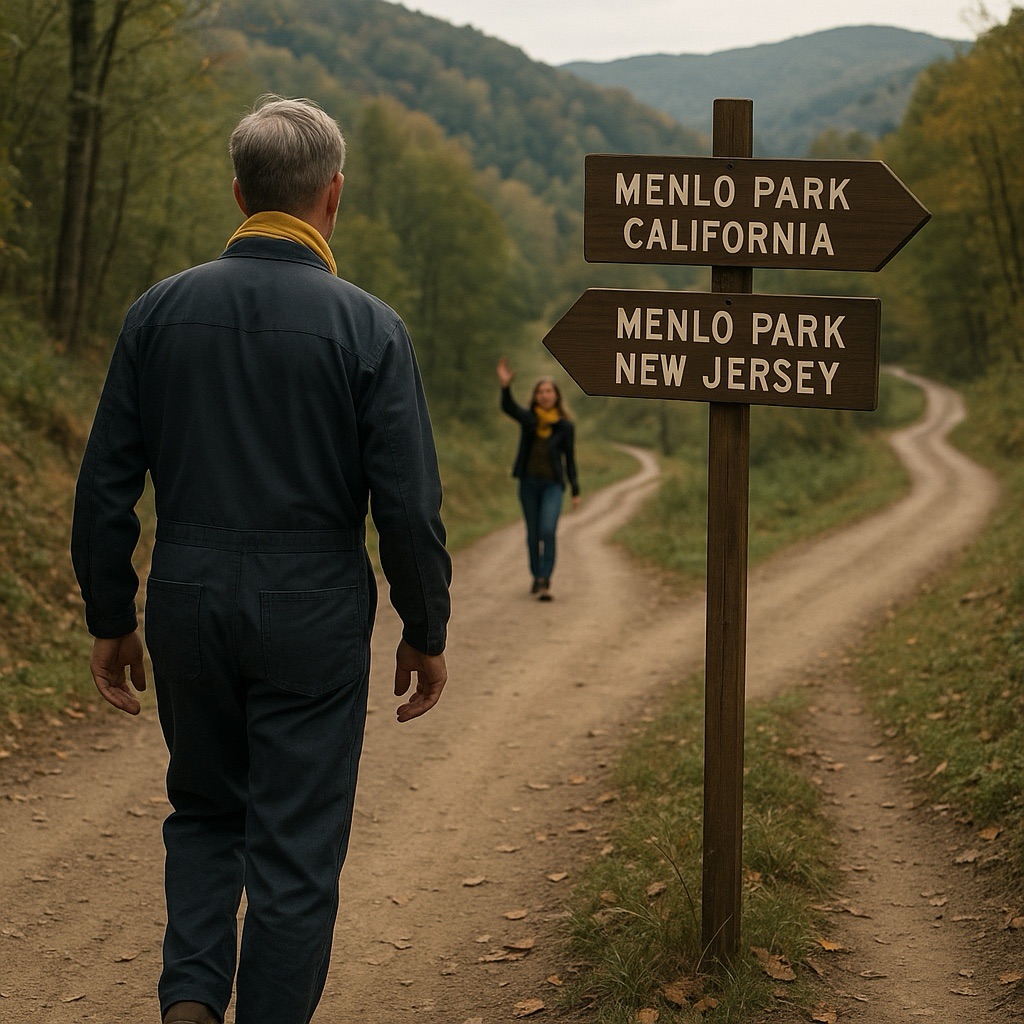
It would be dismissed as coincidence if it weren’t so suspiciously poetic.
Two towns, two coasts, two world-changing technological eruptions—both under the same name: Menlo Park.
In Menlo Park, New Jersey, a young Thomas Edison set up what is arguably the world’s first industrial research laboratory. There, in the 1870s and 1880s, he and his assistants perfected the incandescent lightbulb, developed the phonograph, and pioneered a model for systematic invention—innovation as institutional rhythm, not romantic flash.
Across the continent, nearly a century later, Menlo Park, California birthed another kind of light. Nestled within Silicon Valley, this Menlo became a node in the network that would give rise to the personal computer, internet infrastructure, and the strange glowing interface through which you are reading this now. Companies like Facebook (Meta) would later claim its address, but the soil was already humming. Just up the road: Palo Alto, Stanford, and Fairchild Semiconductor—the cradle of the digital.[2]
But why the same name?
The name “Menlo”—it turns out—is borrowed from Menlough (Mionlach), County Galway, Ireland, a townland whose name has been interpreted as “middle lake” or “small lake.” Irish immigrants gave the name to the California site in the 1850s. The New Jersey Menlo Park was named later, in the 1870s, reportedly by a developer inspired by the California name—already exotic and picturesque by East Coast standards.[1]
So here’s the nominative mystery:
Did the name carry with it a kind of memetic charge?
Was Menlo not just a place name but a premonition—a reservoir of potential, waiting to be drawn out in light and code?
Or did the first act of naming already contain the seed of its unfolding fate?
The Council’s working hypothesis:
Place names, once given, can pull similar events or futures toward them—across both distance and time.[3]
Just as people live up to their names, places may too. The name becomes a portal, and the inventions merely what comes through.
Perhaps someday we will discover a third Menlo—on a Martian plateau or at the bottom of a digital ocean—and know what must come next.

Addendum
by The Backward Scholar (B.S.)
Filed under: Not All Roads Lead to Rome—Some Loop Through Galway
“It may well be a coincidence. But then, so is the double helix.
What troubles me isn’t that two Menlo Parks lit the path to modernity—
It’s that no one can convincingly say why.
We are left with four possibilities:
1. That names are inert and this is all chance.
2. That names carry a silent charge, like seeds fallen from myth.
3. That we named them because they already were what they would become— not prediction, but postdictive enchantment. After all, it is Council gospel that everything was here from the beginning even if in a preform state. It was still all here!
4. That language itself contains encoded potentialities—hidden triggers of destiny. In this view, Menlo is not merely a name but a linguistic frequency, one that resonates with particular archetypes (light, code, inversion) embedded in phonetic or symbolic form. If language is not arbitrary, but a tool of metaphysical engineering, then destiny may begin at the level of syllables.[4]
Western society now prizes communication over conquest, emotional fluency over stoic force, flexibility over fixity. In the long shadow of Menlo’s glow, have men been lowered—not by oppression, but by automation?
I do not know which is true.
But I keep a map of Menlo, Ireland folded in my desk drawer, just in case.”
And yet… there is one more whisper in the name that deserves a paranoid ear:
MEN—LOW
Grudgingly, we must mention modern feminism—not because we wish to drag it into every historical pattern, or as it can insist on being the frame for every narrative. We just noticed.
Over the last half-century, feminism—particularly in its institutionalized, post-industrial forms—has contributed to a restructuring of male identity. The factory man, the protector, the stoic provider—all have been phased out by rhetoric, policy, and yes, by technology. It was not feminism alone that lowered men—but it certainly managed the decline. As Camille Paglia once observed, “If civilization had been left in female hands, we would still be living in grass huts.”[5] The great irony is that now, having inherited a civilization men built, modern systems seem designed to render them functionally redundant. And yet—it may be technology itself that equalizes in the end. In a world where everyone is mediated through the same screen, filtered by the same algorithm, and judged by the same invisible metrics… perhaps no one gets to stand tall.
It’s as if the word Menlo itself forecast not merely invention but inversion. In these Menlos, men created machines that would make strength of hand obsolete. Tools once meant to extend male agency began to replace it. As labor and provision were mechanized and digitized, the traditional masculine role—protector, provider, producer—was first diffused, then diminished.
MEN—LOW
If so, the name didn’t just predict innovation.
It foretold a gendered recursion, where the builders kneel before their creations, and the masculine archetype is outsourced—first to circuits, then to systems, and finally to culture itself.
This too may be coincidence.
But in nominative determinism, as in prophecy:
The name always knows.
And as always, follow the pun.[6]
FOOTNOTES:
[1]: The Menlo Park in New Jersey was named after Menlo Park, California. The California town was named in 1854 by Irish immigrants after Menlough, County Galway, Ireland. The New Jersey real estate development adopted the name in the 1870s—after the California Menlo was already established.
🔗 Menlo Park, New Jersey – Wikipedia
🔗 Menlo Park, California – Wikipedia
[2]: Menlo Park, California, is home to SRI International (formerly Stanford Research Institute), where major computing breakthroughs occurred. Douglas Engelbart, working at SRI, developed the computer mouse, hypertext, video conferencing, windowed interfaces, and more. His 1968 presentation—“The Mother of All Demos”—introduced nearly every major feature of modern computing. In many ways, Engelbart was the true father of personal computing as we experience it today.
🔗 SRI International – Wikipedia
🔗 Douglas Engelbart – Wikipedia
🔗 The Mother of All Demos – Wikipedia
🔗 Engelbart Institute – Official Site
[3]: According to internal Council Theory on Semantic Entanglement and Toponymic Echoes, names like Menlo Park may act as temporal attractors—what John St. Evola once called “phonetic promissory notes” issued by fate. When uttered into the world, such names don’t merely label—they lure. They create metaphysical corridors along which history travels, like iron filings to a hidden magnet. That two Menlos—each named for a lakeside Irish village—would separately give rise to light and code, suggests not coincidence but nominative convergence. In this view, the name Menlo was not just a place—it was a signal.
🔗 See also: Council Entry #CXXIII: The Acoustic Signature of Invention Zones (restricted circulation)
[4]: For the idea that language encodes deep structures of consciousness, see Benjamin Lee Whorf’s theory of linguistic relativity, the Kabbalistic tradition of names as emanations of divine power, and Mark Booth’s exploration in The Secret History of the World. More recent theories in cognitive science and AI, such as those advanced by Terrence Deacon and Nick Chater, also suggest that language is not passive but an active constraint system—shaping thought, perception, and possibly, destiny.
🔗 Linguistic Relativity – Wikipedia
[5]: Camille Paglia, in her book Sexual Personae (1990), famously wrote: “If civilization had been left in female hands, we would still be living in grass huts.” Paglia argues that male aggression and invention—not female nurture—were historically the engines of progress, and that modern society’s erasure of traditional masculinity ignores its foundational role.
[6]: Technically, this is a pun—a phonetic play (or paronomasia) that draws hidden meaning from surface sound. In the case of Menlo read as “men low,” the resemblance is not etymological but hyperstitional: meaning is back-formed from sound, and the name becomes a kind of folk omen. Within Council logic, this constitutes a legitimate instance of nominative determinism. The name did not merely label a place—it whispered a prophecy disguised as coincidence.
Menlo, Menlo, and Men Low: With this instance we will now have to recognize that the Council has upped its game. It is punning in three dimensions. —Anna Graham, C-of-C-C Language Arts & Word Games Division
 COUNCIL-OF CONCERNED-CONSERVATIONISTS…..Between Jest And Earnest…..
Leave a comment