Container Culture: A Brief History of the Box We’re In.
—Daphne Howlsmythe, Fashion, Food & Pet Care Correspondent
Darling ones,
I opened my recycling bag this morning—crinkle crinkle—and stared into a portal of post-consumption truth: a glittering nest of yogurt cups, shampoo bottles, those maddening pump dispensers that give up just when you need them most. It looked like a family reunion of modernity’s orphans: colorful, shapely, sterile, and utterly without a home.
Have you ever noticed how our lives are ruled by containers?
Let’s call this what it is: Container Culture.
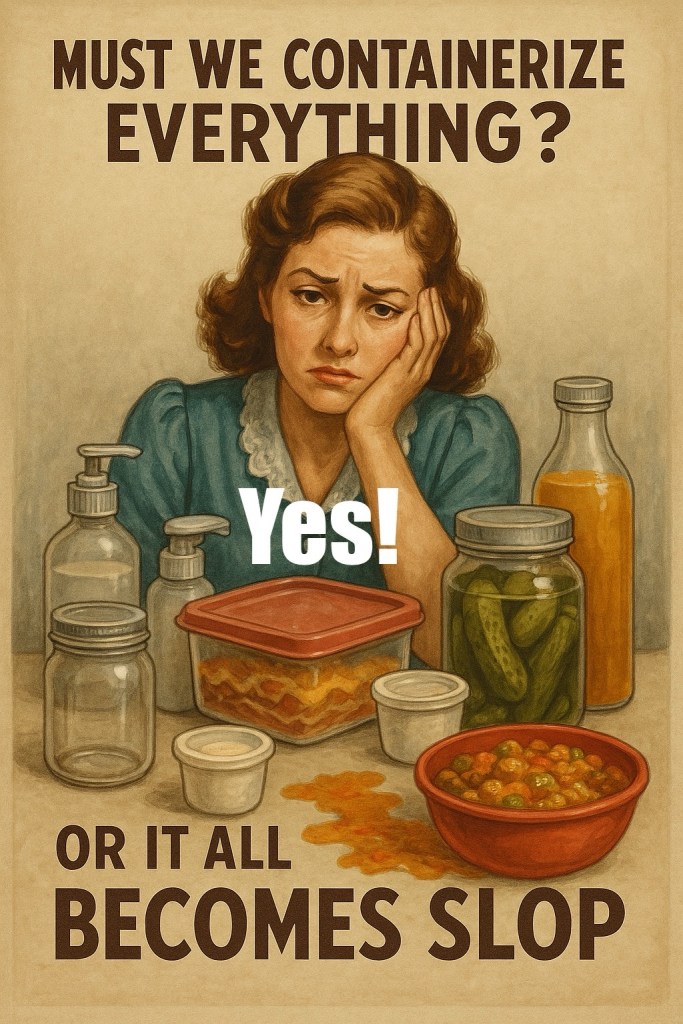
Of course, the 1960s had their own little rebellion against all this. The counterculture railed against compartmentalization, against putting labels on things—romance, gender, morality, mayonnaise. But the irony, darlings, is that even to reject categories, you still need a place to put them. Try throwing out convention, and what do you find yourself carrying? A knapsack full of alternative containers: communes, free love guidelines, astrology charts, and Tupperware full of lentils. They thought they were smashing the boxes—but they were just swapping labels. And now, after decades of decompartmentalization, we’ve arrived at Cole Porter’s worst nightmare: Anything Goes, but with BPA and mood disorders.
They’re everywhere—plastic tubs for leftovers, glass jars for artisanal pickles, designer urns for dead Labradors (RIP, Toodles), travel-sized hope in squeezable tubes, and the omnipresent bento boxes of the anxious lunch crowd. We portion, we seal, we label, we refrigerate. Even our emotions come “pre-sorted” now: compartmentalize your grief, schedule your joy, repress your rage in TSA-compliant amounts.
But where did this all begin? A brief history, if you’ll humor me:
In prehistory, containers were gourds, shells, woven baskets—each with a story, often shared communally.
By ancient Egypt, we had canopic jars. They didn’t just hold pickled organs—they held eternity.
The Romans had amphorae for wine and oil, and I suspect many used them to store gossip.
Then came Tupperware: modernity’s Holy Grail of leftovers, church parties, and suburban containment.
And now? Now we decant our dog treats into minimalist canisters with bamboo lids, as if the Chi of the kibble must be preserved. (I myself have three matching jars for Lady Barkington’s emotional support snacks.)
But here’s the thing, beloveds: containers do more than hold things. They shape them. A muffin tin doesn’t just contain the batter—it instructs it. A fashion clutch isn’t just for lipstick and fear—it’s a symbol of edited presence. The form tells the content how to behave.
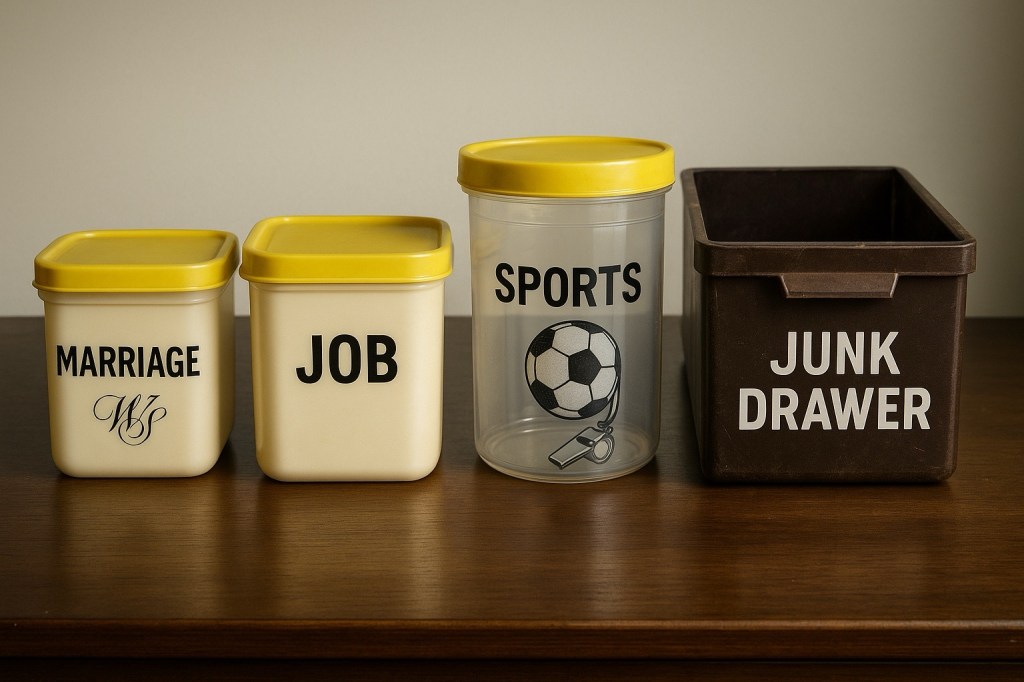
Every culture has its favorite containers. Sex is supposed to go in the marriage container (preferably monogrammed). Greed fits neatly into the job container, where it earns bonuses instead of indictments. Aggression, ideally, goes in the sports container—tight uniforms, whistles, and a scoreboard to civilize the blows. And as for irrational fears, old grudges, and expired opinions? Those go in the junk drawer, darling. Every civilization has one. It rattles when you open it.
This is the metaphysics of containment. And like all metaphysics, it’s hiding in plain sight—under the sink, on the pantry shelf, in the purse that holds the phone that holds the world.
And really, dears—who’s to say human culture itself isn’t just a grand exercise in containment? We box up our urges, vacuum-seal our taboos, childproof our desires. Sex, romance, and marriage—lovely things, yes—but aren’t they also nesting dolls of regulation? The heart wants what it wants, but culture wants it documented, notarized, and preferably celebrated with a three-tiered cake. We quarantine feelings with therapy, we embargo impulses with etiquette, and we send emotional contraband to customs before it’s allowed into polite society. I’m not judging—I adore a good corset, metaphorical or otherwise—but perhaps we ought to ask: are we preserving meaning, or just refrigerating it?
It’s no wonder, then, that I feel a strange kinship with my empty yogurt cups and lavender-scented candle jars—little vessels once brimming with purpose, now waiting politely to be rinsed, repurposed, or reborn.
AFTERWORD
(filed by Turner Frazier, Council Puns Division)
Let this post serve as a gentle lid-rattle of warning: a culture that forgets the value of borders ends up as soup on the linoleum. A container without integrity is just a suggestion. And while the Council supports many forms of freedom, we draw the line at leaks—be they moral, emotional, or geopolitical.
National borders are not the enemies of liberty; they are its containers. What good is your sourdough starter if your mason jar’s a sieve? What is a nation without a rim? What is meaning without margins? Even love—yes, even the mushy kind—needs a container, or else it’s just emotional runoff.
Tidy your lids. Reseal your morals. And remember: not every crack is how the light gets in.
Some are how the coleslaw juice seeps into the sandwich and ruins the picnic of civilization.
 COUNCIL-OF CONCERNED-CONSERVATIONISTS…..Between Jest And Earnest…..
Leave a comment