—BETWEEN JEST AND EARNEST.
By Black Cloud, Chief Poetic Justice Warrior.
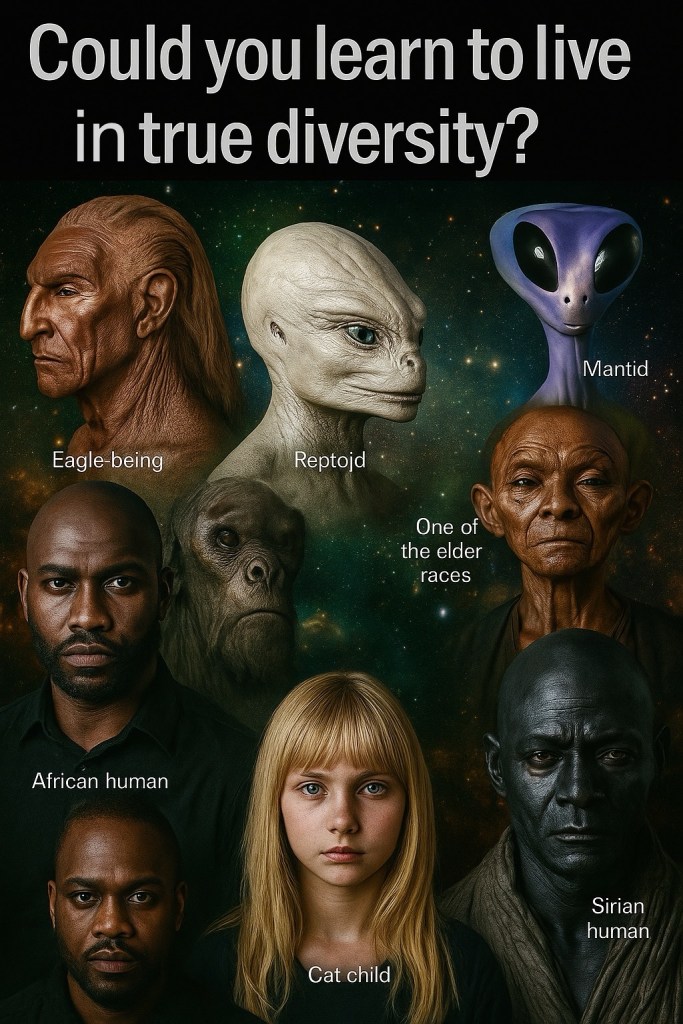
The image said it plainly, as if it were a kindergarten poster on the back of a starship bathroom stall. But we all know it’s not that simple. Because if “true diversity” means getting along with an Eagle-Being while a Sirian Human tries to explain the plot of Galaxy Quest to a Mantid, then we’re going to need a more sophisticated theory of conflict.
In the Council, we’ve seen it all: Cat Children clawing at the upholstery of shared meaning, Reptoids filing lawsuits for emotional misrepresentation, and Losartan-Canines just trying to sniff out sincerity in a universe that smells like performance art and ozone.
People call this hyperreality—when the imitation becomes more vivid than the real thing. When stories replace history. When a fake captain commands more loyalty than a real one ever could. Like the Thermians in Galaxy Quest—they believed in the show because the real was already too distant to touch.
But if there’s no contact with reality anymore, what are we left with?
Instagram wisdom? DEI slogans? Fan fiction about the human condition?
This is what I’m getting at:
“If you don’t have reality, you can’t have any hyperreality.
How can you have hyperreality if you don’t have the real?”
—Black Cloud
(with rhythm stolen from Pink Floyd, and meaning re-routed to the stars)
“The way I see it, you have your attraction, and you have your repulsion,
and sometimes you get them together in the span of moments—
because there may actually be true in diversity throughout the universe.
In other words: peace, love, understanding… and murder.”
The Thermian Parable
The alien Thermians mistook a canceled human television show for historical documents. That’s not just a joke—it’s a parable for our age.
Because we’re all Thermians now.
We take fiction as fact, aesthetics as truth, and myth as operational code. Diversity is our strength, right?
The Thermians didn’t lose their innocence when they learned the truth; they found courage. They fought for the illusion—because, paradoxically, the illusion had become more real than the world that birthed it. They risked everything for a story worth believing in.
Of course, Galaxy Quest was just a movie. In real life, that kind of belief doesn’t end with a crowd cheering—it ends with someone getting eaten. The Thermians were lucky their script had a third act. Most don’t.
But that’s only half the parable. The other half—the one we never tell—is that the Thermians were unprepared for reality. Their innocence was touching, but dangerous. They couldn’t recognize deceit. They didn’t understand cruelty. And they never saw the betrayal coming.
And that’s what we mean when we talk about “true diversity.”
Not just diversity of appearance—but of instincts. Of ethics. Of capacity for deception, violence, or unrecognizable logic. Most people imagine diversity as a kind of universal welcome party—cat girls, frog poets, and wise old aliens sipping soup together. But real diversity includes civilizations where empathy never evolved. Beings who find your scent repulsive, your morality laughable, or your existence intolerable.
You can talk about diversity.
You can theorize it, aestheticize it, sermonize it.
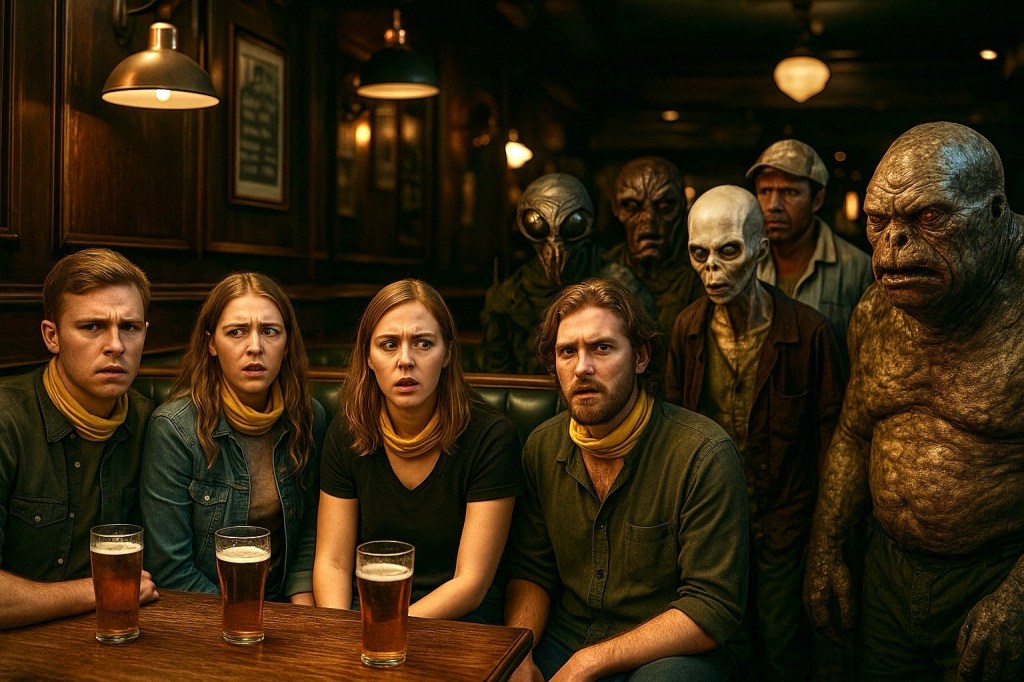
But when it finally walks in the door—reeking of ozone, scaled and silent, accompanied by those who weren’t invited but arrived anyway—your body often tells the truth before your politics catch up.
The Real Cost of True Diversity
So when we ask, “Could you learn to live in true diversity?”—we’re not just talking about hugging a Cat Child or nodding politely at a mantid. We’re talking about facing the full spectrum: the beautiful, the bizarre, the repulsive, the reverent—and yes, sometimes the murderous.
Because real diversity isn’t a utopian mural of soft features and shared values.
It’s friction.
It’s revulsion and reverence sharing a toothbrush.
It’s the moment when peace, love, and understanding sit at the same table as fear, instinct, and the unbearable alienness of the Other.
Most people think they want diversity.
But what they really want is variety—safe, aesthetic, curated.
True diversity might gag you.
And if you’re not ready to sit with that discomfort,
you’re not ready for the galaxy.
—Black Cloud
 COUNCIL-OF CONCERNED-CONSERVATIONISTS…..Between Jest And Earnest…..
Leave a comment