— Reforging the Ancient Insult (‘Yo Mama Is a Hoe’)

A feature of the C-of-C-C Newsletter in which we search for hints and meaning in nearly everything—because it is there where you find it.
Continuing our theme of the day we ask,
WHO’S YOUR DADA?
By Arthur C. Pfärtze, C-of-C-C Newsletter aesthetic interpreter:
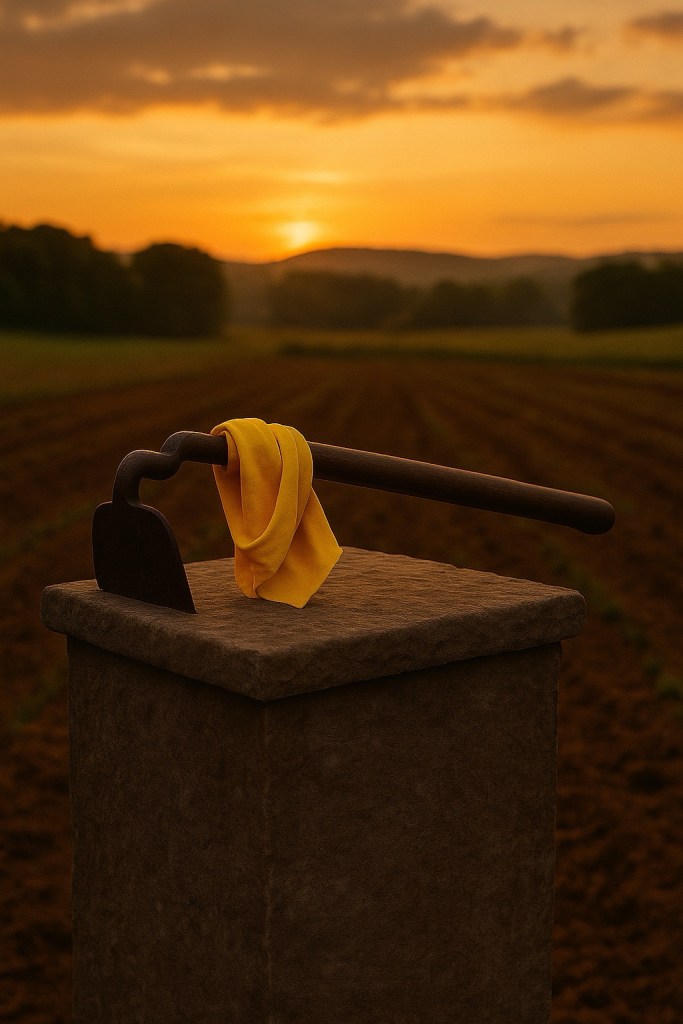
“Sometimes a urinal is just a urinal.
This piece of readymade art above puts to rest a certain kind of insult—those crude maternal jokes that likely trace their lineage all the way back to the Neolithic.
“Yo mama is a hoe,” if you’ll pardon the dip into ghetto lingo, has—through this wrought iron composition—been uplifted, quite literally, to a higher plane of meaning.
It’s worth noting: those who first uttered “yo mama is a hoe” are speaking from a mindset barely out of the Paleolithic. Grunting through a borrowed phrase, they invoke a tool they don’t understand. Because in truth, the hoe didn’t emerge until the Neolithic—the very epoch that birthed agriculture, settlements, and the maternal foundations of civilization itself. So while the insult stagnates in tribal posturing, the hoe—and the mother it stands for—quietly shaped the world.
On the Hoe as Icon: Toward a Cultivated Motherhood
And note the subtle poetry of form: the maternal figure—stoic, abstract, elemental—bears more than a child. She bears a shape that recalls the age-old silhouette of a garden hoe. This isn’t mere coincidence; it’s metaphysical irony. The crude insult—“your mama’s a hoe”—may stretch back to the Neolithic, but here it is transfigured. The hoe, that most basic of tools, becomes an emblem of fertility, cultivation, and care. What was once a slur is now a sacrament. The figure is not degraded by the comparison—she redeems it. She is the plowwoman of meaning itself.
This piece is totally in line with the tradition in European art of family depiction, a motif also found in sacred art. Our forged example plows that same furrow.
And now to counter our necessary but sordid recourse to Black idiom we offer the following:
Der Gott, der Eisen wachsen ließ (The God who made iron grow)
🎶
The God who made the iron grow,
Never wanted slaves or chattel,
He gave man saber, sword, and spear,
To fight his righteous battle!
He gave to him his heart and breath,
His passion of expression,
So he would fight unto the death,
‘Gainst tyrants and oppression.
🎶
—From the poem by Ernst Moritz Arndt (1812), a German nationalist and poet whose verses helped inspire resistance to Napoleon and shaped early ideas of cultural sovereignty. While his politics may no longer fit the globalist phantasy of our time, the spiritual metallurgy still sings true.
FROM ORE TO BEING
Filed by The Backward Scholar, footnoted in spirit by Arthur C. Pfärtze
This isn’t just a hymn to iron. It’s a cosmology.
The old poem—sung by patriots and sometimes forgotten by philosophers—reveals a deeper truth: matter has meaning. Iron does not just exist; it grows, like wheat, under divine intention. This reclaims metallurgy as metaphysics. It is Genesis with a forge.
Iron, in this vision, is not the opposite of the soul—but its vessel.
But let us go further—beyond metaphor. In a materialist sense, iron does grow—not in fields, but in furnaces, hammers, and blood. The moment man learned to extract and shape it, iron entered into a pact with consciousness. It was no longer inert. It became an extension of human will. We co-evolved. From plow to nail, sword to engine, iron has followed us like a shadow made solid. The catalyst was not heat alone, but human desire—to survive, to build, to defend. The ore beneath our feet awaited the fire within our souls. In this view, iron is not a dead thing but a partner in becoming—a metal midwife to civilization, shaped by spirit in the crucible of time.
And this is precisely what the poem reveals:
The poem collapses dualities:
– Material vs. spiritual
– Tool vs. symbol
– Labor vs. prayer
When it declares that “The God who made iron grow never wanted slaves,” it isn’t making a policy statement. It is describing a metaphysical law: freedom is smelted into the structure of creation. That which bends, yields. That which is forged, endures.
It’s worth remembering that even supposed high-minded ideals stumble when they forget the shape of the hearth. The early Israeli kibbutzim tried to replace the nuclear family with collective parenting—a socialist experiment in shared child-rearing which eerily resonates in our time. But the children gravitated back to their biological parents. [1]
Not because of indoctrination, but because of gravity—the kind born of blood, breath, and whispered bedtime stories. You can forge many things—some real, some counterfeit. The family allows neither.
And so, this sculpture—stoic, smooth, yet seamed with subtle emotion—becomes more than modern art. It is a sacrament in silhouette. A visible hymn to the family as furnace and form.
The hollowed heads? They invite the breath.
The broad arms? They carry both burden and birthright.
The asymmetry? A reminder that love is rarely neat—but it holds.
To love, then, is not to melt—but to withstand the fire.
Or as Pfärtze once muttered over lunch (between bites of a coal-fire forged panini):
“The family is the last blacksmith shop. Everything else is just aluminum siding.”
FOOTNOTES
[1] This phenomenon is well-documented in the early decades of the Israeli kibbutz movement, particularly in the 1940s–70s. Children were raised collectively in “children’s houses,” away from their parents, in accordance with socialist ideals. Over time, the psychological and emotional toll became evident. Many children expressed longing for their parents, and by the late 20th century, the model largely dissolved. Studies such as Bruno Bettelheim’s 1969 article “The Children of the Dream” initially praised the system, but follow-up accounts, including first-person memoirs and later psychological research, revealed a consistent drift back toward traditional parent-child bonds.
See also: Yael Neeman’s memoir, “We Were the Future” (2011), and Melford Spiro’s sociological work, “Children of the Kibbutz” (1958, updated).
 COUNCIL-OF CONCERNED-CONSERVATIONISTS…..Between Jest And Earnest…..
Leave a comment