By Black Cloud, in conjunction with Dr. Faye C. Schüß.
Unfathomable Consequences, Artificial Harmony, and the Botox of History.
***
To think: we came this close to being ruled by totalitarian optimists.
According to certain dusty newsletters and subcultural folklore, there were even rumors of a soft coup planned at Disneyland. That wasn’t satire—it was strategy. The Happiest Place on Earth was allegedly scouted as a potential forward operating base for the conquest of the American psyche. Some say a rewritten Declaration of Independence—with jazz hands—was drafted in a subterranean break room below Tomorrowland.
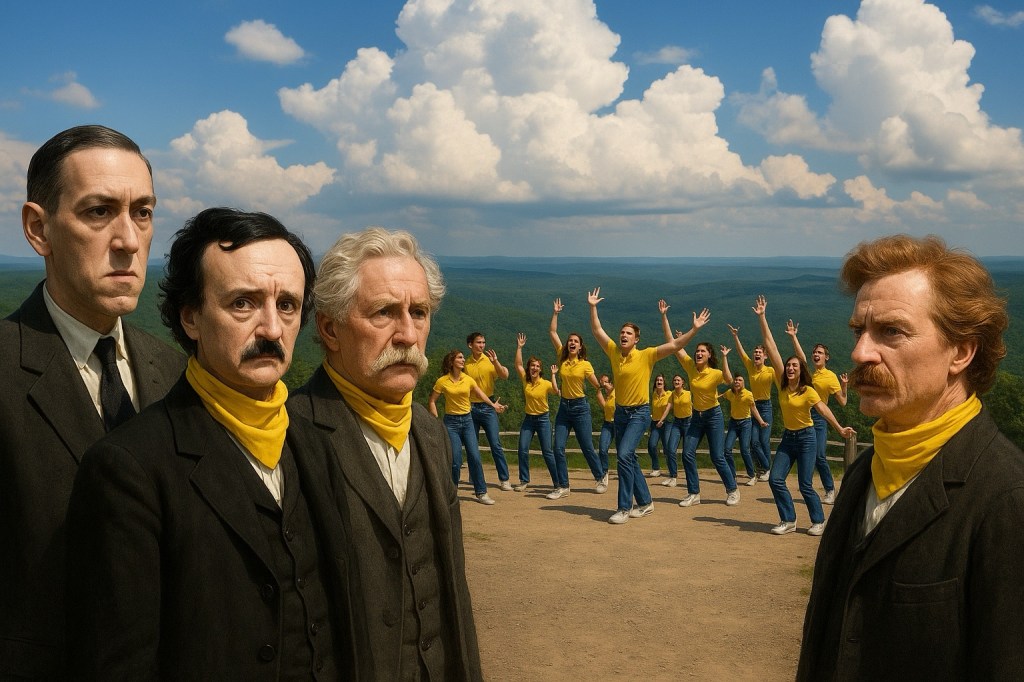
Even more unsettling are the unverified but persistent reports of a campaign to de-literaturize the nation—a proposed purge of “morbid, irreverent” authors such as Ambrose Bierce, Mark Twain, Edgar Allan Poe, Herman Melville, Thomas Ligotti, and H.P. Lovecraft. Whether these were actual plans or just whispers from bookish resistance cells, they point to a cultural moment when optimism nearly became compulsory.
“Hope means hoping when things are hopeless, or it is no virtue at all… it is only when everything is hopeless that hope begins to be a strength.”
— G.K. Chesterton
Said differently: you must first know things are hopeless, or you’re not hoping—you’re distracting yourself.
In the distance: the thunderheads gather. The smiles march on.
Americans, being Americans, resisted in their own peculiar way. Smiling until it hurt, they sought salvation not in rebellion—but in Botox. Their frozen faces became monuments to their existence, taut masks worn in mourning of depth.
🎶 The Anthem of Artificial Joy
Their slogan—“Today America, Tomorrow the World”—briefly taught the globe to sing in perfect harmony. But harmony, like hubris, ages poorly. The movement that put the prog in progressive and the cult in culture lost its grip when the key changed and nobody could follow the melody.
We speak, of course, of Up With People!
Launched in the 1960s as an offshoot of the anti-communist Moral Re-Armament (MRA) movement, Up With People emerged as an all-smiling, all-singing cultural export machine. Its goal? To replace protest with pep. To counter the cynicism of the counterculture with choreography. With troupes of clean-cut young adults singing about peace, unity, and vaguely Protestant work ethic virtues, it quickly found favor with business elites, civic leaders, and international sponsors hungry for American uplift without American politics.
They performed at four Super Bowls, toured over 60 countries, and became the unofficial house band of Cold War soft power—armed not with guitars but with grins.
“The eternal silence of these infinite spaces frightens me,” said Blaise Pascal.
And yet—into that silence, they sent choreography.
“But the world without man,” replied Loren Eiseley, “has its own magic.”
Editorial Confession:
We admit with some embarrassment that Up With People was an easy target—and perhaps a bit below our usual standards of symbolic excavation and high-concept satire. But like all cultural artifacts that attempt to erase complexity in the name of harmony, it invited scrutiny. We critiqued because we cared. And because sometimes, even the Council must take aim at the obvious—if only to remind ourselves how deeply the obvious can wound.
The Psychological Fallout: A Post-Optimist Reckoning
Among those touched by the broader MRA movement was future Oscar nominee Glenn Close, who spent her formative years immersed in the group’s spiritually cheerful rigor. In later interviews, Close described it as a “cult”—not of overt abuse, but of emotional suppression, enforced uniformity, and performative positivity. Members were discouraged from introspection or dissent. This, Close suggested, delayed her development of a true self.
Her psychological reckoning later gave rise to a career of layered, haunted characters—precisely the sort of figures Up With People would have tried to choreograph out of the national psyche.
Dr. Schüß’s Evaluation: Long-Term Side Effects of Moral Pageantry
As a Fellow of The Institute for Theoretical Studies (TITS) and Council expert in Medical and Mental Hygiene, I submit the following provisional findings:
Prolonged exposure to mandatory optimism may result in Delayed Cynical Onset Syndrome (DCOS), in which irony appears only after decades of compulsive earnestness. Chronic participation in scripted moral pageantry fosters affective dissonance, a condition in which subjects can no longer distinguish between inner conviction and outward compliance. In extreme cases, untreated exposure can lead to Empathic Flatlining, where one smiles sincerely at everything—even tragedy, nuance, or Melville. Recommended treatments include exposure to sardonic literature, quiet walks through dying malls, and regular administration of Ambrose Bierce aphorisms in controlled doses.
OPTIMIST, n. “A proponent of the doctrine that black is white.”—Ambrose Bierce (The Devil’s Dictionary)
Let the record show: a nation forced to grin cannot chew, nor speak clearly. Eventually, it gags on its own uplift.
— Dr. Faye C. Schüß, July 2025
Cloris Leachman Correctional Footnote

“Glenn Close—but not quite Cloris Leachman.”
The animus split at the hinge of comedic severity. She insisted the root beer was medicinal and that all laughter masks a scream long domesticated.
While many mistakenly believe that Cloris Leachman was affiliated with Up With People, the Council would like to clarify: she was not. She was, however, everything they feared: messy, subversive, chaotic, brilliant, and human. For this reason, we hereby designate her as:
Spiritual Critic Emerita of the Totalitarian Optimism Experiment.
In Cloris We Trust.
Posted from Korn Krest, PA, where, every now and then, someone still reads Melville aloud under their breath—just to keep the ghosts of depth alive.
Authorial Note:
This dispatch is part of an ongoing collaboration between the poetic diagnostics of Black Cloud and the clinical intuition of Dr. Faye C. Schüß. Together they monitor outbreaks of affective authoritarianism and the weaponization of cheer.
 COUNCIL-OF CONCERNED-CONSERVATIONISTS…..Between Jest And Earnest…..
Leave a comment