A Council Reflection by John St. Evola, Editor-in-Perpetuity.
Filed under: Nomen Est Omen Archives, Literary Prognosis, Symbolic Literacy, Marginal Revelations.
“I think the novelistic form is probably outmoded and that we may look forward to a future in which people do not read at all or only read illustrated books and magazines or some abbreviated form of reading matter.”
— William S. Burroughs, Post-Literate Prophet
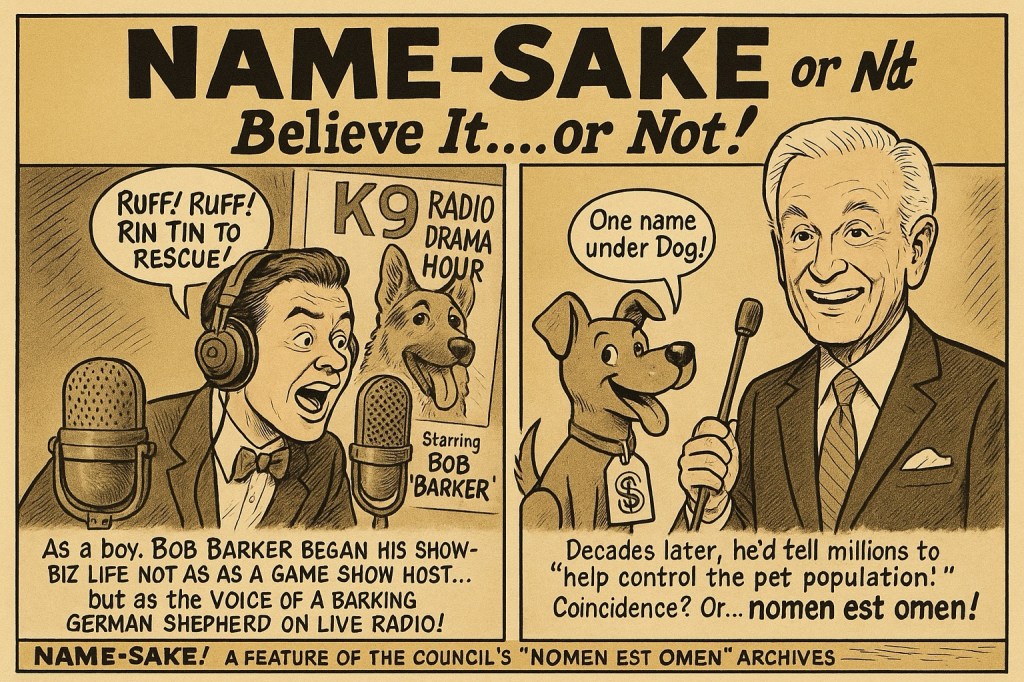
This panel tells you all you need to know about Bob Barker.
Let me confess something at the outset:
My literary career began not with Melville, but with Classics Illustrated.
Before I had the stamina for Dickens, I had the gallop of Dumas in 48 pages of ink and color. I wasn’t cheating my reading level—I was living up to it. The great books were there, just compressed, distilled into visual myth. You could cover more imaginative terrain in an afternoon with Classics Illustrated than in a week with a slogging term paper on the same.
And yes, I went on to read some of those 600-page monsters too. But I never forgot the panel’s promise: that story could be seen and still retain its power. That thought could be bubbled, and still ring true.
So when Burroughs predicted the end of the novel and the rise of the illustrated page, I took it less as warning and more as prophecy fulfilled.
We’ve always found Burroughs a bit creepy at the Council—unclean in spirit, and too fond of his own shadows. But we can’t deny it: the man had a drawl that stuck in the ear like a recurring dream, and once in a while, he caught the future in a single murmur. This was one of those times.
***
Long before they were graphic novels, they were just the funny pages.
Tucked in the Sunday paper, half-buried under coupons and Calvin, they formed a nation’s informal Book of Revelation. Here was serialized absurdity. 4-panel theology. America’s true apprenticeship in irony, pathos, and timing.
But beneath the gag—the thought bubble.
What is that puff of interiority if not the visual soul?
The essence of consciousness, captured mid-sentence, mid-doubt.
Not what is said—but what is nearly said.
A philosophical device disguised as a cloud.
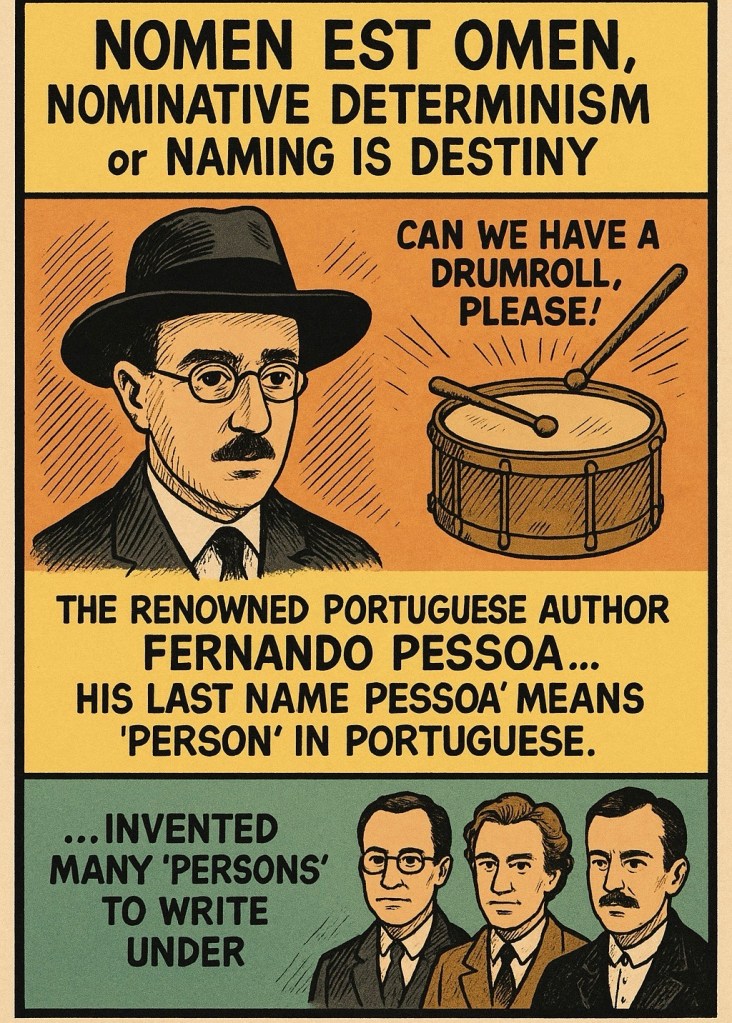
Each ‘Pessoa’ wrote with a different mind, a different soul.
When your name means person, why stop at one
[Editorial Insert: A Note from the Electric Chapel of Marshall McLuhan]
The comic panel, said McLuhan (or would have), is not a regression—it’s an evolution.
A cool medium, it invites participation. Its gutter—that empty space between frames—is not absence but interface. The panel doesn’t narrate—it resonates. The thought bubble is Joyce electrified. The strip is the return of the tribe via mimeograph.
The novel privatized the soul.
The panel performs it.
It’s why I endorsed the Council’s “NAME-SAKE!” series. Not just for its humor, but because it marks a return to semiotic awareness—to that ancient truth that names mean things, and those meanings ripple through fate.
Bob Barker, who barked on the radio as a boy and later told America to spay its pets. Fernando Pessoa, whose very name meant “person,” and so he split into several. Richard Parkers , fated to be eaten at sea.
These aren’t just freak coincidences. They are illustrated truths, drawn with a wink but framed like scripture.
And the medium matters. The panel format is not a limitation—it’s a vessel. It speaks to the age we’re in. Fragmented, fast, but still hungry for coherence. Hungry for fate.
So yes, the novel may be limping. But don’t mistake the cartoon for a crutch. It’s a crystal—condensing narrative into symbol. Offering us epiphany without apology.
The funny pages were never just funny.
They were initiation.
We now live in their aftermath, in the fourth panel that never ends.
Let the thought bubble rise.
Let the names fulfill themselves.
Let the Council keep drawing the lines between meaning and meaninglessness, frame by frame.

Poe may have invented the first—
but reality followed the script.
Since 1838, the name Richard Parker has carried a strange, sinking fate.
We may be the last organization on Earth that believes cartoons can carry metaphysical weight.
And we’re not kidding.
—Filed by John St. Evola, Editor
 COUNCIL-OF CONCERNED-CONSERVATIONISTS…..Between Jest And Earnest…..
Leave a comment