By Jánosh Alovatski, All-Spiritualities Correspondent.
“Ah, well, I am a great and sublime fool. But then I am God’s fool, and all His works must be contemplated with respect.”
—Mark Twain
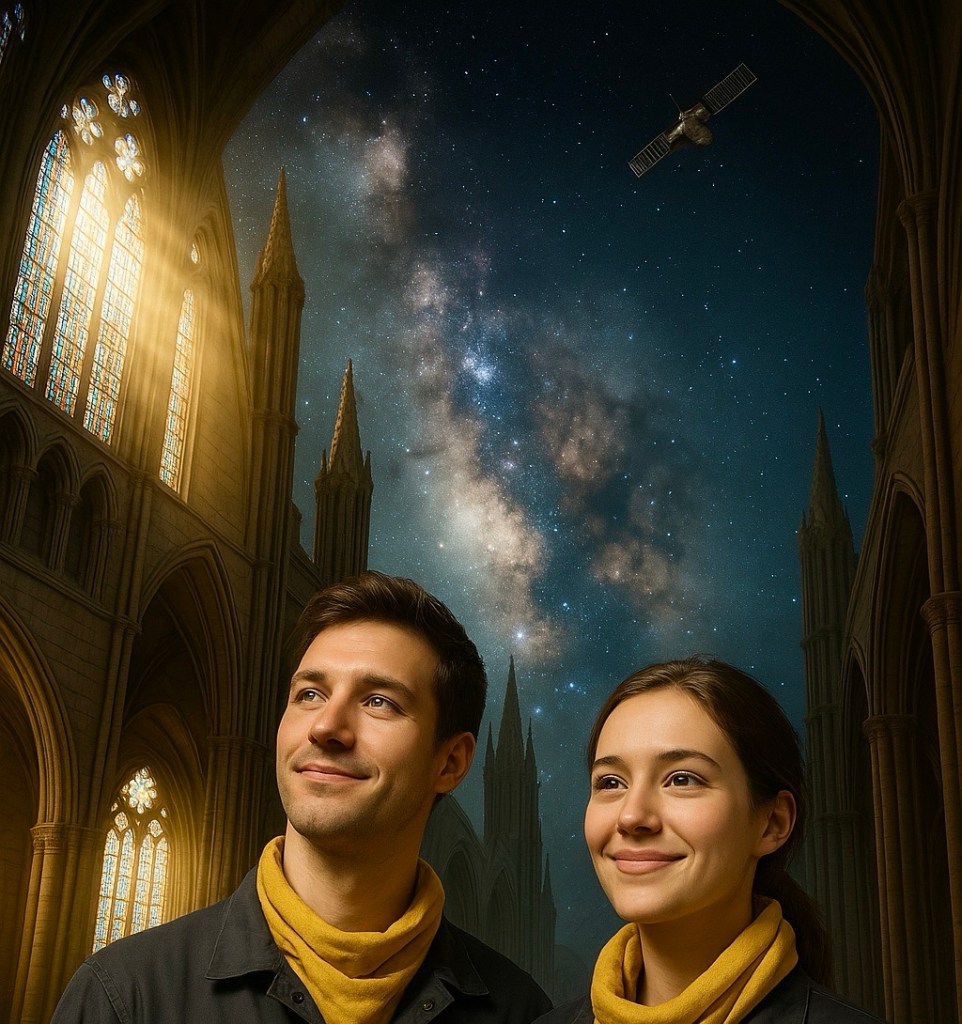
I suspect Twain would have made a fine member of the Council. He understood that holiness is not neat. It’s ragged, awkward, sublimely foolish. Saints often look like madmen, and madmen often pass for saints—both stumble forward through history carrying contradictory relics: rosaries in one pocket, pagan talismans in the other.
Teilhard de Chardin—the Jesuit paleontologist with fossil dust in his hair—saw this contradiction not as blasphemy, but as destiny. For Teilhard, Christ was the Cosmic Axis, drawing every shard of matter, every ancient myth, every fossil and photon toward the Omega Point—the final coalescence where evolution and divinity meet. Paganism, with its reverence for nature and elemental forces, was not erased by Christianity but transfigured within it, like iron filings drawn into a magnetic field. The old gods of grove and stone bowed, not in defeat, but in fulfillment.
GOTHIC LIGHT: PAGAN TEMPLES IN CHRISTIAN CLOTHES
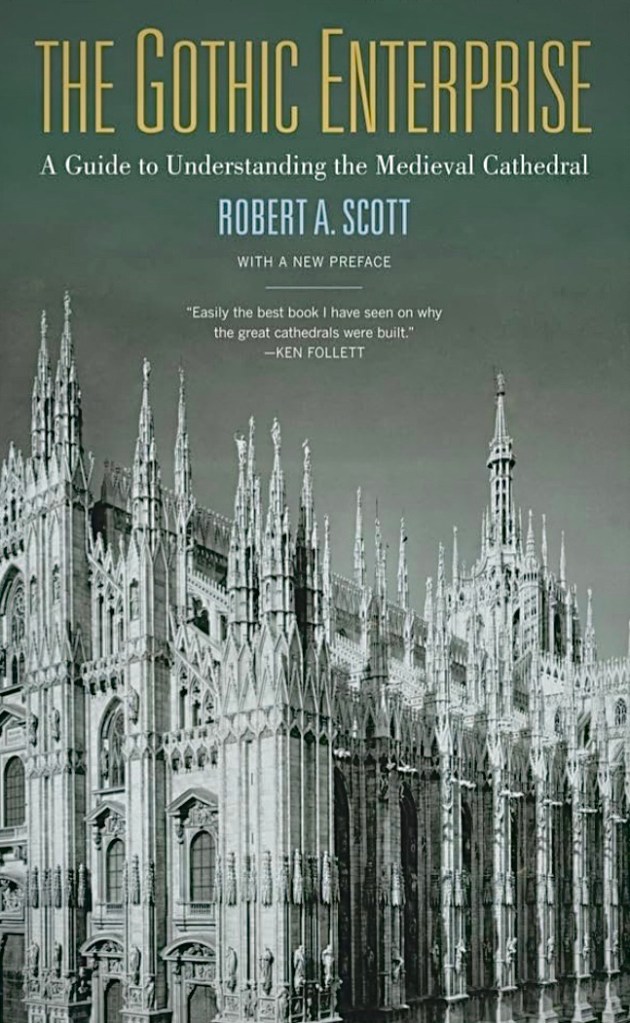
Robert Scott, writing on the Gothic cathedrals, reminds us that those soaring spires were not purely Christian inventions. They were pagan temples in Christian vestments—green men and gargoyles lurking at the edges, carvings of fertility and harvest smuggled beneath the archangels’ wings.
“And the quality that unleashed their intrinsic potential, the thing that enabled a stone or piece of wood to serve as a vehicle for experiencing God, was… LIGHT.”
—The Gothic Enterprise, Robert A. Scott
The medieval mind believed all visible objects contained the potential to reveal the divine. John Scotus Erigena put it plainly: we understand a stone or piece of wood only when we perceive God in it. What made that revelation possible was light—the same light the pagans once worshipped, now refracted through stained glass to bathe worshippers in rose and sapphire.
Light wasn’t mere illumination. It was transformation. Matter became porous to spirit. The cathedral was a pagan grove with better acoustics; the grove was a cathedral without scaffolding. Both reached upward. Both yearned for radiance.
FROM STAINED GLASS TO STELLAR GLASS: THE NEW SPIRES
Teilhard saw this yearning extend beyond medieval Europe. He read the Gothic cathedral as prophecy: spires were never meant to stop at clouds. The Omega Point, in his vision, is a new kind of Gothic spire—a spiritual architecture not of stone but of consciousness, rising beyond Earth into the noosphere, the planet’s thinking layer.
If the medieval builders transformed stone and wood into vehicles of light, Teilhard asks: can humanity now transform circuits, code, and stardust into the same? Could the next “cathedral” be a space station, an orbital monastery, or the web itself—a vault of servers and satellites where prayer and data coalesce?
Our ancestors raised Chartres; we raise antennas. The difference is scale, not substance. Both are aspirations in matter, yearning for transcendence. Both rely on what medieval theologians and Teilhard alike recognized: the divine hides in the ordinary, waiting for light to reveal it.
GOD’S FOOL, STILL
We modern fools—cosmic, sublime, or otherwise—may laugh at gargoyles and relics, yet the synthesis persists. Our cathedrals are particle accelerators; our relics are Voyager’s golden records; our spires are rockets tipped with communion wafers of silicon. We are still, as Twain put it, God’s fools—contemplating His works with awe, reverence, and the occasional smirk.
Pagan sun-worshippers and Christian mystics alike knew this much: the world is luminous if you know how to look. Teilhard merely widened the lens, stretching the Gothic arch beyond clouds, toward the Omega horizon.
And maybe, in the end, being a fool of light is the only sane response to a universe that insists on becoming holy.
Filed under: Alt-Spirituality, Metaphysical Field Reports, Omega Architecture
Cross-reference: Cosmic Christogenesis, Pagan-Christian Continuities, Cathedral as Cosmic Antenna
 COUNCIL-OF CONCERNED-CONSERVATIONISTS…..Between Jest And Earnest…..
Leave a comment