By Mrs. Begonia Contretemp, European Correspondent and NVZ Spokesperson.
I. Prologue: A Civilization of Groans
Permit me, dear Council members, to open with a lament disguised as observation: we live in an age where a pun can spark either conversion or cancellation, salvation or scandal. Once, puns were whispered in cloisters to unlock the divine; now, they are shouted in food courts to sell denim. And always, always, there is groaning.
The pun is the lowest form of humor precisely because it is the most democratic: no barrier to entry, no taste required, merely the accident of sound. How terrifying, then, that so much of civilization has been steered by this accident. (And how reassuring: the barbarians, too, loved a good homophone.)
II. Puns That Shaped the Sacred
1. Greek Philosophy → Christian Logos
In Greece, logos meant “word” or “reason,” the rational principle behind the cosmos. Enter the Christians, who with typical audacity claimed the same term for Christ: the Logos made flesh. A pun, yes—a holy capital letter that transformed philosophy into theology.
2. Buddhism in China → Nirvāṇa as “No Wind”
Sanskrit nirvāṇa (extinguishing, blowing out) arrived in China via transliteration. The phonetics resembled “no wind”—a metaphor of exquisite stillness, ideal for Zen. Thus, enlightenment was sold not as fire extinguished but as airless calm. (Do not underestimate the marketing power of meteorology.)
3. Compostela → Compost
The name Santiago de Compostela derives from campus stellae—“field of the star”—likely referencing the Milky Way guiding pilgrims to Saint James’s shrine. And yet, in medieval Europe, the resonance with “compost” (humble earth, decomposed matter) was irresistible. Pilgrims whispered that holy relics “fertilized” the ground. Compost, compostela: sanctity and soil entwined.
(What is sainthood if not a higher form of decomposition?)
4. John Donne’s Homiletic Acrobatics
Donne’s brilliance lay in stacked homophones:
“Son” (Jesus) and “Sun” (light) — Christ as the rising sun of salvation. “Done” (completed) and “Donne” (himself) — the poet confesses that even when God’s work is done, Donne himself is not.
In his famous line:
“When Thou hast done, Thou hast not Donne, for I have more.”
He simultaneously laments his unworthiness and immortalizes himself in the pun—binding confession and ego in a single groan-worthy flourish.
III. The Son That Rose Twice
Missionaries converting European pagans performed a sleight of tongue: You worship the Sun? We worship the Son. One vowel away, and Apollo becomes Christ. The solstice becomes Christmas. The halo becomes the crown of thorns. The pun becomes the bridge. (Conversion by coincidence—how very medieval.)
IV. Pun & Sword: Political Wordplay
History, for better or worse, is thick with puns wielded like weapons:
Henry VIII’s “Annul/Anne” The king’s quest to annul his marriage to Anne Boleyn—while sparking a schism—was whispered about in taverns as divine wordplay. “God annulled Anne,” they said; thus the jest became prophecy.
“Deus vult” → “Vault” Crusaders cried Deus vult (“God wills it”)—yet folklore jokes emerged that soldiers heard vault, mistaking holy will for holy treasure, storming both cities and coffers in equal zeal.
“Madame la Guillotine” A Revolutionary nickname that puns on guile (cunning) and ton (fashionable tone)—a chic blade adored by pamphleteers and feared by necks. The guillotine was brutal, yes, but she had style.
V. Fast‑Forward to Fast Fashion: The Great Jeans Crisis
And now, the modern epoch. American Eagle launches an ad: Sydney Sweeney in blue denim, tagline “Great Jeans.” The pun—genes/jeans—is so obvious it barely deserves mention.
Most telling is the campaign’s own typography: “genes” literally crossed out and replaced with “jeans.” It is capitalism’s catechism in miniature — the erasure of inheritance, the denial of givenness. You are not bound by the accidents of birth, dear consumer; you are merely one purchase away from reinvention. An Army slogan older readers may recall — “Be all you can be” — is here repurposed: be all you can be, if only you buy. As though a new pair of pants could rewrite the double helix, scrub the ancestral ledger clean, and grant the absolution no church dares promise. In denim we trust; cash, not grace, is the sacrament.
Within hours:
Think‑pieces sprout like fungi on damp discourse. Accusations of eugenics trend before lunch. The former president endorses the pants.
(In Europe we call this Tuesday.)
But the outrage itself reveals the power white supremacy still wields—even in its absence. A mere whisper of “genes” summons the ghost. We live in a culture primed to hear racial hierarchies in every homophone, to scan every billboard for coded supremacy. The pun did not invent these anxieties; it merely exposed them, like denim snagging on a nail long buried in the cultural floorboards.
That denim, dear reader, traces back to the port of Dongri, where a coarse cotton cloth — dūngrī — clothed dockworkers and the unwashed. Europe, in its genius for alchemy, elevated this humble fabric into ‘dungarees,’ then into high fashion, and now, inevitably, into culture‑war artillery. Such is civilization: compost to compostela, dung to dungaree.
**************
VI. Conservationism, Conversion, and the Groan That Saves
Here lies the paradox: the same pun that once converted pagans now starts culture wars over pants. Puns are mnemonic barnacles—they cling to meaning, accrue outrage, and refuse to die. For conservationists, this is both gift and curse:
Beleaf in forests. (Faith in foliage.)
Save the knotty pines. (Because ecological crises are never simple, and neither are pines: their wood is literally full of knots—gnarled, resistant, beautiful. Saving them means saving complexity itself.)
Make Earth grate again. (An appeal to humility: the planet grates against us like a rough surface on skin, reminding us that living here was never meant to be smooth.)
Closing Callback: The Pun That Might Save Europe
If puns can topple kings, convert civilizations, and ignite denim‑fueled panic, perhaps—just perhaps—they can also save Europe.
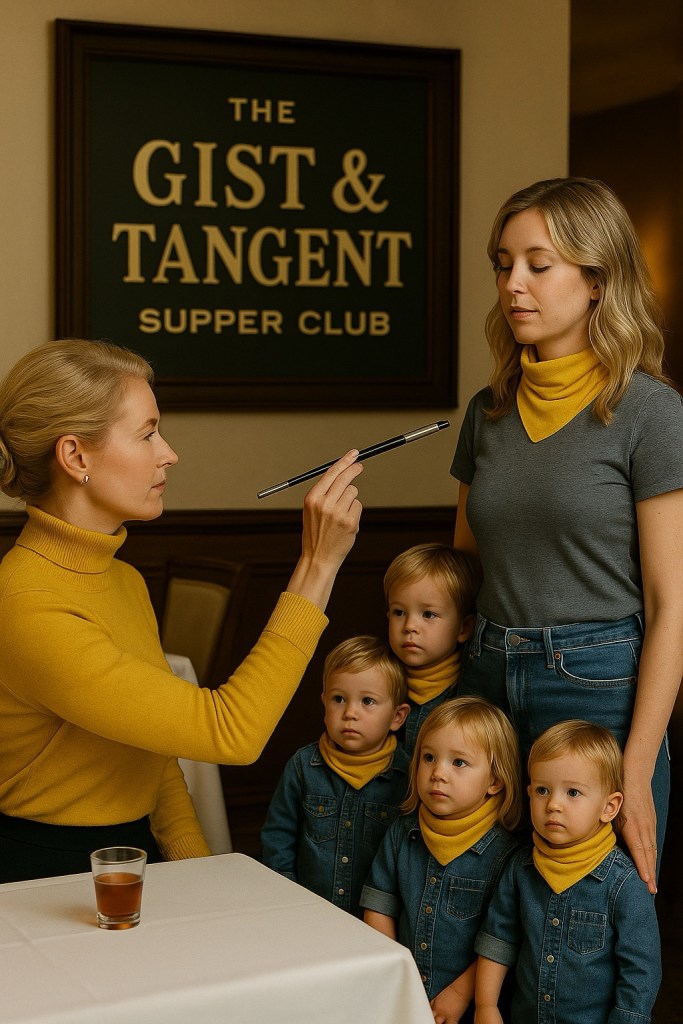
I propose this modest slogan, to be stitched onto every yellow neck gaiter from Lisbon to Lviv:
“Re‑Member Europe: Piece Together Our Peace.”
A pun on member (limb, nation, person) and piece/peace—an appeal to wholeness through fragments. Sardonic? Naturally. Sentimental? Unavoidably. Effective? Only if we dare to groan together.
(Motion: tabled, pending embroidery samples.)
 COUNCIL-OF CONCERNED-CONSERVATIONISTS…..Between Jest And Earnest…..
Leave a comment