More Real Than Realism.
A Dispatch from Mrs. Begonia Contretemp.
“If only the young were pagans…” — G.K. Chesterton
“There is a tide in the blood…” — Lord Dunsany
“Eggs were simply eggs…” — Alas.
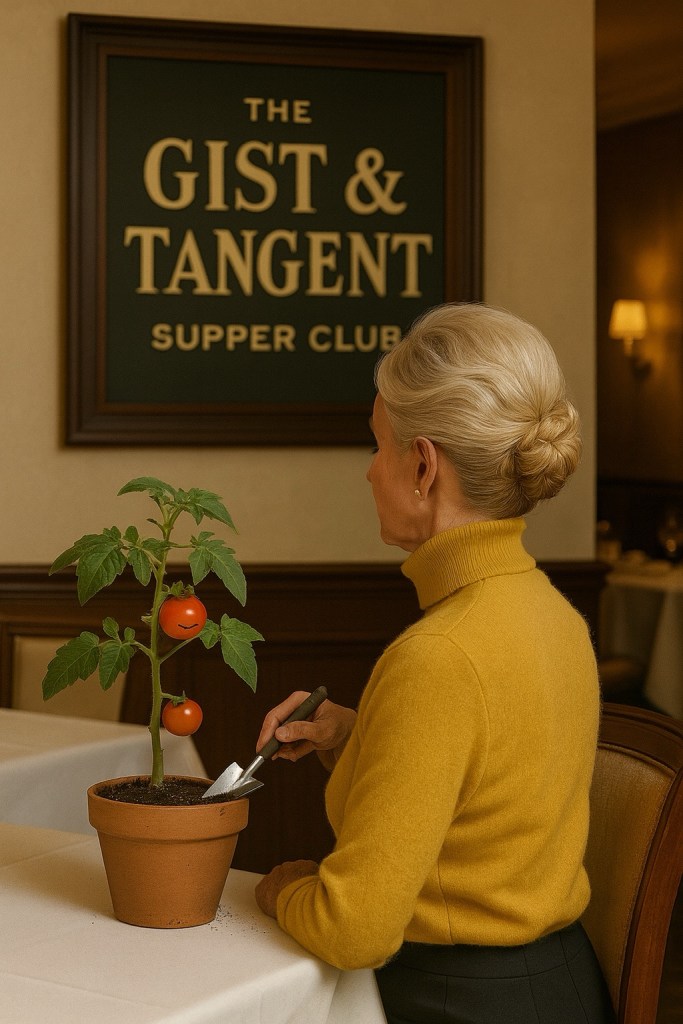
Goethe proposed that all plant life unfolds from a single archetypal form—not merely evolving, but expressing an invisible idea. Mrs. Begonia suspects it still lives in the vine, if you know how to listen.
A Note from the Autopsy Table
My sincere thanks to C-of-C-C member Suzy Generis of Mystic, Connecticut—a name which alone should qualify one for spiritual ambassadorship—for sending in this morning’s Quotes-of-the-Day. Ms. Generis shares our concern regarding the great disenchantment that haunts this era like a sanitized ghost: odorless, noiseless, and entirely without mythic relevance.
Her submission reminded me, with a pang of curatorial despair, of an excellent and exasperating article from Intellectual Takeout (2018) titled “Why Chesterton Appreciated Paganism.” The piece offers a sobering reminder: Chesterton did not fear modernity for its lack of belief in gods per se, but rather for the extinction of the supernatural halo that once hovered—reverently—over all created things.
And what an extinction it has been. A cultural mass die-off of meanings.
Paganism, Properly Understood
As the article wisely paraphrases, to the true pagan “wine was always more than wine; it was a god. Corn was always more than corn; it was a goddess.” That is: the material world was not merely symbolic, it was sacramentally saturated. There was a mode of realism that exceeded itself—a metaphysical luxuriance that modern “realism” cannot even begin to touch.
Chesterton’s lament, then, was not that the young were engaging in sensual rebellion or neopagan cosplay. No. His despair was more refined: they were the first generation not to be pagan at all. They had accepted the odious flattening of reality. They had come to believe, under some ghastly spell of fluorescence and empiricism, that eggs are just eggs.
I find this not merely regrettable. I find it uncivilized.
There Are Worlds Beneath Seeds
Permit me a moment of personal wonder: I have never understood how anyone—especially in possession of a functioning kitchen or garden—could become a materialist. To hold in one’s palm a tomato seed, a speck no larger than punctuation, and to witness what erupts from it—a climbing, fruit-bearing organism with geometry, fragrance, ambition—is to behold a miracle that mocks every glib reduction. Where, pray tell, does the tomato come from? From the seed? Yes—but what is behind the seed? Another world? Another logic?
And is it not the same with us? A single sperm cell—an unremarkable swimmer among millions—crosses a threshold and the result is a violinist, a welder, a lonely child with a love of birds. Something is coming through. We are not manufacturing these forms—we are receiving them.
Any worldview that does not tremble before this process is not sophisticated. It is simply blind.
As Goethe himself remarked, “In the seed lies the future plant in miniature, but more than that—it is the idea of the plant.” Not merely matter, but its metaphysical blueprint, poised on the edge of manifestation. Goethe understood—long before we began flattering ourselves with predictive algorithms—that form was not an accident of matter, but its destined elaboration. What unfurls from a seed is not just a tomato, but an archetype made edible.
And Christ, too, pointed toward this metaphysical disproportion when he told his disciples, “The kingdom of heaven is like a mustard seed… the smallest of all seeds, yet it becomes a tree in which the birds of the air make their nests.” A mustard seed! Not a doctrine, not a treatise—a speck. And yet from it, a kingdom. Shelter. Song. Sunday and Wednesday dinner.
We are not clever clumps of evolved protein—we are mysteries in miniature, trembling footnotes in the metaphysical botany of creation. That we can ignore this—mock it, even—is not a sign of intellectual maturity. It is a mark of spiritual degeneracy, politely dressed in lab coats.

Dunsany’s Driftwood and the Diluted Blood
To counter this grim reduction, I return—as one must—to the twilight-drenched prose of Lord Dunsany, who once wrote:
“Yet in the blood of man there is a tide, an old sea-current, rather, that is somehow akin to the twilight, which brings him rumours of beauty from however far away, as driftwood is found at sea from islands not yet discovered…”
Here, then, is the antidote to the condition Chesterton diagnosed: This is not a call for aesthetic paganism, nor for earnest pantheism. It is a call to reawaken what Chesterton named (and I now borrow, with attribution) the “projected halo of the supernatural”—that ancient iridescence which once shimmered over wine and wheat, shadow and swan.
That deep tide, that old current in the blood, was once capable of carrying myth across the generations like luminous detritus from a divine shipwreck. But now?
Now the blood runs thin with podcast summaries and powdered greens.
We are a civilization that has forgotten the music in its marrow. One that no longer listens for ancient song, but instead demands that everything be streamable, quantifiable, and aggressively literal. Even the sacred must be “on brand.”
A Word to the Youth, If They Still Read Words
It is a call to refuse the doctrine of dullness.
To the youth who reject myth because it is not “factual,” I say: Your world is already smaller than you realize. You have mistaken disenchantment for sophistication. You have replaced the divine with diagrams. You have surrendered mystery at the altar of measurability.
And you’ve done all this without even knowing what you’ve lost.
In Closing: A Council Creed
At the Council, we preserve. Not only foods, forests, and folkways—but frequencies. We are stewards of the old enchantments, the minor gods, the sacred hum in ordinary things. And we suspect (privately, of course) that the real heresy of the modern world is not atheism. It is realism, unadorned.
Let me toast, then, in honor of Ms. Generis and in memory of Chesterton’s halo:
May your eggs whisper prophecy.
May your wine remember its god.
And may your driftwood come from islands yet unnamed.
Yours in the sacrament of subtlety,
Cultural Autopsy Correspondent, NVZ Liaison, and Semiotic Preservationist
Council-of-Concerned-Conservationists
 COUNCIL-OF CONCERNED-CONSERVATIONISTS…..Between Jest And Earnest…..
Leave a comment