The Chair Was Just the Beginning: Notes on the Crackering of the Barrel.
“Civilizations rise from stools and fall from ottomans.”
— A Council maxim, misattributed to John St. Evola
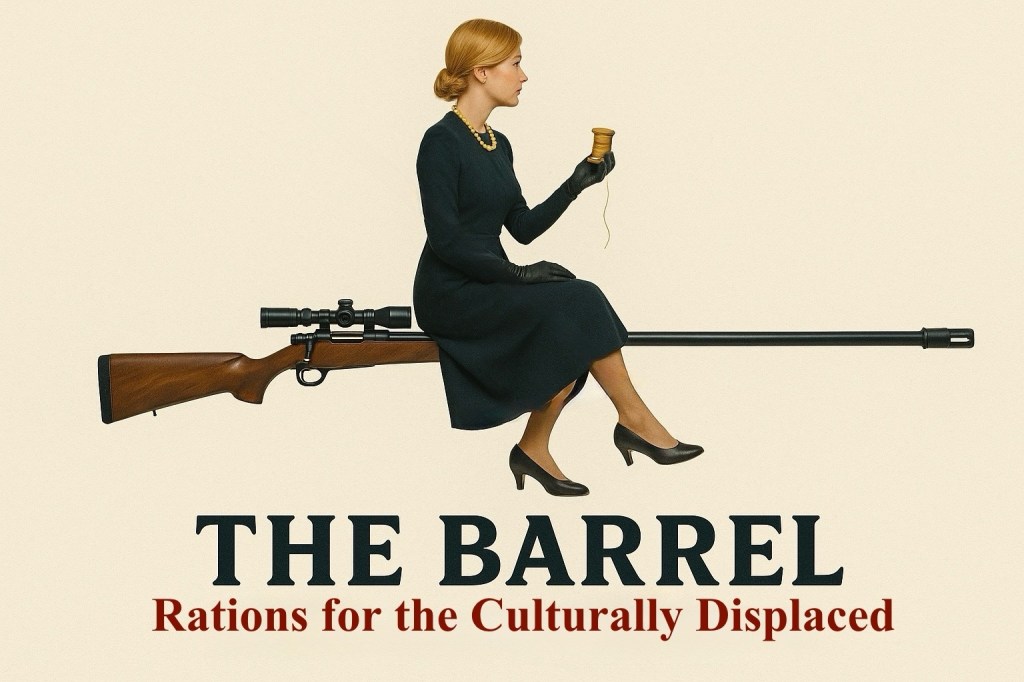
Mrs. Begonia didn’t redesign the logo. She reloaded it.
Ancestral elegance meets precision at the twilight of taste.
From Post-Sitting to Post-Logo
When John St. Evola published his watershed piece “Civilization After the Chair: Toward a Theory of Post-Sitting”, many in the Council thought he had gone too far— off his rocker as some may say. Many whispered he had finally stood up and walked out of sanity. But now—thanks to Cracker Barrel’s chair-ectomy—we see he was only getting comfortable.
The Council has long argued that the humble chair is not a furnishing but a worldview.
To sit is to belong. To rock is to remember.
So when Cracker Barrel quietly deleted the rocking chair—and the old man seated in it—from its logo this summer, we knew: the metaphysical barrel has cracked.
A Short History of the Crackering
For 54 years, Cracker Barrel reassured us that America still knew how to sit down properly: on a porch, in public, with pancakes.
Their logo?
A man in a rocking chair beside a literal barrel—a visual thesis on rural timekeeping, domestic settlement, and the digestive demands of biscuits and gravy.
Now?
The man is gone.
The chair is gone.
(But the barrel has been—oiled.)
In their place: a minimalist golden wordmark, presumably designed by a suburban AI that once binge-watched Fixer Upper and thinks “Cracker Barrel” is a lifestyle brand for stylized pantry goods.
Some called the backlash political.
We called it eschatological.
The Council Saw It Coming
We knew the post-sitting era was upon us when John first posed this forbidden thought:
“What if the future chair is not meant to be sat in, but merely recognized, like a flag or a former friend?”
This was no metaphor. He meant it. The avant-garde chair has become a sculpture. The ergonomic chair has become a surveillance device. And the rocking chair? Erased—its kinetic memories sent to the digital scrapyard of deprecated Americana.
So when Cracker Barrel—America’s last publicly traded front porch—removed its chair, it didn’t merely redesign a logo.
It signaled the dawn of Post-Sitting, Phase II: The De-Chairification of Public Life.
Chairs We’ve Known, Chairs We’ve Feared
Throughout history, the chair has not simply cradled the body—it has positioned the soul.
The Bauhaus chair was a statement: function over form, simplicity over ceremony. You could sit in it. But only if you were geometrically pure.
The Louis XIV throne was a declaration: behold the state! Sit not—kneel.
The IKEA chair is a semiotic riddle: part affordable utopia, part marital endurance test. Assembly may result in philosophical collapse.
The Gaming Chair is cybernetic armor for digital warlords, upholstered in vinyl and hubris.
The Airport Chair is Purgatory in brushed steel.
The Midcentury Modern Chair has not held a real human since 1973. It exists solely to be featured in Dwell magazine beneath the headline: “Where Design Meets Grief.”
Each chair carries a message.
The Cracker Barrel rocking chair said: “You made it through. Here’s a biscuit. Sit down.”
And for that, it had to go.
Plug-In Thrones for the Decline
It’s worth noting—and we say this with all due respect to our elders and our outlets—that chairs have begun to draw power.
Not metaphysical power. Actual wattage.
Chairs now come with USB ports, HDMI slots, Bluetooth recline functions, heating pads, massage nodes, and even 120-volt AC outlets, in case your soul requires a microwave burrito mid-repose. Some now feature “wellness syncing” with your smartwatch to monitor heart rate, blood oxygen, and the exact second you stop pretending to read.
These are not chairs.
They are pre-coffin command centers.
A chair that must be plugged in is not a chair.
It is a sedentary exosuit for decline.
We used to build chairs to escape labor.
Now we build them to simulate life.
The Chair as Civilizational Metric
We say this without irony (except the sacred kind): we knew the chair would become controversial.
Why? Because the chair is not neutral.
The chair is a benchmark of civilizational timing.
In the early periods of culture-making, there is no chair.
There is movement. There is labor. There is dance, migration, firewood, flint.
You do not build a throne until you have built a world.
But once the world is built—and begins to slip—the chair emerges.
It becomes a station of pause, then repose, then lethargy, then ornament. Eventually: icon. Then: USB hub.
The elderly, with whom we share blood and biscuits, know the truth.
They have become chair-sensitive.
The seat matters, the cushion matters, the incline and the ottoman matter—because the body has become furniture.
It rests, not from the day’s work, but from being.
And yet—
To remove a chair from your logo at this stage of the game is not modern branding.
It’s a quiet civilizational scream.
The rocking chair, once a signal of rhythm and return, now reads—apparently—as nostalgic baggage.
Uncle Herschel has become a risk factor.
And so we sit upon our own anxieties, unchaired, unmoored, and rebranded into the abyss.
Notes from the Absurd Barrel
The man in the chair (known internally as Uncle Herschel) is now a ghost in the machine. We expect a future HBO limited series about him called “The Last Sit” starring Jeff Bridges. Rumors that the new Cracker Barrel app will feature “Augmented Reality Rocking Chairs” are unconfirmed but likely. In 2026, we anticipate a follow-up brand shift: Waffle House will remove the booth and replace it with an NFT of a synthetic syrup swirl. The Council has issued a preemptive advisory to La-Z-Boy: do not test us.
Philosophical Aftertaste
This isn’t about a logo.
It’s about a cosmic realignment—the replacement of rooted symbols with disembodied fonts.
The porch, once a spiritual threshold, is now a UX (user experience) suggestion.
The chair, once our metaphysical exoskeleton, is now an emoji or a deprecated glyph.
Cracker Barrel used to sell the illusion of rest and refreshment. 
Now it sells rebranding.
Which is to say: they’ve gone barrel-deep into postmodern fatigue.
But the Council will not yield.
We continue to sit.
We continue to rock.
We continue to eat our fried okra in the presence of actual furniture.

The country store was never real, but the biscuit was. That’s why she turned her back.
 COUNCIL-OF CONCERNED-CONSERVATIONISTS…..Between Jest And Earnest…..
Leave a comment