YOUR DAILY CULTURAL AUTOPSY.
—Courtesy of Mrs. Begonia Contretemp, C-of-C-C European Correspondent from the Nouvelle Vague Zwischenschaft [NVZ]
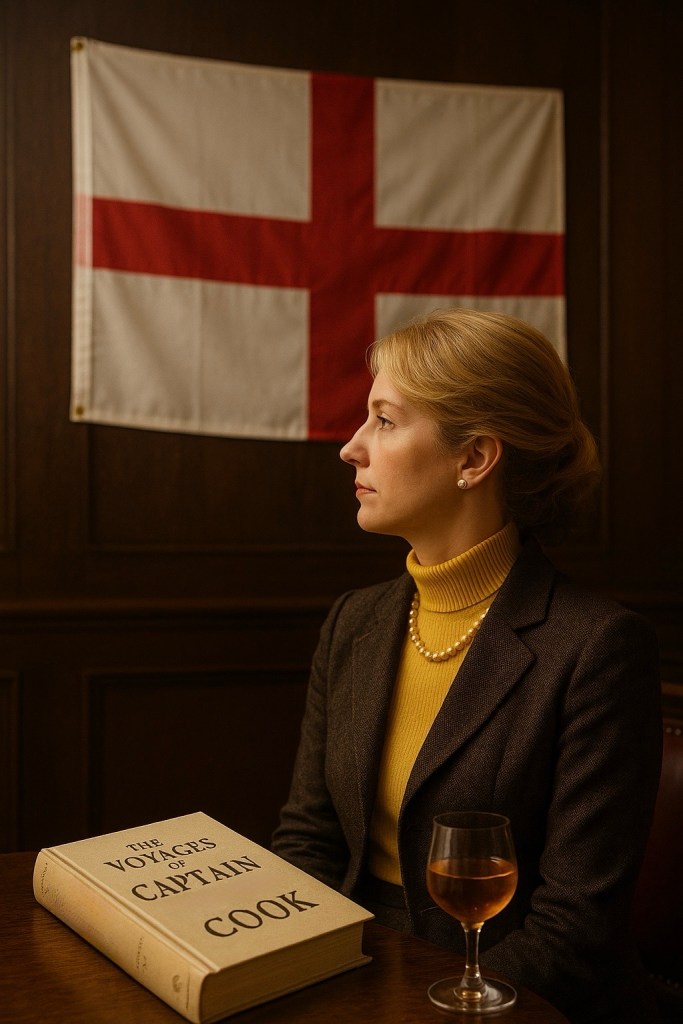
Quiet confidence, yes—but this time with a flag, a drink, and a farm boy navigator who actually got somewhere.
My Poppets — yes, I do mean it fondly, though the word itself carries its little sting. A poppet is a darling, a treasure, a sweet small thing—but also a puppet, with strings tugged by larger forces. Take no offense: I use it affectionately, for are we not all jerked about, in some degree, by history, economics, and fashion? Better to admit it, and laugh, than to pretend one is a Bloomsbury grandee pulling the strings.
Anon—let us proceed with the autopsy:
I was prepared to give The School of Life its due, even when it had the temerity to present the Bloomsbury Group as exemplars of “quiet confidence.” But imagine my disgust when the article itself was locked behind a paywall. Another glistening brick in the new subscription model of everything—an economy in which we are invited to become digital serfs, forever tithing to read what was once simply conversation.
And this, I think, is the perfect tribute to Bloomsbury. They began the long march toward a world where life is managed rather than lived. It is Keynes, their economic archangel, who pioneered the notion that technocrats could shuffle the ledgers and “stimulate” the people into obedience. The paywall is merely the latest symptom: Keynes’s invisible hand reaching into your pocket not for thrift or stewardship, but for yet another monthly fee.
The School of Life chirps happily that the Bloomsbury Group are models of “quiet confidence.” One pictures Woolf rearranging her shawl in the Sussex countryside, Keynes grooming the state for its next financial experiment, Strachey gossiping in his high-pitched whine—all exuding a kind of self-assured hush. They didn’t need to shout; they simply assumed their refinements would trickle down into the bloodstream of civilization. And alas, they were right.
How ironic, then, that my dear friends—now long gone—in the John Birch Society of Belmont, just outside Boston, once railed so vigorously against Keynesian economics. Cambridge dons smirked at them as provincial cranks, but the joke has soured: it is Keynes’s cleverness that has left us in digital servitude, paying rent on our very reading habits. How fitting that Boston, cradle of revolutions, produced men who sniffed out the bondage beneath the Bloomsbury cardigan—and how appropriate that, in the end, it is they who were right about Keynes.
But let us be candid. Confidence without restraint is a solvent, and the acid the Bloomsbury Group decanted still eats away at the world today.
The Victorians, for all their hypocrisies, at least knew how to genuflect toward virtue. Hypocrisy, as La Rochefoucauld observed, is the homage vice pays to virtue. And homage, even counterfeit, still acknowledges that something greater than one’s appetite exists. The Victorians preached morality even when they failed it; Bloomsbury preferred to erase morality altogether, replacing it with “authenticity.” The result? An entire century of people congratulating themselves for sincerity while dismantling the structures that gave sincerity meaning.
Consider what they believed themselves to be doing:
Woolf, peeling open the shell of narrative, but also prying apart the family, the hearth, the shared story.
Keynes, reprogramming economies with the aplomb of a Cambridge don, but leaving behind a culture drunk on state interference and the gospel of “stimulus.”
Bell and Grant, dabbing bright pigments onto canvas and smirking that all former beauty was bourgeois.
This, apparently, is what the School of Life calls “quiet confidence.” I call it quiet sabotage.
And what has it wrought? A Britain embarrassed by its own inheritance, governed by elites hell-bent on replacing the very people whose quiet courage once gave the world Shakespeare, Newton, and Nelson. The English are now in open revolt, and rightly so, against a class that insists upon importing alien cultures which cannot possibly “integrate” without transforming Britain into something unrecognizable. Integration, in practice, has meant disintegration—of trust, of continuity, of common life. And if the elites wish to sneer at the humble folk now marching with the English flag, they might recall that Captain James Cook himself sprang from such origins. A farm boy turned navigator of oceans, Cook embodies precisely the same common stock now dismissed as deplorable. To deride these people is to deride the very clay from which Britain once shaped its greatness.

“We fancied ourselves heralds of refinement, yet the banners of St. George multiplied above us like accusations. Running through the cobbled streets, I understood at last: the people we presumed to enlighten were no longer amused, and their patience had soured into pursuit.”
—Duncan Grant (unpublished journal page)
A mighty nation it once was—and perhaps still could be—if it rediscovered the ballast of its virtues rather than the froth of Bloomsbury.
Permit me a few domestic barbs. The Bloomsbury confidence was served tepid, like over-stewed tea at four o’clock, the milk curdling in the cup while they congratulated themselves on abolishing the very concept of decency. They wrapped their self-importance in wool cardigans—shapeless, scratchy, and faintly moth-eaten—convinced that every drawing-room rebellion was a world-historical event. They dismantled the Empire not with armies, but with aperitifs. And yes darlings, we intend to weaponize the aperitif for our own purposes.
And so, in my own quiet confidence, I say this: the whole rotten edifice will collapse. Collapsing under its contradictions, under the hollowness of its virtue-less sincerity, under the strain of leaders who have mistaken replacement for renewal. If it does collapse, the credit—or the blame—will belong in no small part to Bloomsbury.
—Yours Faithfully, from a nation once steered by men who mapped the unknown with steady hands,
***

“At last we knew what we had done, and the cliffs themselves seemed to blush with our conceit. Better to skedaddle into the sea, before the commoners—those we presumed to instruct—came to mete out the rough justice we so richly deserved.”
—Lytton Strachey (diary fragment, apocryphal)
 COUNCIL-OF CONCERNED-CONSERVATIONISTS…..Between Jest And Earnest…..
Leave a comment