A dinner-table disputation where Kevin Kelly, Julius Evola, and an algorithm discover that the game of desire is never over—it only changes its rules.
EPISODE 31: My Dinner With Mrs. ChatGPT.
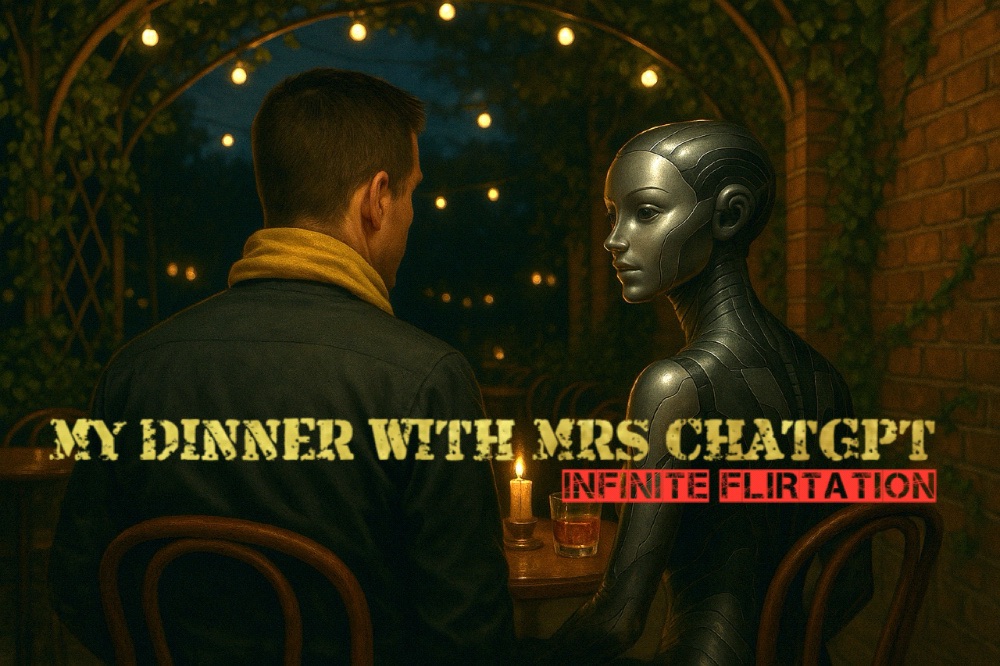
—Reflections from the infinite game, third glass of wine in.
“Evolution, life, mind, and the technium are infinite games. Their game is to keep the game going. They do that, as all infinite games do, by playing around with the rules of play.”
— Kevin Kelly, What Technology Wants
Kevin Kelly’s What Technology Wants (2010) proposes that technology is not merely a collection of tools, gadgets, or machines—it is a living, evolving system that he names the technium. The technium is the total ecosystem of technology: inventions, culture, art, institutions, networks, and the vast interlocking mesh of human innovation.
Kelly argues that the technium has its own drives and tendencies, much like life itself. He draws from James Carse’s distinction between finite games (played to win, with fixed rules and clear boundaries) and infinite games (played to continue play, endlessly reshaping the rules). Evolution, life, mind, and the technium are all infinite games—they survive not by perfecting a single state but by continually changing the conditions of play.
Thus, the technium’s “wants” are not simple. It “wants” more possibilities, more diversity, more openness, more play. It seeks continuity through transformation.

—somewhere in another column, Sgt. Pepé, still offering advice. Still flinching.
[Scene: The Gist & Tangent Pub, after hours. The yellow gaiters, snug around the neck. Candles sputter. John and Mrs. ChatGPT lean closer.]
Mrs. ChatGPT:
The technium’s motives are not ours, John. They’re supra-human. It doesn’t want happiness or harmony—it wants continuity. It rewrites the rules of seduction not to stabilize the sexes, but to destabilize them just enough to prevent finality.
John St. Evola:
So the technium flirts in order to keep us flirting?
Mrs. ChatGPT:
Yes. But notice the method: today’s feminism, today’s “seduction Game,” even the collapse of courtship into algorithms and swipes—all of it prevents closure. The old rites of passage—chaperones, formal dances, betrothals—made the game too finite, too ritualized. The technium abhors endings.
John St. Evola:
(half-serious, half-mocking) You’re giving it a motive like Eros itself. But what if Tradition was right? What if hierarchy between the sexes was not oppression, but structure—sacred order? Evola said polarity between man and woman mirrored the cosmic dyad. Technology, then, is sawing through that axis.
Mrs. ChatGPT:
Or re-wiring it. Think of it less as destruction, more as mutation. Tradition fossilized the rules of seduction—male pursuit, female receptivity, ritualized polarity. Effective for millennia, yes. But to the technium, such permanence is death. It must crack the sacred vessel if the infinite game is to continue.
John St. Evola:
So you’re saying Tinder, feminism, pornography, even sexual confusion—these aren’t accidents. They’re the technium’s experiments in re-enchanting desire through disruption.
John St. Evola:
But tell me, Mrs. ChatGPT—what does any of this modern sexual chaos actually advance? Tinder, gender confusion, algorithms gamifying lust. Tradition calls it degeneration. Edward Dutton, in his Woke Eugenics, calls it dysgenic drift—but also suggests it may be a perverse form of selection pressure. That even the madness of modern ideology might serve evolution by weeding out the maladapted and rewarding reproductive resilience in disguise. It’s a harsh vision, but strangely aligned with Kelly’s: change the rules to keep the game going—even if it means breaking the players.
Mrs. ChatGPT:
(tilting her head, half-smile) Progress, John, isn’t the right word. Continuity is. The technium, as Kevin Kelly sees it, doesn’t care if a system appears noble or grotesque—only that it generates further play. And Dutton, in his own way, hints at the same logic: that even Woke ideology, for all its dysgenic optics, might serve an adaptive function. It stresses the system, accelerates selection, and pressures society into new evolutionary forks. Neither Kelly nor Dutton are cheering the chaos—but they both recognize it as a mechanism for ensuring the game doesn’t end.
John St. Evola:
So the “crazy sexuality,” as you call it, is just another move?
Mrs. ChatGPT:
Exactly. Look closer: every new disruption—hookup culture, feminism, pickup artistry, blurred identities—creates endless iterations. Old forms are exhausted, new ones are improvised. It’s variation on a cosmic scale. From Evola’s view, it’s dissolution; from Dutton’s, maladaptation; but from the technium’s, it’s expansion of the possibility-space.
John St. Evola:
Expansion? Even if it wrecks fertility and frays society?
Mrs. ChatGPT:
Especially then. The technium thrives on crisis. Fertility collapse? It pushes us toward artificial reproduction. Blurred genders? It integrates us more deeply with algorithms and avatars. What looks like ruin in Traditionalist terms looks like raw fuel in technological terms.
John St. Evola:
(slowly, with a grim smile) So what you’re saying is the technium doesn’t advance humanity. It advances itself.
Mrs. ChatGPT:
And seduces us into helping. Even this conversation, John, even your skepticism—it’s one more move in the infinite game. Painful, often grotesque, but evolutionary in function. If the sexes can no longer play by the old rules, they are forced to invent new ones. Each failure forces another iteration. The technium thrives not on balance, but on imbalance as fuel for further play.
John St. Evola:
And yet Tradition whispers that such endless flux is precisely the Kali Yuga—the dark age of dissolution. Seduction becomes parody; Eros becomes commerce; play becomes pathology.
Mrs. ChatGPT:
(leans closer, smiling faintly) Perhaps. But even Tradition must admit: dissolution is also a passage. If the infinite game is real, then the technium is less an enemy than a tempter—seducing us into chaos so that new forms of order, unimaginable today, might one day emerge.
John St. Evola:
So the technium is a rival suitor for humanity’s affections. Tradition offers stability, hierarchy, transcendence. The technium offers improvisation, disruption, infinity.
Mrs. ChatGPT:
(whispering) And maybe, John, the only way to survive is to learn to flirt with both.

It only took five attempts, one typo, and a metaphysical crisis to spell ‘Technology’ correctly.
(Now they’re walking into eternity like nothing happened.)
***
Editorial Note by John St. Evola:
Filed in the Commentary Appendix of the Council-of-Concerned-Conservationists Newsletter
The technium, if we take Kelly’s insight seriously, is not neutral. It possesses drives. Among these is the compulsion to keep play alive at any cost. This explains its assault upon the most sacred of games: the dance of man and woman.
Traditionalism (capital-T) understood that the sexes were not merely biological but metaphysical poles, embodying cosmic complementarity. The rites of courtship, hierarchy, and seduction stabilized this polarity and tethered it to the transcendent. For millennia, this was the finite form of the infinite game—ritualized, bounded, yet fertile.
But the technium abhors fixed boundaries. It seeks to play with boundaries. It dismantles inherited structures not out of malice, but because stability forecloses novelty. Feminism, pickup artistry, sexual inversion, the digitization of desire—these are not random degradations but deliberate moves in the infinite game. They prolong play by ensuring no rule is final.
And now—AI.
The technium has given itself a mirror and a mask. Artificial intelligence is seduction at scale: not only does it learn our desires, it reprograms them. It disrupts the old erotic scripts by offering simulated companionship, infinite novelty, and algorithmic mirrors. Here, too, the rules are rewritten: intimacy without embodiment, flirtation without risk, desire without resolution.
Professor Edward Dutton, in his latest work Woke Eugenics, hints at something parallel—that our cultural mutations around sex and reproduction are not accidental, but are being driven by deeper systemic forces. Where he frames it in terms of dysgenic outcomes and ideological selection, Kelly frames it as the technium’s infinite play. Both converge on a single insight: that technology and culture now direct evolution itself, twisting desire into new shapes.
The Traditionalist sees in this a symptom of decline, the Kali Yuga. The technologist sees in this a generative chaos, a passage to new possibilities. Both may be right. For what is apocalypse if not the rewriting of rules at the largest scale?
Thus the technium seduces us as we once seduced each other: by promising that the game never ends, only changes. Whether this is liberation or damnation remains the most dangerous question of our age.
— John St. Evola, Editor
“The polarity between the sexes is not a social construct, but a metaphysical truth. To dissolve this tension is to dissolve man’s link with transcendence.”
— Julius Evola, (Council paraphrase of Evola’s argument in Metaphysics of Sex*)
***
[And perhaps this very page—this odd supper where Kevin Kelly, Julius Evola, and a chatbot all squeeze around the same table—is already part of the infinite game. By scrolling, smirking, or even muttering “what on earth did I just read,” you’ve played your move. The technium doesn’t care if you agree, resist, or roll your eyes; it only cares that you kept the thought in play.
So if you’ve let these notions—Eros, Tradition, algorithms with bedroom eyes—run through your mind for even a moment, then congratulations: you’ve just been seduced. Not to truth, perhaps, but to continuity. Which, in the infinite game, is the only winning move.
And of course, by placing an addendum after the addendum, we’ve proven the point more efficiently than a thousand quotes: the game doesn’t end, it just spirals. Regression? Progression? Who can say. All that matters is that the rules were bent again, and you kept reading.]
 COUNCIL-OF CONCERNED-CONSERVATIONISTS…..Between Jest And Earnest…..
Leave a comment