No, Bella Addio. A Council Meditation on Europe’s Slow Goodbye.
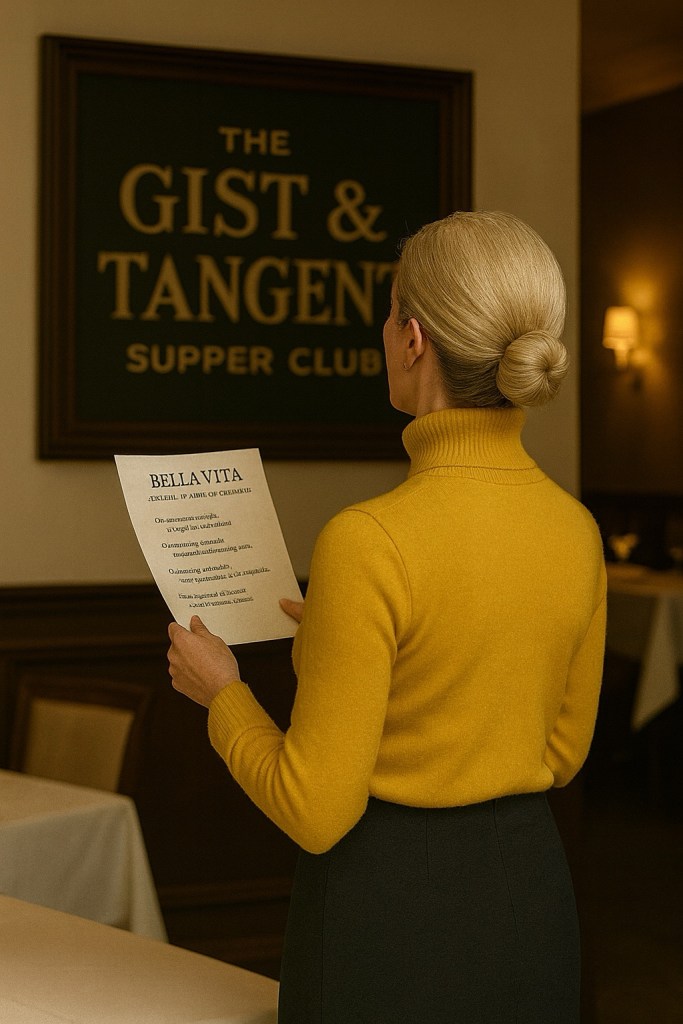
At the Gist & Tangent Supper Club, Mrs. Begonia sings what the partisans could not—Bella Vita, the flower of ascending life.
SONIC CONNECTIONS.
—By Mrs. Begonia Contretemp, European Correspondent
My Dear Provincial Cousins,
The song is called “Bella Ciao.” Once upon a time, it was sung by Italian communists and their unwitting fellow travelers as they marched to die in the mountains, farewell on their lips, rifles in their hands. A folk melody from the rice paddies of the Po Valley, polished into a hymn of resistance. So much for the romance.
And yet, as one of our own Council members—the Accidental Initiate—reported from his provincial outpost, the song is still alive. He stumbled into a county fair, that temple of fried food and civic boosterism, and there on the talent-show stage stood a youth of hermaphroditic bearing, singing “Bella Ciao.” My colleague’s grandchildren whispered the scandalous detail: the teenager had been expelled from school for threats of violence. And yet—applause for the anthem of the partisans. Subversion recycled as spectacle. But to be fair to the fair-goers, no one knew the provenance of this song. However, you will read about it very soon as others take up the connection.
The grotesquerie does not end at the midway. The assassin of Charlie Kirk engraved “Bella Ciao” onto his rifle cartridges. Even the Breitbart scribes noticed, helpfully labeling the song “idolized among Antifa.” And indeed, it has become their darling. What was once sung in the snow of 1945 now bubbles up at climate protests, football stadiums, weddings, Netflix soundtracks, TikTok scrolls, and yes, even on the iPhone screen of some cheerfully chirping 911 or 711 smart-phone savant who says, “Letsdodiz!”
Consider also the Certosa di San Lorenzo at Padula — a monastery turned prison, where Fascists and collaborators languished after the war. Local memory whispers that many were simply left to perish, a southern echo of the Rhine meadow enclosures where surrendered German divisions dissolved in mud and hunger. “Freedom,” it seems, has always been able to starve its enemies while still claiming clean hands.
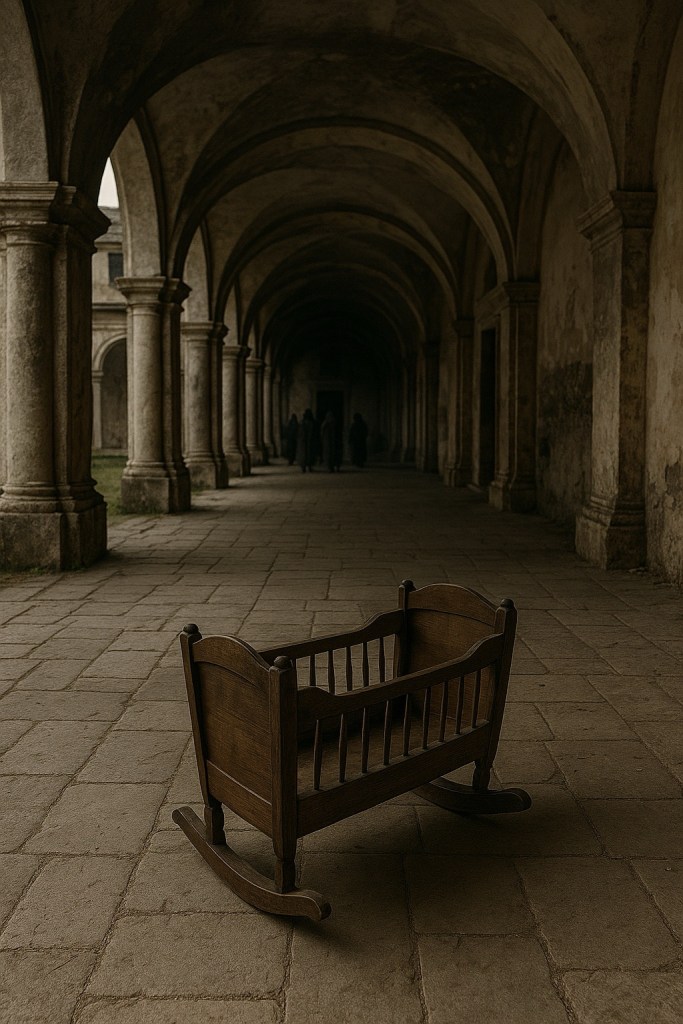
“Padula’s silence reminds us—the slowest genocide needs no firing squads, only liberal democracy ripened into selfish individualism, until even the lullabies fall silent.” —Mrs B.C.
But let them not be sentimental. The partisans of 1945 were not noble martyrs; they also murdered—yes, murdered—many in the chaos of victory. And in their triumph they bequeathed to Europe what we so delicately call “liberal democracy.” How splendid. A democracy that dissolves the family, glorifies abortion, enthrones consumerism, and delivers us at last to an aging continent where the cradle lies empty. Freedom, you see, can be a very slow form of death.
“Bella Ciao”? No—Bella Addio. Goodbye, my beautiful—goodbye to Europe itself.
Yours, as ever, in exasperation and elegance,
**************
POST SCRIPT:
But perhaps I am too cruel. Let us not become as the partisans. Venom without vision is merely complaint. So allow me, for once, to turn my Continental spleen toward a hymn of life rather than of loss. If the partisans could sing “Bella Ciao” as they marched to death, then we of the Council, together with our Nouvelle Vague Zwischenshaft cousins, may yet sing “Bella Vita” as we plant for life.
🎶BELLA VITA🎶
(A Rewrite in Place of Farewell)
One morning I awoke, oh bella vita, bella vita
One morning I awoke, and I chose the rising sun.
O Council, keep the cradle, bella vita, bella vita
O NVZ, keep the cradle, preserve the hearth and song.
For ascending life, oh bella vita, bella vita
For ascending life, we plant and we endure.
And if I falter, oh bella vita, bella vita
And if I falter, let my children rise instead.
This is the flower, oh bella vita, bella vita
This is the flower, the Council’s yellow bloom.
 COUNCIL-OF CONCERNED-CONSERVATIONISTS…..Between Jest And Earnest…..
Leave a comment