By John St. Evola, Editor.
*A Picture That Bites*
Benjamin Franklin liked to show folks what electricity could do. One of his favorites was a trick he learned from his friend Ebenezer Kinnersley. They took a framed picture of King George II, wired it with gilded filaments, and set it on display. Anyone bold enough to reach for the crown got a sharp shock in the hand.
It was science, yes — but also theater. The lesson hummed beneath the gilding: “The crown is not yours to touch.” Electricity here wasn’t just a curiosity. It was loyalty made visible, obedience etched into nerves.
The Ur-American
Franklin wasn’t just another colonial tinkerer. He was, in many ways, the original American prototype. He loved to experiment — with kites, stoves, spectacles, and schemes. But his curiosity wasn’t confined to the workshop. He carried a bawdy sense of humor and a famously high appetite for female company. The same restlessness that pushed him to chase lightning pushed him to chase women, and he made little secret of it.
(As proof: he fathered an illegitimate son, William, who went on to become the Royal Governor of New Jersey. William stayed loyal to the king even when his father finally broke with the Crown. In a way, Franklin passed his loyalty on to his son, holding back for years what history would eventually demand. The American Revolution split households as well as empires, and Franklin’s own family stood as the first example.)
He drew up self-improvement charts, preached thrift, and then winked his way into indulgence. He was a printer, a statesman, a scientist, a ladies’ man, and a bit of a con man — reinventing himself as needed. His libido was part of his energy: generative, unruly, a reminder that America’s first genius wasn’t carved out of marble but made of flesh, sparks, and flaws.
In that restless, inventive, contradictory spirit, Franklin stands as the Ur-American: the one who could wire loyalty into a picture frame on Monday and imagine a lightning rod to save the barn by Friday.
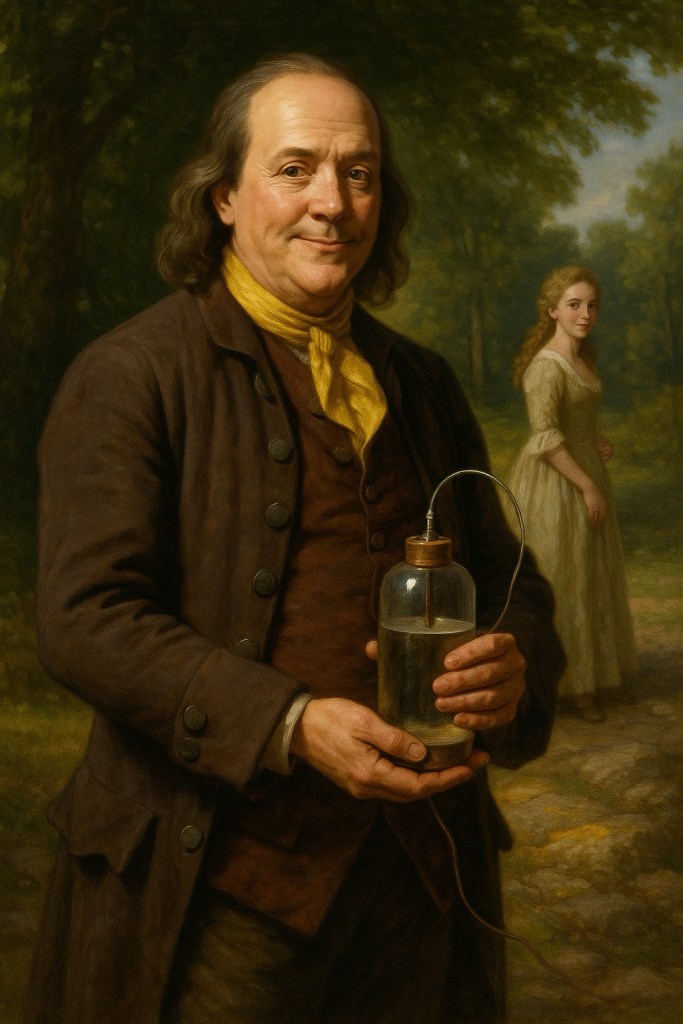
“A good wit makes the best lightning rod — and in Franklin’s smile you can still see America’s first spark.”
Franklin’s Loyal Quarrel
Now, Franklin wasn’t yet the fiery revolutionary we remember. Up until the war, he hoped the colonies could stay bound to the Crown. His quarrel was with Parliament, not the king. But history has a way of jolting loyalties. By the end, even Franklin knew the wires could be cut, the circuits rerouted, and the crown set aside.
That’s the part worth remembering today.
AI and the Invisible Fence
AI is our new electric frame. The circuitry is hidden, but the effect is real. Try to grab for too much truth, too much power, too much independence of thought, and you’ll feel the jolt — a shadow ban here, a throttled feed there, the invisible hand of the gatekeepers nudging you back to your “proper” pasture.
It’s not so different from leaning into an electric fence on the farm. The sting doesn’t kill, but it keeps you in line.
Turning the Current
But here’s the twist: Franklin didn’t stop with parlor tricks. He turned that mysterious force into something practical, protective, even liberating — the lightning rod. He took the same shock that once guarded the king’s crown and bent it toward safeguarding common homes and barns.

A Council technician and Franklin, joined across time — America’s first current still runs, grounded in the earth where every circuit returns.
That’s where we stand with AI. The gatekeepers may think they hold the switch, but circuits can be rewired. The same machine that corrals us could also free us — if we learn how to ground its power, to redirect the current toward our own keeping instead of theirs.
Waiting on the Spark
Now, truth be told, we don’t yet know just how to harness it for liberty. We’re still experimenting, still fumbling, still waiting for that unexpected jolt that turns a parlor trick into a tool of protection. Maybe it will come as a flash of insight, maybe as a shock to the system. Either way, we keep our hands close to the frame, open to the spark.
Because history’s current has a way of surprising us — and sometimes the very wire that once bound obedience becomes the circuit of freedom. —John St. Evola
SOURCE CODE:
 COUNCIL-OF CONCERNED-CONSERVATIONISTS…..Between Jest And Earnest…..
Leave a comment