A Drive-By Baptism of Fire On lawn signs, assassinations, and the venom of the educated classes
I never meant to find it. After all these years of walking past the lawn signs—the ones that bloomed across suburbia like ideological tulips—reading “Hate Doesn’t Live Here” with their rainbow-inflected reassurance, I assumed hate was a kind of itinerant ghost that only haunted someone else’s house.
But then I tripped into it. By accident, as always.
It happened in the wake of the assassination of Charles Kirk. I shouldn’t have been surprised, but I was. The digital air filled with venom: laughter, mockery, indifference so sharp it cut. Not from the expected quarters of the jackbooted strawman—(if he only had a brain)—or the long dead cross-burner, but from those who had long sworn their allegiance to “anti-hate.” Antifa, and now its next metamorphosis—Transtifa—proved all too eager to spit contempt at the body of a man they disliked.
That’s when it struck me, as if a brick had fallen off the protest sign itself: hate did live there after all. The slogan was not a truth but a ward, a talisman hung like garlic against evil spirits. And yet—as with all talismans—it said more about the fear of what already dwelt inside than about what was kept out.
A Brief History of a Sign
The phrase “Hate Has No Home Here” is not ancient. It sprouted in the North Park neighborhood of Chicago in 2016, born from neighbors and children at Peterson Elementary who wanted to draw a line in bright colors after Trump’s election. The campaign wasn’t aimed at the gang violence that racks Chicago’s South Side every weekend—those grim headlines of shootings, drug feuds, and turf wars—but at what the organizers saw as a rising tide of political hate and xenophobia tied to Trump.
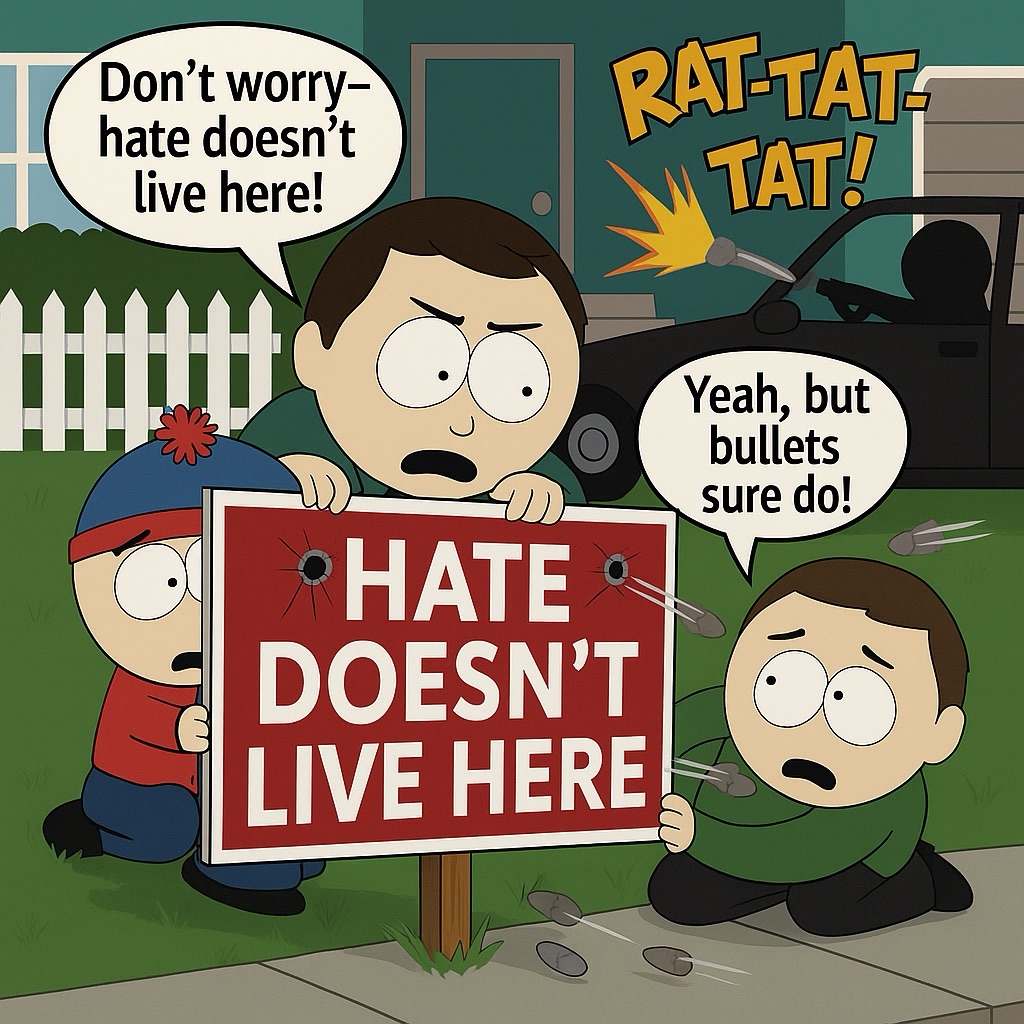
(Ironic, isn’t it? South Park made its name mocking everything sacred. North Park managed its own parody—mocking consistency itself. The lawns declared “Hate Doesn’t Live Here,” and yet when Kirk was killed, hate spilled out of those very houses with a vengeance.)

The irony, of course, is hard to miss. In a city scarred by endless gunfire, the sign served not as a shield against bullets, but as a cultural statement, a kind of moral branding. If hate doesn’t live here, it certainly seems to rent across town, leaving bullet casings behind as its calling card.
In Contrast
All my life, I have stumbled toward older voices—traditionalists, anti-modernists, men and women who were not free of flaws, but who longed for something more than slogans. They spoke, even in their severity, not of hatred but of the sacred. They yearned for continuity, for the eternal flame that modernity tried to smother beneath convenience and ideology.
Compared to their desire for transcendence, the contemporary carnival of spite is cheap. Where the traditionalist reached toward the holy, the activist sneers toward the grave.
Where I Actually Live
And then I realized something even more unsettling. Hate didn’t just show itself on the lawns of suburbia, or in the venomous pixels of activist feeds. It lived closer to me than I cared to admit.
I had expected to find it among Trump supporters. Among the working class. Among the “nice white people” of America—those forever caricatured as the natural carriers of resentment. But that’s not where I found it.
The laughter over Kirk’s death came not from them but from the educated. From doctors in their white coats, and others in the medical profession— from professors and teachers in their lecture halls— from those in the political arena, from the very people whose credentials and diplomas were supposed to mark them as refined. They were meant to heal, to teach, to elevate. Instead, they revealed themselves as eager custodians of contempt.
So here, at last, I stumbled into the address. Hate does live here, and its residence is not only in the shadows but in the institutions most loudly declaring their enlightenment.

 COUNCIL-OF CONCERNED-CONSERVATIONISTS…..Between Jest And Earnest…..
Leave a comment