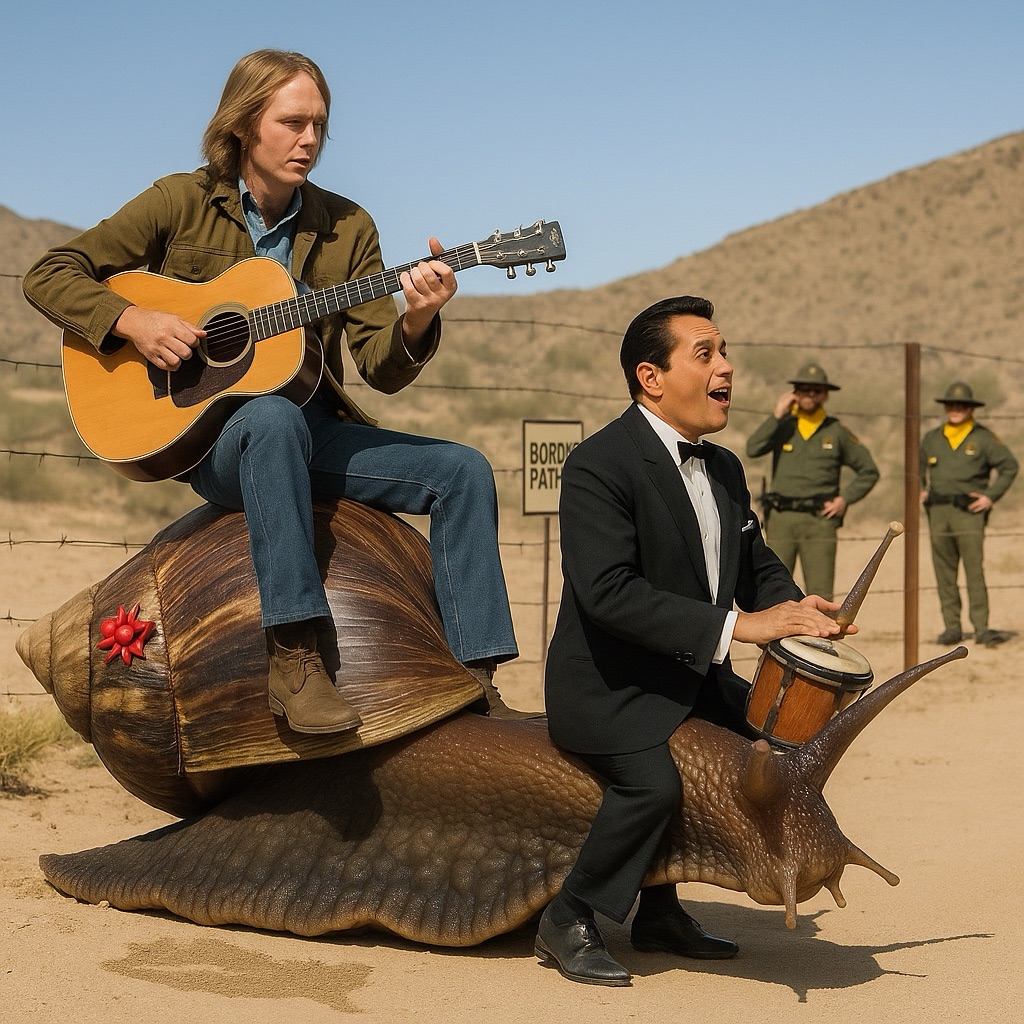
“No need for fantasía, amigos — the mundo, she paint herself more bizarre than Dalí ever dream.”
“Ohhh Ricky… now you have some ’splainin to do.”
—Lucy Ricardo
Tradition is a strange cargo. Sometimes it carries wisdom that steadies us generation after generation. Other times it delivers baggage we should have left behind. Evolutionary psychology tells us a practice usually lingers because it once conferred an advantage. But advantage can sour when the context shifts.
Case in point: the Florida Department of Agriculture’s surreal PSA
Giant African Land Snails are Real.
They eat plaster. They spread meningitis. They are not for internal consumption.
Yet Charles Stewart — also known as El Africano, or Oloye Ifatoku — brought these snails into ritual use, cutting their heads and pouring the juices down followers’ throats as part of a healing rite within the Ifa Orisha tradition. The result wasn’t restoration but a waiting room full of puzzled Florida Men trying to explain to the triage nurse why they just swallowed garden paste. Tradition carried over, but in this soil it went awry.
Now place that beside another inheritance: the all-American holiday ritual of Lucy marathons. Around Thanksgiving or Christmas, reruns return to the air. Families gather, the food settles, and there he is — Ricky Ricardo in his tuxedo, crooning “Babalu.” Most viewers hear a novelty nightclub number. But in truth, Ricky was singing to Babalú-Ayé, the Orisha of sickness and healing, often twinned with Saint Lazarus in Cuba. In Havana, it was a prayer for protection from disease. On CBS, it became comic relief — the only sitcom in history where an Orisha had better ratings than Fred Mertz.
And then there is Uno Mundo. Stephen Stills, son of a U.S. military officer, raised across Florida, Costa Rica, the Panama Canal Zone, and El Salvador, absorbed Latin rhythms in his youth and carried them into American pop. His song “One World” rides a Latin groove while chanting a vision of global unity:
Uno mundo / Asia is screaming / Africa seething / America bleating / just the same.
On the surface, it’s an idealist’s anthem. But as the Council reads it, Uno Mundo is also a symptom of the homogenizing pressure that comes when “one world” becomes more than a metaphor. Stills’ biography makes the posture unsurprising: the child of the military, moving from base to base, half-insider, half-outsider. Military brats are raised to salute authority — and then, naturally, to form a rock band rebelling against it. It’s practically in the syllabus.
What unites Ricky’s Babalu and Stills’ Uno Mundo is the way traditions slip into culture under the guise of entertainment. In one case, an invocation to an Orisha arrives in American living rooms dressed as comedy. In the other, the rhythms and ideals of Latin America arrive through the chords of a military brat turned troubadour. In both cases, the infusion is quiet, almost invisible — and because we don’t recognize it, we don’t reckon with what it carries. Sometimes it’s harmless nostalgia. Sometimes it’s ideology — the kind you don’t notice until your kids are humming it between bites of stuffing.
Here lies the paradox of tradition and inheritance:
One ritual (the snail) preserved form but delivered poison.
One song (Babalu) carried a deity across oceans only to become a laugh track.
Another (Uno Mundo) tried to carry a moral tradition — awareness of global suffering — but risked flattening difference into a bland, borderless unity.
The Council’s view is that tradition is ballast, not contraband. Each nation’s traditions are precious precisely because they are distinct. Diversity between nations preserves the world’s cultural ecosystem, just as biodiversity preserves the planet. But “diversity within” — when everything blends into one domestic conglomerate — doesn’t preserve diversity at all. It dissolves it. A world without national distinctness is like a gene pool without species: uniform, vulnerable, and finally empty.
So yes, tradition deserves respect — but also discernment. We must preserve what heals and discard what harms. Ricky, in his tux, may only have been singing for laughs, and Stills may only have been strumming for unity, but both remind us: what tradition carries matters, and what we do with it matters even more.
In this season of reruns and recycled anthems, it isn’t Lucy but Ricky — and perhaps Stephen, too — who have some ’splainin to do.
Once again, something has—
Gone Awry.
***
Editor’s Note — John St. Evola:
Our correspondent Black Cloud means well, but his cultural references are beginning to yellow like old clippings in the Council archives or an eight-track cassette on the dashboard in the July heat. Call it a boomer handicap: Lucy reruns as prophetic text, Stephen Stills as a global bellwether. He sees the end of the world around every corner, yet the world, with a kind of stubborn humor, refuses to oblige. It keeps going, one damn thing after another — and perhaps that’s the only tradition truly immune from going awry.
Or as R.E.M. once sang back in ’87 — which, sorry to say, is now dated boomer music too — 🎶 it’s the end of the world as we knows it, and I feel fine. 🎶
And if the second law of thermodynamics is to be believed, the world can’t really end after all. Energy isn’t destroyed; it only converts. Which means eternity is nothing but one damn thing turning into another damn thing, forever.
 COUNCIL-OF CONCERNED-CONSERVATIONISTS…..Between Jest And Earnest…..
Leave a comment