
By Libby D’Annous, Correspondent for Domesticity and the Slightly Out-of-Bounds
The curious thing about democracy is that it never asks our permission before reshaping tradition. One day you’re told the Institution of Marriage (capital “I,” capital “M”) has gone the way of the Tupperware party—lidless, sagging, and misplaced in the back cupboard. The next day, you look up from your latte and realize it has been rescued—by men in pressed shirts who adore brunch.
Let’s be blunt : heterosexual couples were letting the bonds loosen, filing no-fault divorces as casually as credit card applications, muttering that marriage was “just a piece of paper.” Enter the homosexual male couple, who treated the paper as if it were parchment, gilt-edged, and suitable for framing. With their striving for bourgeois respectability, they shored up the crumbling edifice, hammer and nail, as if they were reenactors of a lost domestic frontier. One almost hears the wedding bells ringing like a cavalry bugle: “Tradition rides again!”
And while we’re handing out commendations, consider the pioneer spirit. The American West was once tamed by men with rifles; the American inner city was reclaimed by men with rainbow flags and impeccable taste in crown molding. They settled into places where crime was high and the sidewalks cracked, neighborhoods so dodgy they might as well have been Dodge City. With no children yet to fret over, they bore the risk, and in the grand tradition of homesteaders, turned them into upscale enclaves. Historians call it gentrification—but doesn’t the very word ring of gentry, a title nobler than the average?
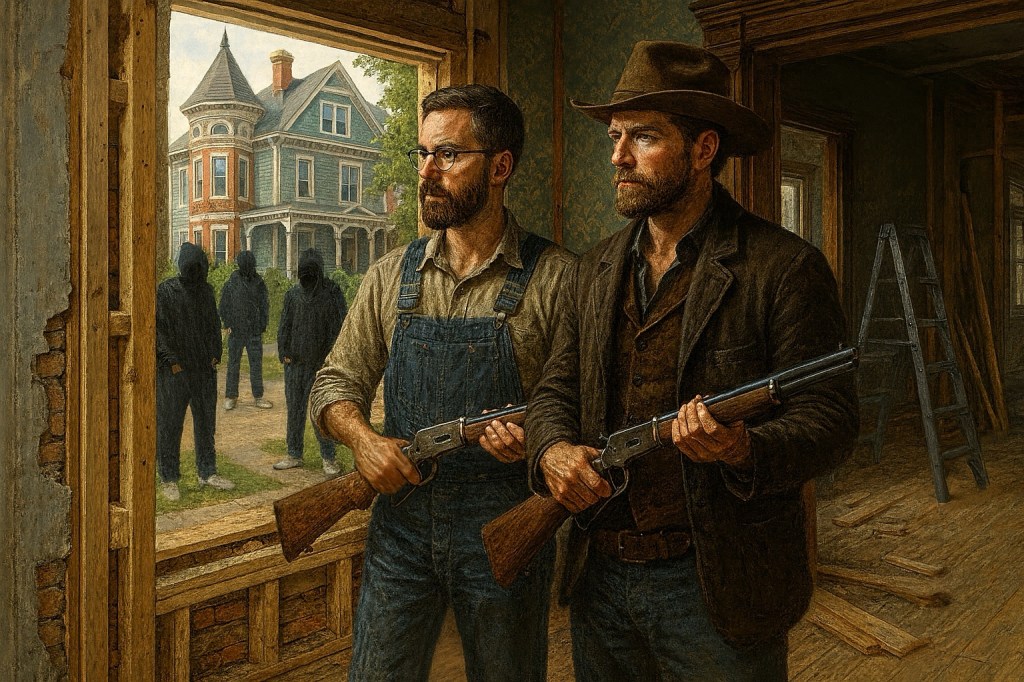
Still, even as I hand out laurels, I confess to a nagging dissonance. Nature, in its stern wisdom, designed men and women as complements, opposites aligned for survival’s sake. Male and female together can reproduce in the old-fashioned way, no lab coats required. That fact remains a stumbling block for same-sex marriage: love and property deeds may be secured, but lineage still falters.
Science whispers that one day, perhaps, two men might merge their genomes into a child entirely their own. Yet what would it mean if a little one carried only the markers of the male haplotype, stripped of maternal inheritance? Would survival be diminished, some crucial balance lost? Tradition has long insisted that children need both kinds of roots—branches grafted from father and mother alike.
Thus, by their fruits (in the biblical sense: by what they produce), you shall know them. And here, at least for now, the fruit of male coupling is cultural rather than biological: reinvigorated marriages, reclaimed neighborhoods, and a testament that even Dodge can be domesticated. The nursery, however, still waits—though I suppose if anyone can wallpaper it into respectability before the stork arrives, it’s these pioneers.
And pioneers they are indeed: domestic pathfinders, refitting an old institution with fresh dignity, and reminding the rest of us that tradition isn’t only inherited—it can be rebuilt, reclaimed, and yes, even redecorated.
Alan Watts once remarked: “The fallacy of all traditionalist or back-to-nature romanticisms is that they are themselves progressive, looking to a future state of affairs which is better than the present. The goal of a traditional culture is not the future but the present.”
Homosexual marriage may have worn progressive colors when it marched, but in its lived reality it has proven something else: a strangely faithful restoration of marriage to the present moment. Tradition was not abolished, but revived by those who most hungered to belong to it.
This, I should stress, is the achievement of married male couples—those who tied the knot, bought the row houses, and put down roots. They were not marching under every new letter in the ever-lengthening alphabet. They were building hearths, not hashtags. While the rest of the movement chanted slogans about dissolving norms, these men quietly re-stitched the fabric of marriage and renovated the block around it. In short: they didn’t just join tradition, they rescued it.
“The whole modern world has divided itself into Conservatives and Progressives. The business of Progressives is to go on making mistakes. The business of the Conservatives is to prevent the mistakes from being corrected.”
— G K Chesterton
Who knew the cavalry bugle of tradition would sound like a show tune?
 COUNCIL-OF CONCERNED-CONSERVATIONISTS…..Between Jest And Earnest…..
Leave a comment