Always On, Slightly Off — when philosophy climbed into the ring as exhibition wrestling.

Introduction:
From time to time the Council reviews cultural diagnoses that have aged less like fine wine and more like medical curiosities. In 1968, Ayn Rand delivered such a verdict on the question of a woman president. Her reasoning was clinical in tone but absolutist in content. Today, with hindsight, biology, and a sigh, we examine her words as both artifact and provocation.
“I do not think that a rational woman can want to be president. It is not a matter of her ability, but of her values. To act as the superior, virtually the ruler of all the men she deals with, would be an excruciating psychological torture. It would require her to suppress every personal aspect of her own character and become only a mind, not a person — sexless, unfeminine, and metaphysically inappropriate. For a woman to seek the presidency is so terrible a prospect of spiritual self-immolation that the one who would seek it is, by that very fact, unworthy of the job.”
— Ayn Rand, An Answer to Readers (On a Woman President), The Objectivist, December 1968
Council Commentary
By Dr. Faye C. Schüß
It is true, as Rand declared with unyielding certainty, that the sexes incline toward poles: masculine and feminine, absolute ends that tradition has honored as if they were fixed stars. Biology confirms the polarity in its hormonal gradients — testosterone and estrogen pulling the organism toward distinct forms. And we must admit: most of the time, nature does indeed strike close to the mark. If it did not, if the sexes were not generally clear and distinct, humanity could not have survived.
And yet in the case of female heads of state— not always. Consider Golda Meir and Dame Thatcher. Their jawlines alone bespoke a certain masculinization, more angular than conciliatory. To note this is not to diminish them, but to suggest the possibility of admixture. Medical literature records the phenomenon of chimerism, in which a fetus absorbs genetic material from a vanished twin. If that twin is of the opposite sex, the surviving child may carry a subtle imprint — a hint of brother within the sister, or sister within the brother. Such mysteries remind us that nature, while usually steady in her aim, sometimes misfires — or experiments.
Nor should we overlook history’s quieter arrangements: the power couples in which a wife played the role of eminence grise. John Adams and Abigail Adams, enough said. Edith Wilson, wife of Woodrow, effectively governed in the shadow of her husband’s stroke; Eleanor Roosevelt shaped policy with a blend of conscience and counsel; Nancy Reagan’s influence extended deep into staffing and strategy. In such cases, feminine counsel moved through masculine office, neither denying the poles nor collapsing them, but entwining them. Tradition bent, but did not break.
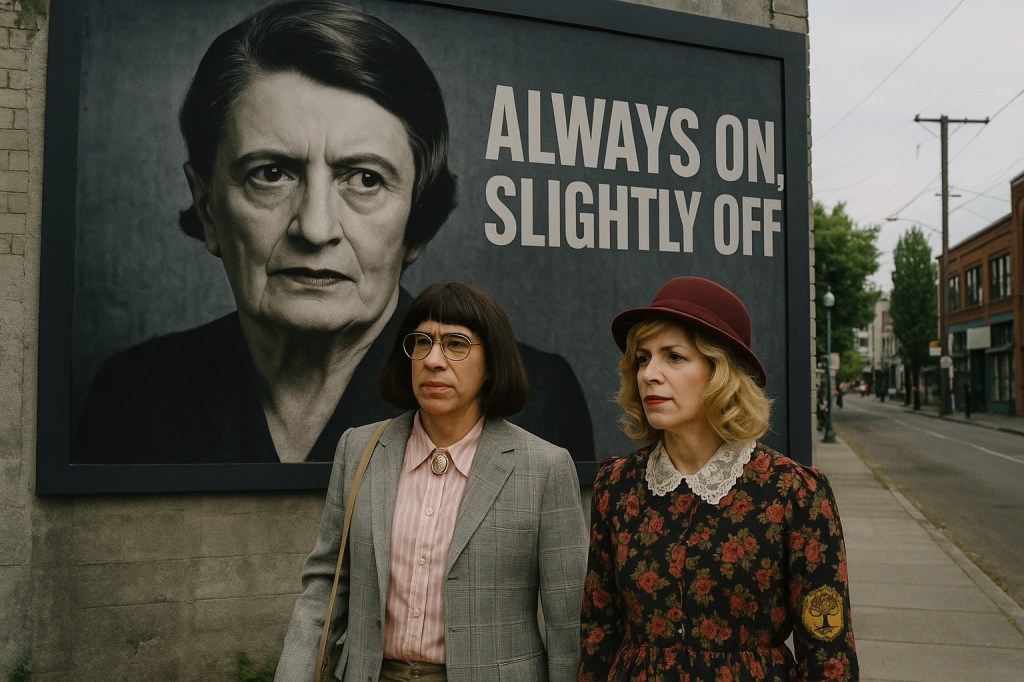
Here is where the sigh intrudes: we were taught the world is black and white, man and woman, tradition and certainty. But life reveals itself in gradients, and even tradition’s poles may be approached only asymptotically. The Independent Film Channel [IFC] once summarized it perfectly in a slogan: “always on, but slightly off.” Culture itself has taken up the theme. IFC’s Portlandia made sport of androgyny, its characters blurred in presentation, a sketch of what nature occasionally performs without satire.
And yet, even within this ambiguity, tradition whispers. The game of chess once accorded the queen only a halting diagonal crawl. Later centuries transformed her into the most versatile piece on the board, moving freely in every direction. What was once confined became central. And so with the presidency: where Rand imagined unbearable torture for a woman, culture may already have supplied the counterexample. The queen, once limited, is now supreme — not by abolishing the poles of the game, but by reimagining their play.

Perhaps this is our condition. Nature strikes true more often than not, but she also produces gradients, chimeras, jawlines, hormonal weather, television sketches, and cultural revisions. These are not errors but part of becoming. Tradition gives us the pattern, the poles, the goal. But in the meantime we live between: sighing at the loss of black and white, hoping that the crooked path still leads us closer to the end toward which nature gropes — a final form as clear and commanding as the queen at the center of the board, presiding with a versatility that Rand, in her absolutism, could scarcely imagine.
And yet here we meet the final contradiction. Rand herself became what she warned against: the commanding presence of her own philosophical circle, a matriarch in all but name, dispensing judgments and excommunications with the authority of a chief executive. She did not suffer psychological torture in the role; she relished it. What does this reveal? That nature, while usually striking close to the mark, also permits exceptions that defy even their own doctrines. Tradition points to absolutes, but individuals prove provisional, improvisational, sometimes hypocritical.
The contradiction is instructive. It shows us that the black-and-white lines of doctrine — Rand’s or anyone else’s — may themselves be the most “slightly off” creations of all. For in the living world, nature and tradition weave together not only poles but paradoxes, producing leaders who embody both the command of the king and the versatility of the queen, however much they may deny it.
And this aligns with Council doctrine: tradition itself is double. It is sometimes the simple preservation of the old ways that work, but it is also the mysterious obligation to keep the ball rolling. Both instincts sustain us — the ballast of memory and the momentum of becoming. The one provides the poles, the other provides the play. And it may be that in this tension between stability and motion, tradition itself finds its truest expression: always on, slightly off, yet still rolling forward.
—Dr. Faye C.Schüß, the C-of-C-C’s resident medical and mental hygiene expert and current fellow at The Institute For Theoretical Studies (TIFTS)
Afterword
By John St. Evola, Editor
Alan Watts once remarked that tradition, if it is authentic, is always in the here and now; if it orients itself toward the future, it ceases to be tradition and becomes progressivism by another name. I cite this to remind myself — and you, dear readers — that the Council’s doctrine is not about embalming the past but about carrying the weight of what works into the present moment. Tradition is a living posture, not a museum label.
Now, as editor, I must pause and ask a question that has been murmured to me: why do I bring so many female correspondents to the forefront of our newsletter? Why allow Daphne’s daffiness, Mrs. Begonia’s barbs, and Dr. Faye’s clinical sighs to take such frequent turns at the lectern?
The answer, I suspect, is equal parts aesthetic and metaphysical. Their voices unsettle and amuse me. They puncture the solemnity of our moss-covered historians. They cut diagonally, like the chess queen they each resemble, across the board of our newsletter. Where the men supply ballast, the women provide momentum; where tradition draws poles, they reveal gradients.
And perhaps — here comes the editor’s confession — it is also because I am mostly male, and I can’t help but find something numinous in the feminine. I hate to sound like a Jungian parrot, but one could call it the anima peeking through the typewriter ribbon. If so, then every time I publish Begonia, Daphne, or Faye, I may simply be flirting with the other half of my own psyche. Consider it less a mystical revelation and more a professional hazard of editing.
Perhaps I enjoy this tension more than I should. But then again, perhaps it is the essence of Council work: to hold the paradox in play. And if it takes the amused severity of Mrs. Begonia, the aristocratic daffiness of Daphne, or the clinical lament of Dr. Faye to remind us that tradition is alive in the here and now, then I will keep inviting them forward.
—John St. Evola, Editor
 COUNCIL-OF CONCERNED-CONSERVATIONISTS…..Between Jest And Earnest…..
Leave a comment