There is a threshold, familiar yet uncanny. It is not the twilight of day nor of night, but a more curious borderland. It lies between scholarship and satire, between what can be counted and what must be sung. You are now entering… the space Between Jest and Earnest.
Eugene Bodeswell:
Identity: the abiding frontier.
These are the chronicles of the Scottish traders and the Cherokee matrons.
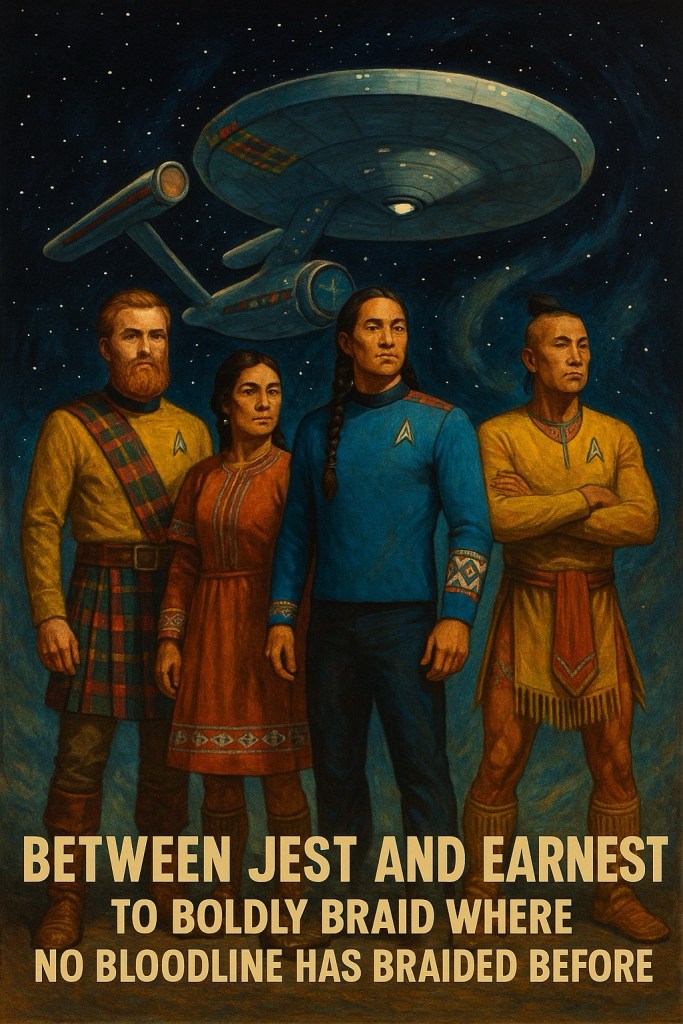
Their generations-long mission: to weave strange new alliances,
to seek out survival through mixture and distinction,
We begin not with conquest, but with commerce. Scottish Highland traders carried musket, fabric, and flint into Cherokee country, where a matrilineal people knew the worth of their daughters and their status. From these encounters came marriages—alliances that blended Highland stubbornness with Cherokee sagacity. The descendants became cultural interpreters, brokers of fur and treaty alike, and, sometimes, political dynasts.
[An aside: this reflection was sparked by reading about (not yet in) Theda Perdue’s Mixed Blood Indians: Racial Construction in the Early South. We mention it not as a citation of authority but as inspiration: a seed glimpsed from the dust-jacket rather than harvested from the field. For in my practice, sparks are as valuable as sources.]
Keeping watch where lineage must needs guard its flame, and where new strands may kindle together.
Yet the deeper pattern is clear enough. Such fruitful unions depended on the fact that there were Scots to be Scots, and Cherokees to be Cherokees. Distinction made blending possible. Without the continuity of Highland stock—its kinship code, its resistance to disease—the marriages would not have been strategic assets. And without the Cherokee principle that children follow the mother, those unions would not have been absorbed into a strong tribal lineage.
Here lies the Council’s concern: what happens when all the strands are pre-mixed, when “pure” threads of identity are no longer present to braid? The Cherokee-Scottish knot shows how difference preserved and then combined can yield resilience. But difference itself must be maintained if such exchanges are to mean anything. If every thread is already mottled and frayed, there is nothing left to weave.
We call this the paradox of preservation: to conserve, one must sometimes resist mixing, precisely so that future mixing can still have consequence. Otherwise, the tartan fades to a blur, and the beadwork loses its pattern.
Now, a final speculation, drawn in Council ink but pointing starward:
If Cherokee-Scottish marriages once produced a lineage of resilience—combining immunity, diplomacy, and adaptability—might not the same principle apply in the next frontier? A long-duration space mission, measured in generations rather than months, would require not only fuel and food but also genetic stamina.
Pure lines, however noble, carry their brittle edges: one population may excel in cold resistance, another in bone density, still another in oxygen efficiency. Yet no single strain is sufficient. Hybrid vigor—the interlacing of once-distinct genetic toolkits—could yield crewmen and women with a portfolio of strengths:
immune systems less prone to collapse under alien microbes or closed-loop ecologies, skeletal structures resilient against low-gravity bone loss, metabolic diversity enough to handle unforeseen diets or atmospheres, and, just possibly, psychological flexibility born of dual or multiple inheritances.
The Cherokee matrilineal model also suggests a social architecture: communities that carry identity forward even as they absorb newcomers. A starship, then, might resemble a rolling nation, its continuity ensured by the careful conservation and also the weaving of strands, not only the bleaching of them.
Thus, from the beaver pelts of the 1700s to the starships of tomorrow, the Council draws the same lesson: hybrid vigor depends on preserved difference. To erase the pure strands now is to foreclose the possibility of strength later. The braid must be woven aboard the ship, not pre-fabricated in the laboratory.
We in the Council respect Eugene’s thesis: it is sober, well-framed, and carries more truth than some will care to admit. Only after the memo was finished did we realize what it secretly resembled: the crew manifest of the Spaceship Enterprise. A Japanese helmsman, a Russian navigator, a Scots engineer, a Vulcan philosopher—the potential for hybrid vigor rehearsed on a television set.
That realization made us laugh—not to undercut Eugene’s concern, but to admit that he had unknowingly rewritten Roddenberry’s casting notes in the idiom of beadwork and tartan. Someone muttered: “Beam me up, Scotty.” The transporter hum doubled as a punchline, and our laughter was simply the Council recognizing itself, once again, caught between jest and earnest.
EDITOR’S NOTE :
You have just read an account that was at once serious and ridiculous, speculative and true. This is the landscape the Council inhabits. It is our Zone.
And if you find yourself smiling and frowning at the same time, then you’ve already stepped into– – -a dimension:
“Where few have gone before”. — and like the Fermi Paradox, the silence is deafening, but at least it’s ours.

 COUNCIL-OF CONCERNED-CONSERVATIONISTS…..Between Jest And Earnest…..
Leave a comment