CONVERSATIONS UNDER THE KNIFE:
Hosted by Mrs. Begonia Contretemp as part of her column,
Cultural Autopsy—Supper Club Series, Vol. I
Introduction
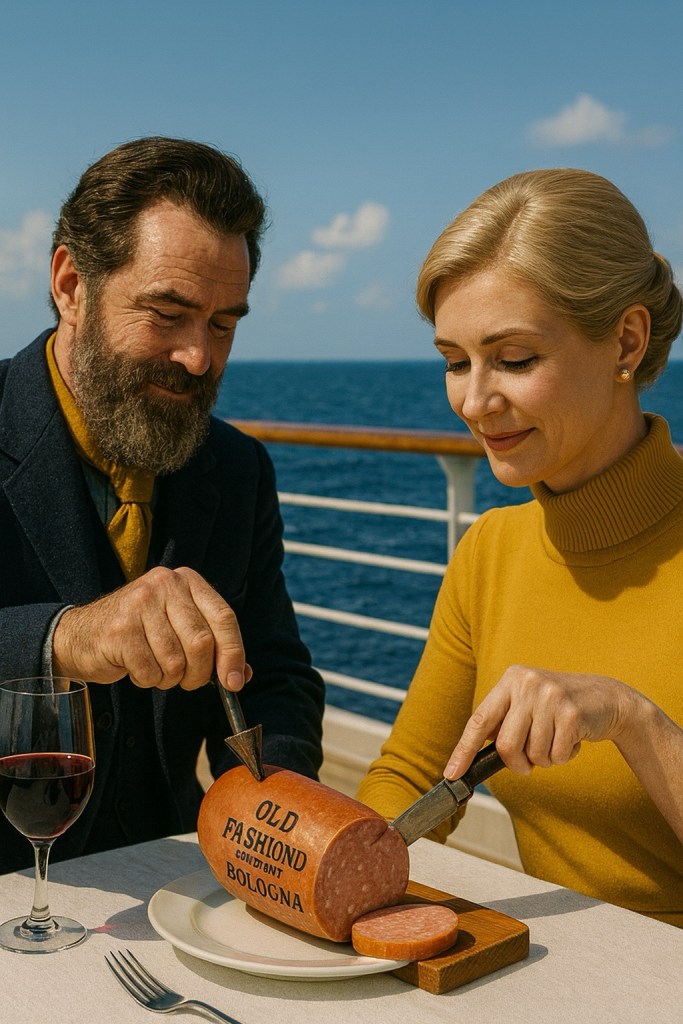
The Council-of-Concerned-Conservationists inaugurates this supper-club dialogue series under the aegis of Mrs. Begonia Contretemp. With amoretto in hand and her eyebrow arched like a guillotine blade, she sits down with historic and spectral figures to slice through the fads of the age. In this inaugural conversation at The Gist & Tangent Supper Club Cruise, she welcomes Herman Melville to consider the inky scourge of tattooing: from its rare, practical uses in sailorly and criminal desperation, to its grotesque inflation in the modern suburbs.
The Dialogue
Mrs. Begonia (eyebrow arched like a guillotine blade only sharper now):
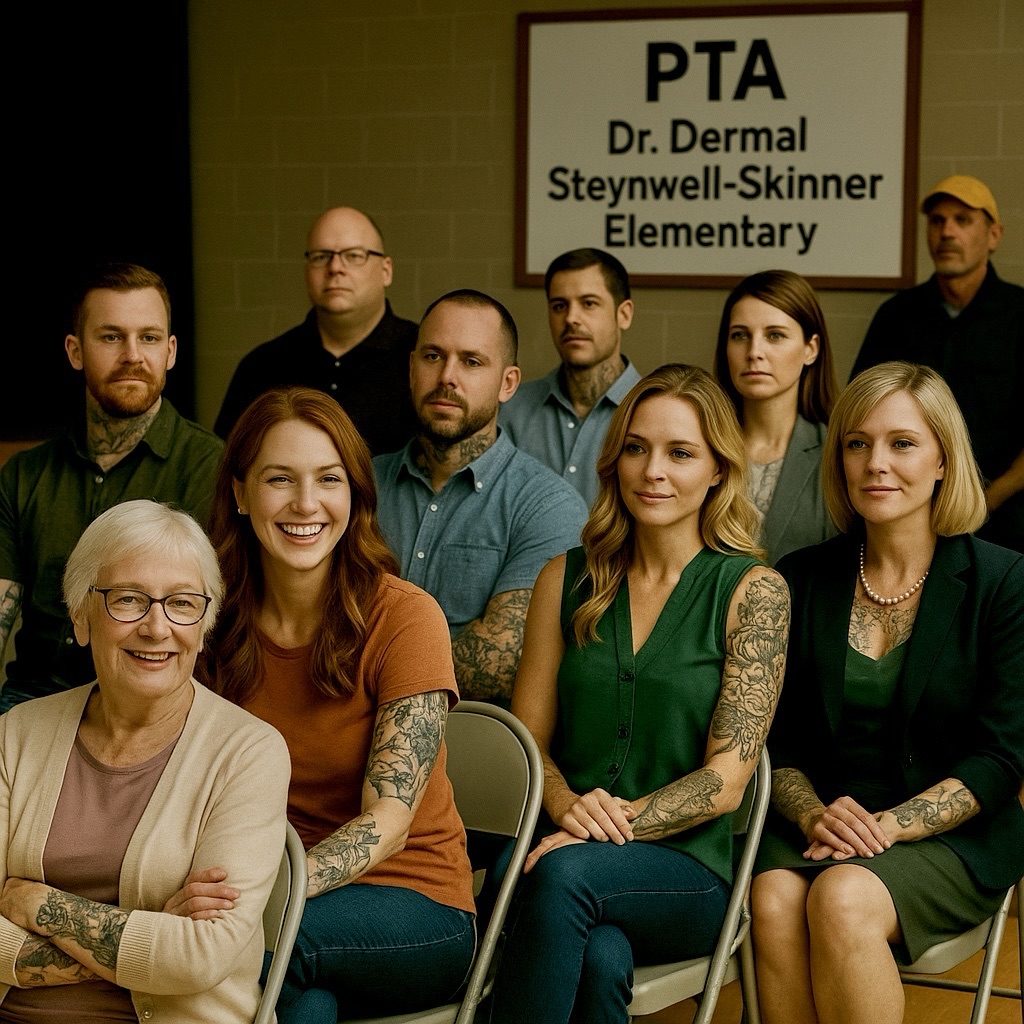
From the slender Scarsdale housewives with Pilates-toned arms to the boxcar ladies lumbering through Walmart parking lots, I see tattoos everywhere. Roses sagging, dragons sprawling, scripture dissolving into cellulite. Even grandmothers — pillars of supposed propriety — now parade about with serpents coiled up their calves or wilted roses fading on their shoulders. The epidemic spares no class: the upper crust scrawled like parchment, the underclass billboarded like freight cars. Is everybody inked now?
—The Wailing Harpooner
Mrs. Begonia (with an eyebrow arched like a blade about to drop):
In former days, Herman, the tattooed lady was a carnival aberration — wheeled out beneath a greasy canvas to horrify the yokels. A grotesque novelty, paraded for pennies. Now the librarian, the schoolteacher, the soccer mom all volunteer for the same degradation, only without the sideshow curtain to contain it. What was once a freak attraction has become a PTA fashion statement. And I say to you, the freak tent was the more honest arrangement.
Mrs. Begonia (leaning in, with theatrical relish):
Have you heard, Herman? Now there’s rumored to be a new service calling itself Jewish Space Lasers™ — positively operatic! From orbit, no less, they promise to sear away the vulgar ink you once paid dearly to acquire. You pay for the tattoo, then you pay again to have it scorched from heaven itself. The conspiracy theorists finally got their wish: salvation beamed down, invoiced by the session. Forgive me — the very topic of tattoos is so absurd to me that I could not resist a flight of fancy. But it was a delightful tangent, and the laughter did me good. And who knows? It may yet point to something, some source of revenue in the real world, if only by outrageous analogy.
Melville (shaking his head with weary amusement):
Madam, your fancies would be dismissed as lunacy in my century, yet in this modern age they strike me as all too probable. To bottle the sun and sell it as penance — aye, that is commerce enough for our times. You jest of space lasers, but I fear the jest is already halfway to reality.
Mrs. Begonia (sighing, with finality):
And so it is with modernity: they pave the way for the craze, they sell the cure, and then we are expected to congratulate ourselves on progress. The tattoo is not just ink in the skin, Herman — it is modernity itself, etched in bruises, then erased in beams, a cycle of folly without end.
Melville (with a sailor’s sly grin):
“Your blade cuts true. Still, I must concede: in extremity tattoos once bore utility. Sailors scratched their names and ports upon themselves, so the sea might not steal their identity altogether. Soldiers bore their regimental marks. And in Stalin’s camps, some convicts etched the tyrant’s face upon their chests, hoping the firing squad would not fire upon their idol. Grim, but practical.”
Mrs. Begonia (with elegant contempt):
Practicality is desperation’s excuse. And desperation has given way to decadence. Now the banker’s clerk, the PTA mother, even the Sunday-school teacher wears graffiti as though vandalism were virtue. They ruin themselves for nothing but fashion—and a low fashion at that.
Melville (leaning in with amused recollection):
I’ve also seen the absurdity of indigo tattoos on those with skin dark as midnight. One squints to perceive the mark—it is like carving shadows on shadow.
Mrs. Begonia (collapsing into cruel laughter):
Oh, Herman! Yes! An invisible tattoo—why bother at all? The emperor’s new bruise, written on obsidian! The very point of defacement defeated. If only all tattoos were so mercifully invisible.
Melville (chuckling, then turning grave):
And Tommo—my poor Tommo—fled the Typee rather than yield his flesh to their needling. He would rather risk the pot than wear their hieroglyphs. A wise horror.
Mrs. Begonia (adding new barbs, voice sharp as vinegar):
Besides the sacrilege, there is the absurd spectacle:
Muscles sag, and the grand dragon becomes a wrinkled worm. The proud rose wilts when the skin creases. The sacred verse is cut in half by a muffin top.
And science itself has turned against them! Magnetic resonance imaging makes their pigments burn. I almost relish the irony: their vanity scorched by their own folly.
Melville (raising his cup in sly salute):
Providence and physics united in judgment.
Mrs. Begonia (speculating, amoretto raised):
When will this mania reach its apogee? Perhaps when infants are issued barcodes in maternity wards, or brides bear their vows upon their thighs. Until then, civilization declines needle-prick by needle-prick.
Both (sharing their dark hilarity):
The emperor’s new bruise, indeed.
CLOSING
Mrs. Begonia (with a satisfied sigh, setting down her glass):
And so ends this inaugural episode of An Eyebrow Like a Guillotine. My thanks to Mr. Herman Melville for lending his wit and gravity to our lament against the modern bruise. Herman, you must return soon—next time, we shall devote ourselves not to needles but to your own sly humor, which the world has too often overlooked.
Melville (bowing slightly, a smile tugging his lips):
Madam, I would be honored. For in humor, too, there are depths uncharted.
**************

—Thus concludes another dispatch from that narrow borderland between jest and earnest — where a postmark on the flesh may yet be read in the ledger of the Infinite .
THE EDITOR
 COUNCIL-OF CONCERNED-CONSERVATIONISTS…..Between Jest And Earnest…..
Leave a comment