For aye, this Ship’s the Titanic true,
one flag waves red, the other blue;
the White between grows frail to view—
the part that must be guarded true.

Filed under Council Poetic Justice, where rhyme doubles as rough justice.
Tonight’s broadside comes from Black Cloud, who has sighted the federal judiciary not as a bench but as a brig. His verses chart the voyage of robed actors turned pirate crew — courtrooms as stages, gavels as cutlasses, and precedent drowned beneath partisan seas.
The Partisan Ship
by Black Cloud
The robes be black, the mast be tall,
they swear the law should guide ’em all;
yet up the shrouds their banners fly—
the donkey’s bray, the elephant’s cry.
They brawl like gangs upon the deck,
red scarves to port, blue flags to wreck;
they swing their gavels, shout their cries,
yet ne’er behold the iceberg’s rise.
For aye, this Ship’s the Titanic true,
one flag waves red, the other blue;
yet White — the founders’ sails in view —the part that must be guarded true.
The gavel’s cutlass splits the air,
yet justice hides a partisan glare;
blindfold slipped, she squints to see—
which gang shall claim the victory.
So hoist the flag, red stripe or blue,
the end be carved the way ye knew;
but White’s the heart that must shine through—
the trust they’re sworn to guard for you.
And we, poor souls, must ride this trip,
aboard the sinkin’ Partisan Ship.
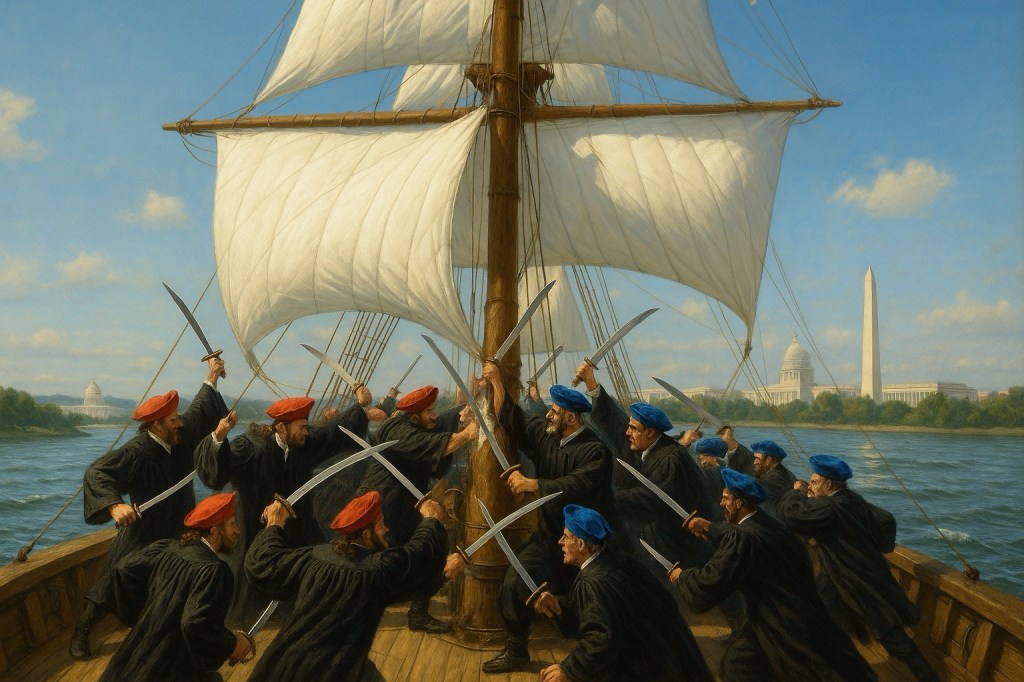
Play, of course, is never “just play”: it’s rehearsal, parody, prophecy. What seems juvenile is often dead serious, and what seems serious often needs a little campfire laughter to keep it afloat. The sails are White, and the joke cuts close.)
Council Review
by Cliff Langour (with Arthur Haus, silent as ever)
Black Cloud has cast the judiciary as a ship of fools — no, worse, a pirate barque. And we are all on board. Not just the Supreme Court, but the whole federal fleet of benches, all creaking with partisan timber. The robes? Costumes. The confirmations? Auditions. Each nominee struts as “impartial interpreter,” while the Senate plays casting director, fitting them neatly into the troupe of donkey-flag or elephant-flag players.
Arthur (though mute) insists this is not tragedy but traveling theater — the same plot, endless sequels. I half agree: every district, every circuit reheats the same melodrama, verdicts decided not by law but by party script. The docket is a playbill; the rulings, a performance.
And here’s the self-aware wrinkle: by publishing this poem, then reviewing it, the Council joins the theater it lampoons. This page is stagecraft. You, reader, sit in the pit. Black Cloud bellows as pirate, I play the critic, Arthur plays the silent extra. What we call truth may be nothing more than a line from a threadbare script — yet even clichés, dressed in fresh robes, can still command the mind’s eye. That’s theater, after all.
So down the curtain falls. The Partisan Ship sails on — not toward justice, but toward its iceberg. And we, passengers and players alike, clap, curse, and critique as the hull takes on water.
***
POSTSCRIPT
Let it be noted: the detritus we gather comes in two distinct heaps. The first is the classic rubble of failed seriousness—bad verse that still carried meter, rhyme, and a yearning for meaning. As Wilde and Sontag remind us, its collapse can be tender, even liberating, a holiday from high culture. The second heap is more recent: the ruins of self-importance, word salad, and the endless “I.” This rubble Black Cloud presses down upon, toppling the false temple. Between the two, the Council finds both jest and earnest—sympathy for the poet who stumbled in form, and stern laughter for the one who abandoned form altogether.
“The discovery of the good taste of bad taste can be very liberating,” especially when we realize that the pleasure we take from a real howler of a poem is mixed with a degree of sympathy not just for the poet but for the lost souls who mistake such poems for poetry. Camp, then, becomes for us, as it does for Sontag, a “tender feeling.” — from The Stuffed Owl: An Anthology of Bad Verse
 COUNCIL-OF CONCERNED-CONSERVATIONISTS…..Between Jest And Earnest…..
Leave a comment