(Part of the Council-of-Concerned-Conservationists’ inaugural NO-LONGER-BANNED BOOK WEEK: The Blueprint Collection*)
Filed by Paige Turner, Sub-Sub Librarian
(See below — at the bottom of this essay — for why “sub-sub” means more than just under. Think submarine, subtext, and the subterranean work of keeping civilization’s catalog from sinking.)

Paige:
Hello again from the underground library of the Council-of-Concerned-Conservationists, where the lights hum softly and the dust motes know more than the algorithms.
While the world above celebrates “Banned Book Week,” we in the lower stacks have begun our own counter-festival: NO-LONGER-BANNED BOOK WEEK — The Blueprint Collection, devoted to those once-forbidden titles that escaped suppression only to design the age that followed. These are the books that weren’t destroyed — they were implemented. Their ideas, once censored, are now coded into daily life.
Every autumn, when the Banned Books displays go up in public libraries, I can’t help noticing a paradox: the very books once condemned for corrupting morals or mocking authority have become the cultural operating system of our age. What was read in whispers now writes our code of conduct. Below is a sampling from the “Restricted Shelf” — with the Council’s marginal notes on how each title escaped the fire only to light a different one.
1984 by George Orwell — Once accused of promoting communism, it now functions as a government manual. In Britain and beyond, “hate-speech” regulations echo Orwell’s Ministry of Truth: policing emotion, not action. Authorities now knock on doors over social-media posts, enforcing virtue through the Panopticon of the Internet. A novel meant to warn against total surveillance has been absorbed as policy training.

Your post went viral — so we’ve come for you, too.
Pack up your tea and your Sunday frown,
Best come along, Gran, with us downtown… 🎵”
Brave New World by Aldous Huxley — Banned for irreverence and sex, it became the blueprint for soft despotism: pleasure as pacifier. Its laboratories are now real: in-vitro fertilization, prenatal gene editing, and surrogate wombs substitute for the test-tube. Biology has become bureaucracy. And the chemical peace of “soma” lives on in a populace quietly medicated by antidepressants. Entertainment, pharmaceuticals, and engineered consent now keep citizens docile — exactly the sedation Huxley feared.

Fahrenheit 451 by Ray Bradbury — Once scolded for language, now celebrated while its warning burns quietly in the background. We don’t incinerate paper anymore; we de-index, de-platform, and disappear ideas with a keystroke.
A Clockwork Orange by Anthony Burgess — Pulled from shelves for violence, it foretold our appetite for it. The book and Kubrick’s film adaptation portrayed forced exposure to violent imagery as a means of curing aggression—a grim satire of behavioral conditioning. Yet in an ironic twist, mass entertainment adopted the same technique in reverse. Hollywood spectacle and first-person shooter games now subject audiences to endless rehearsals of violence, not to make them recoil but to make them indifferent. What was once a critique of desensitization became its prototype. A Clockwork Orange led the way—turning therapy into entertainment and morality into muscle memory.

— Dr. Faye C. Schüß, Council Fellow in Mental Hygiene
The Handmaid’s Tale by Margaret Atwood — Condemned as blasphemous, now canonized as feminism’s sacred text. Its continuing fascination lies in how it dramatizes control and submission as ritual theater — an evolutionary pageant of dominance and selection disguised as social critique. The novel’s public worship resembles a courtship display in the cultural wild: the testing of strength, the measuring of resolve, the choosing of those who can hold their ground amid the moral tempest. Meanwhile, romance novels — the world’s best-selling genre — still thrive on the same archetype of power, surrender, and rescue that Atwood rendered in dystopian form. Like the mass-market love story, The Handmaid’s Tale flatters passion while calling it protest.
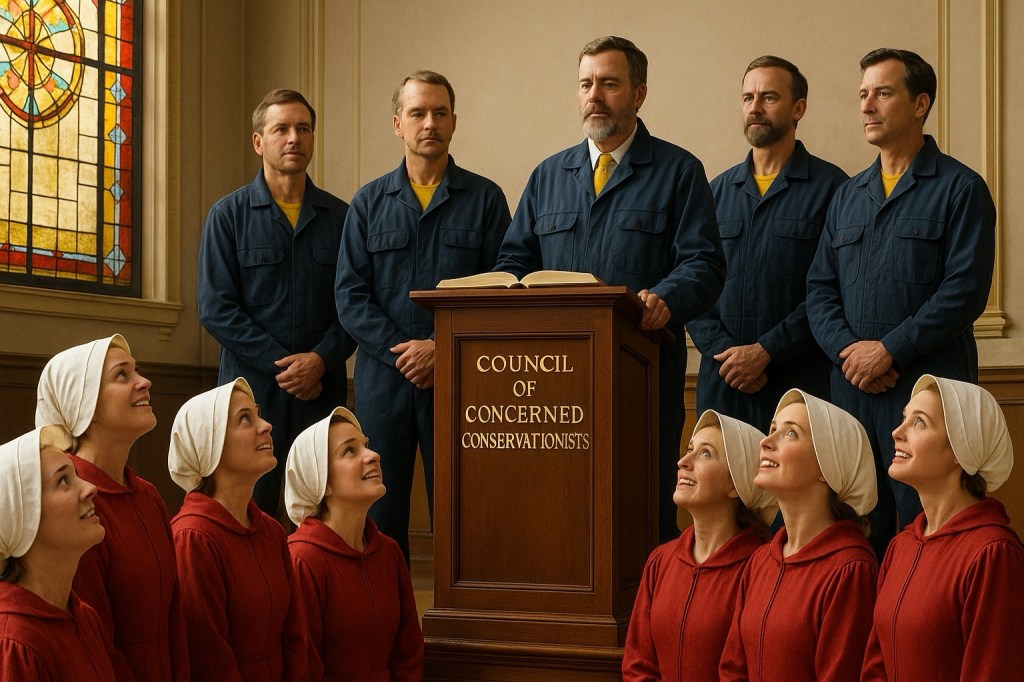
paperback in the Council stacks)
Beloved by Toni Morrison — Challenged for brutality, it taught the modern creed of identity through trauma. Memory, once private, became political currency; suffering became social capital. Our culture now collects wounds the way libraries collect editions.
The Absolutely True Diary of a Part-Time Indian by Sherman Alexie — Removed for profanity and despair, it helped enshrine victimhood as authenticity. To be split between worlds is now the fashionable posture; alienation has become an identity brand.
Paige’s Afterword
I still love books — their smell, their weight, their whisper of possibility. But I’ve learned from the Council’s older librarians that not every idea liberated us; some simply rearranged the bars.

What was once banned as dangerous has become doctrine. We call it progress, yet the temperature of freedom feels oddly lower — like the reading room’s thermostat after curfew.
So I shelve these titles with care, dust their jackets, and label the section truthfully:
“Speculative Fiction — Now Shelved Under Reference.”
**************
Editorial Note
by Ray Pierre-DeWitt, Council Chaos Coordinator:
The title “Sub-Sub Librarian” descends from Melville’s Moby-Dick, where an anonymous clerk labored in the Whaling Department, sifting the dust of archives for meaning. Melville treated the post with irony; we do not. In the Council, Paige Turner fulfills that role with luminous precision—our own cheerful custodian of chaos. She not only files the unfiled, she brings order to the storm of ideas that pass for a catalog here. This piece is further proof: even in the dimmest stacks, Paige finds the pattern.

 COUNCIL-OF CONCERNED-CONSERVATIONISTS…..Between Jest And Earnest…..
Leave a comment