—La Famiglia as Folk Religion: The Ethnography of a Misunderstanding.
By Eugene Bodeswell, Council Ethnographer
Introduction by Mrs. Begonia Contretemp
[European Correspondent – Council-of-Concerned-Conservationists]
As the Council’s resident Norman of mixed British and French extraction, I was naturally chosen to introduce this ethnographic meditation. Eugene Bodeswell and I were selected precisely so that no accusations of partiality might arise; appointing one of our Italian-American council members to examine The Godfather would have suggested bias.
Eugene has written, with unnerving calm, about how America took a Sicilian mother and promoted her to mob boss—how The Godfather turned devotion into intimidation and made family affection sound like organized crime. It is, as he shows, not a story of corruption so much as translation: a maternal virtue rendered in gunfire for an audience that mistrusts gentleness.
Reflecting on his findings, I can’t help thinking the old protection racket was simply ahead of its time. The manners, the persuasion, the pledge of safety—for a small monthly fee, of course. Once they sold protection; now they sell subscriptions. The velvet glove remains, only the manicure has improved. Do donate—at the Council-of-Concerned-Conservationists’ website, Between Jest and Earnest. It would be such a shame if the culture were to, how do you say, vanish.
Eugene’s Preface
Among the Council-of-Concerned-Conservationists, we study not only the ecology of landscapes but of legends. Myths, like invasive species, often escape their native habitat and take root in foreign soil. Few examples are more telling than America’s adoption—and mutation—of the Italian Mafia myth.
I. The Myth Mistaken for History
The popular image of the Mafia is not Italian; it is Italo-American cinema rendered as scripture.
Ever since Mario Puzo’s The Godfather and Coppola’s films, many Americans have taken this stylized fiction for sociological fact—as though one could wander through modern Britain expecting to meet Sir Lancelot polishing his sword in a pub.
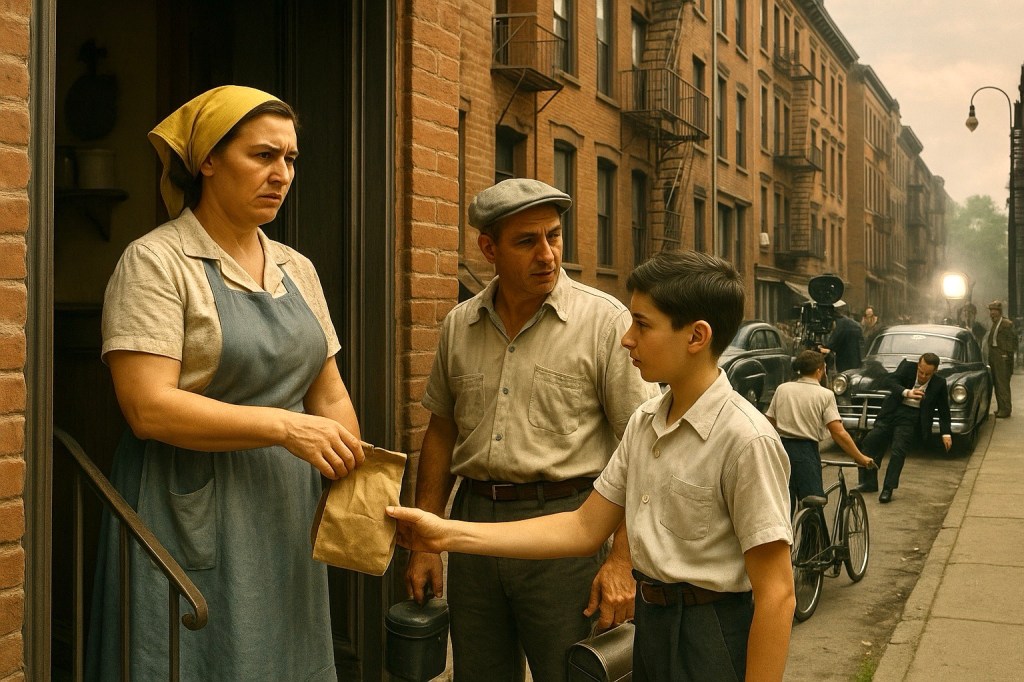
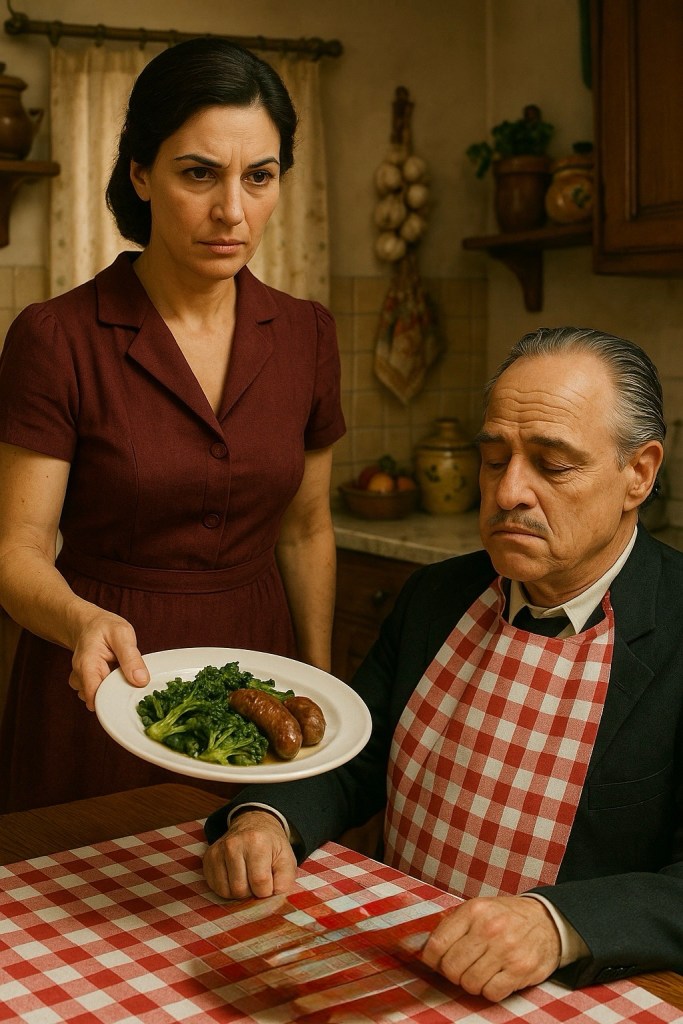
The real Mafia was a loose criminal network, often pitifully small, parasitic, and opportunistic. Yet through film, it became a kind of American Camelot: a world of hierarchy, honor, and tragic family loyalty. When Mario Puzo confessed that Don Corleone was modeled not on a Sicilian boss but on his mother, he revealed something vital—the heart of the myth was domestic, not criminal. The supposed story of organized crime was, at its core, a story of Italian family virtue: of sacrifice, patience, and fidelity amid chaos. Audiences were moved not by the murders but by the morality.
Thus, an underworld epic became a household romance. The violence was background music; the melody was maternal love.
— Council-of-Concerned-Conservationists, Department of Social Irony and Grace
II. Parasitic Stories and Parasitic Structures
But myths, like the Mafia itself, rarely live without a host. The truth is that organized crime in both Italy and America fed upon the very community it claimed to defend. It extorted the grocer, the mason, the baker, the small contractor—the working class that carried old-world virtues into the new.
The Mafia was never the guardian of Italian America; it was its parasite. It siphoned wealth and honor from those who worked hardest, then posed as their protector. Hollywood’s Mafia films did much the same. They fed upon the moral capital of the Italian family, draining its symbolic strength to stage dramas of sin and redemption for mass consumption — and, in the process, provided the perfect camouflage for the real underworld bosses.
Both enterprises—the real and the cinematic—thrived on borrowed dignity. Both mistook exploitation for homage. The Italian family, not the Mafia, was the true source of what the audience found noble.

— Vito Haeckeler, Council Man-on-the-Street, Dept. of Orthographic Enforcement & Public Embarrassment
III. The Feedback Loop of Legend
Once myth enters the bloodstream, it begins to circulate back to the source. After The Godfather, many Italians in America found that they had been given an identity not of their making. “Italian” came to mean the gestures, diction, and fashion of movie gangsters—a costume stitched in Hollywood.
And then the feedback began: young men, eager for power or belonging, began imitating the very fictions that had once misrepresented them. The performance became self-fulfilling. Life began quoting the script.
Some adopted the accent, the hand gestures, the lines. The cinematic myth had spawned a new folk theater—what anthropologists might call reflexive folklore, a culture performing its own parody.
IV. Hybrid Masculinities: From Pazienza to Performance
In later decades, another cross-pollination occurred. These self-styled “new gangsters” fused the imagined Mafia style with the aesthetics of black street culture—chains, swagger, conspicuous display, verbal bravado. From hip-hop videos they learned flamboyance; from the movies, faux-Sicilian ritual.
What emerged was not Italian, but a postmodern hybrid: a synthetic street nobility with no memory of the virtues it mimicked. The ancestral code of Southern Italian manhood—Pazienza, the quiet endurance that dignifies hardship—was replaced by theatrical aggression.
Where the old men of Naples prized composure, the new imitators prized spectacle. Pazienza was inward mastery; the new code was outward display. The patient artisan became the impatient influencer. The code of silence was drowned out by the code of noise.

— Council-of-Concerned-Conservationists, Department of Ethnographic Corrections and Comic Tragedy
V. Myth as Mirror
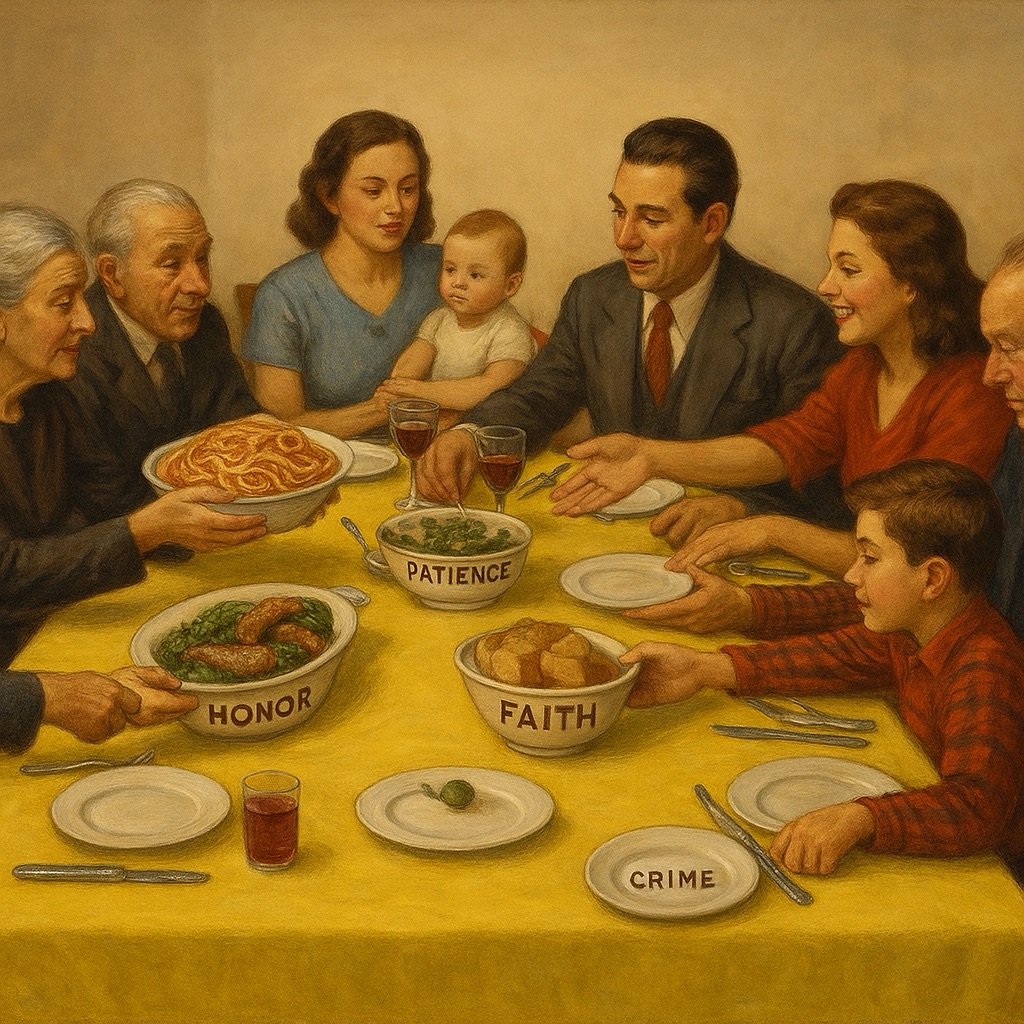
The ethnographic truth is simpler and sadder. The Mafia’s power came from the same source as its movies: the virtues of the Italian family it parasitized. Without those virtues—discipline, loyalty, affection, Pazienza—neither the criminals nor the filmmakers could have composed their legends.
The Mafia film borrowed the family’s honor to disguise its theft; Hollywood borrowed it to decorate a fiction. Between them, they created a myth that was at times beautiful, tragic, but false.
And yet myths, however wrong, tell us what a culture longs for. Americans did not fall in love with organized crime; they fell in love with the idea of belonging—to a family, a faith, a code. They mistook the parasite for the parent, the myth for the moral.
Coda
If myth is the dream of a people, then The Godfather was America’s dream of Italy—shot through with incense and gunpowder, family and fate. The tragedy is not that we believed it. The tragedy is that, in believing it, we forgot the real story:
the story of ordinary Italians who worked too hard to have time for crime,
who practiced Pazienza in quiet kitchens and union halls,
and who, without ever knowing it, gave Hollywood its most enduring moral vocabulary.
— Council-of-Concerned-Conservationists, Department of Social Irony and Grace
Filed under: Cultural Mythography, Cinema as Ethnographic Error, Council-of-Concerned-Conservationists Newsletter – Timestream Edition
**************
NOTE [for the dutiful or the curious]:
Those wishing to see the gentler truth behind the myth may consult Marianne Leone’s reflection on Mario Puzo’s The Fortunate Pilgrim, which reminds us that his truest epic was written not in blood but in devotion. It remains a quieter masterpiece, long eclipsed by Hollywood’s gunfire:
***

 COUNCIL-OF CONCERNED-CONSERVATIONISTS…..Between Jest And Earnest…..
Leave a comment