“One invites guests not for their manners,” I remind my readers, “but for their metaphysics.”
This evening’s Conversation Under the Knife concerns that most indecorous of graces—the laughter that arises when existence itself slips the surgeon’s glove. To explore it, I’ve summoned two men who met dread with an unnerving smile: Herman Melville and Ernst Jünger.
Melville wrote of a man who, in some extremity of tribulation,
“takes this whole universe for a vast practical joke… bolts down all events, all creeds and beliefs… and death itself seems to him only sly, good-natured hits and jolly punches in the side bestowed by the unseen and unaccountable old joker.”
Yet we are left to wonder—did he laugh with that unseen joker, or was he being laughed at? Melville never says, yet, he had a sense of humor. He leaves us suspended between cosmic collusion and cosmic humiliation.
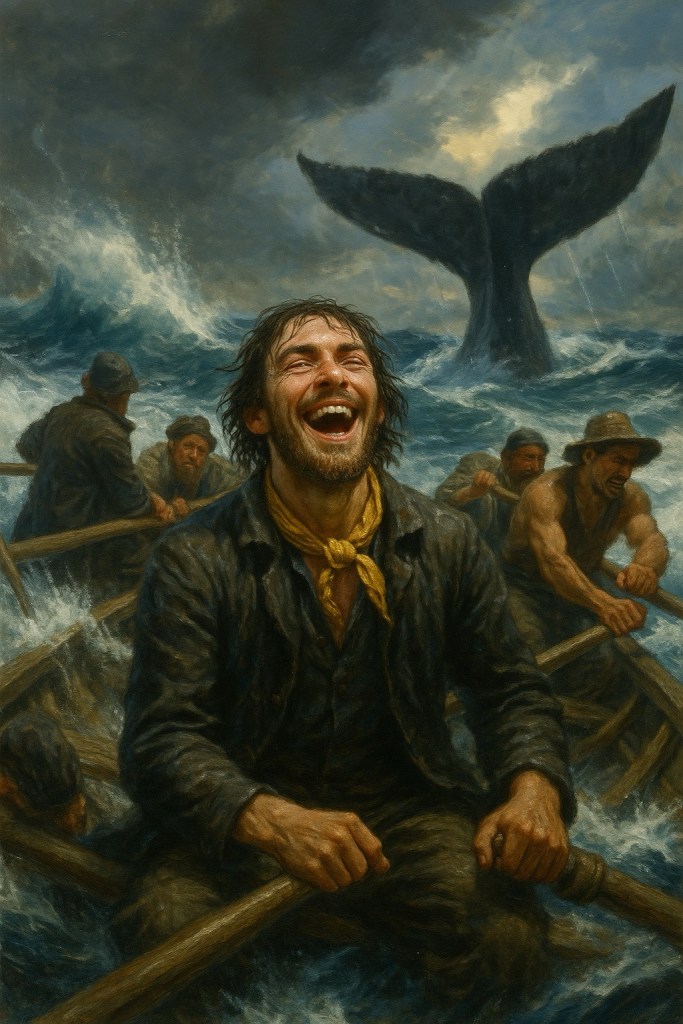
From the chapter, “The Hyena” in Moby-Dick: — Ishmael and his shipmates, moments after nearly capsizing, break into hysterical laughter. It is the same laugh the Council recognizes as the first proof of metaphysical buoyancy.
Jünger, by contrast, felt no humiliation—only exaltation:
“There is a quality of dread that feels as unfamiliar as a foreign country—often attended by fits of laughter I was unable to repress. —The ability to think logically and the feeling of gravity, both seemed to have been removed.”
Between Melville’s mockery and Jünger’s ecstasy lies the narrow operating table upon which the modern soul writhes and giggles. Tonight we attempt its diagnosis.
Even our own John St. Evola, Council editor and patient emeritus, once confessed that as he was wheeled toward emergency surgery, he felt an irrational calm—“clarity with the humor left on.” He later admitted a quiet thrill at the thought he might die and wake in a new world—where, if there was laughter, so much the better.
Three cases, one condition: the human capacity to find poise in danger. Some call it gallows humor. The Council, ever euphemistic, calls it spiritual buoyancy under pressure. Anesthesia, as usual, will not be provided.
“Someone must always make the first incision,” Mrs. Begonia quipped as John St. Evola cut the cheese—thus commencing another Conversation Under the Knife in the Gist-and-Tangent Ratskeller.
Scene I — The Table Set for Paradox
The long table gleams like a surgical tray. Silver glints beneath chandelier light; candles tremble, unsure whether they illuminate a dinner or an autopsy.
At the head, Mrs. Begonia adjusts her lace cuffs with the composure of a duchess about to dissect a saint.
Next to her: Herman Melville, sea-salted, eyes alight with mischievous melancholy.
Across: Ernst Jünger, immaculate in field-gray, his Iron Cross catching the same candlelight.
At the far end: John St. Evola, deftly wielding the carving knife as if preparing to divide thought itself into moral cuts.
Mrs. Begonia’s Toast
“My dear captains of calamity—welcome.
Tonight’s subject is the laughter that follows horror the way thunder follows lightning.
Mr. Melville, you swallowed the cosmos and found it a jest; Herr Jünger, you swallowed dread and called it clarity; and dear John, you swallowed anesthesia’s promise and found instead the giggle of grace.
Let us dine upon dread, savor absurdity, and test whether gallows humor might yet be a Eucharist for the modern age.
To jest and earnest both—and to those who can tell the difference without losing their appetite.”
Glasses rise. Thunder—or laughter—rolls.
Scene II— First Course: The Cosmic Jest
MELVILLE
“There are moments, Madam, when the universe grins through its teeth at me, and I can do no better than grin back. I have seen the sea mock its own depth, and men mock their own doom.”
MRS. BEGONIA
“Ah, self-referential despair—how very contemporary! It takes a sailor to laugh while sinking; the rest of us merely wave and call it stoicism.”
JÜNGER
“Despair is cowardice in evening wear. On the front, laughter was our respirator. One gasps, then giggles—it’s the same motion.”
MRS. BEGONIA
“Gentlemen, you make nihilism sound positively chic. Still, I grant you this: style under pressure is civilization’s last defense.”
JOHN ST. EVOLA
“In the field, we called it gallows calibration. When you smelled gas, you tested the line with a match—strictly unapproved. Still, the joke and the flame did the same work: they told you how bad the leak really was.”
MRS. BEGONIA(high, delighted laugh)
“Precisely! We are all technicians at the threshold—Mr. Melville tightening bolts on the cosmos, Herr Jünger soldering nerves to courage, and you, dear John, adjusting the voltage on civilization’s dimming bulb.”
Scene III— Second Course: The Euphoria of Doom
JÜNGER
“In the storm of battle one perceives a purity. The self dissolves; what remains is service to the elemental.”
MELVILLE
“Aye—and the trick, Herr Jünger, is not to mistake the wave for applause.”
MRS. BEGONIA
“How nautical of you both. Whether you surf or sink, the froth tastes the same. Perhaps theology was always just hydrodynamics in a better dress.”
JOHN ST. EVOLA
“Then laughter’s our life-vest.”
MRS. BEGONIA
“And irony, dear John, the whistle attached. Civilization survives by those who can giggle on cue while the orchestra floods.”
Scene IV— Closing Toast: Laughter as Last Rite
“So then,” she declares, lifting her glass,
“to all who can laugh without malice, bleed without melodrama,
and digest their disasters gracefully.
Let the solemn choke on seriousness—
we shall dine upon dread and call it dessert.”
Thunder again—or laughter. The carving knife gleams.
“Between jest and earnest lies the incision.”
— Council-of-Concerned-Conservationists, Cultural Autopsy Series


 COUNCIL-OF CONCERNED-CONSERVATIONISTS…..Between Jest And Earnest…..
Leave a comment