GONE AWRY.
The Council-of-Concerned-Conservationists Newsletter Column
—In which we explore the unintentional or unfathomable consequences of human endeavour.
(A Field Note from Black Cloud, Chief Poetic Justice Warrior)
Council, let me set the scene:
I’m in my cabin in the Wilds, coffee gone lukewarm, the propane heater humming its secular chant.
On the table: an old Time Magazine, a clipping of a cartoon, and a bottle of Heinz ketchup glowing red in the window light.
Strange altar, but we take what revelation we’re given.
The Time piece was about Desmond Shum’s Red Roulette — he calls it the Red aristocracy.
Seven busloads of hereditary CCP insiders, “citizens of no particular merit,” seated beside Xi Jinping just because of bloodline.
Bureaucratic nobility.
It’s hierarchy without spirit — a kind of powdered-milk dynasty, thin but shelf-stable.
I remember shaking my head and saying aloud, “Even socialism needs a crown; it just keeps changing the logo.”
Then my eyes fell on this cartoon: two monks beneath the trees:
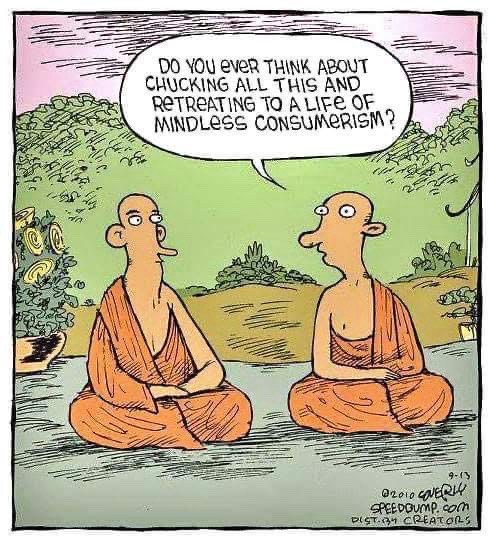
I used to laugh at that. Now I just nod.
Because the monk isn’t joking—he’s confessing.
He’s the most honest man in the monastery.
Back in my counterculture youth, we thought Asia had transcended all this.
The Tao was balance, Confucius was order, and the East was supposed to be a spiritual guide.
Fast-forward half a century, and the disciples of detachment are sprinting through shopping malls faster than any hedge-fund trader ever dreamed.
The Tao flows toward the outlet mall.
[Could there be a back-eddy developing?]
So I look up from the magazine, through my window, and there they are:
two hunters on a stand, old-fashioned red and black plaid Woolrich jackets for visibility, motionless, patient as saints.
Monks in plaid, waiting on deer, content in the quiet before the drag.
The cartoon had walked out of the paper and into the pines—only the roles had switched.
The monk longed for distraction; the hunters sat content in the anticipation, knowing that whether or not a deer appeared, the waiting was its own reward—and if their moment did come, the prize wouldn’t be bought in a marketplace but earned in the quiet work of the woods.
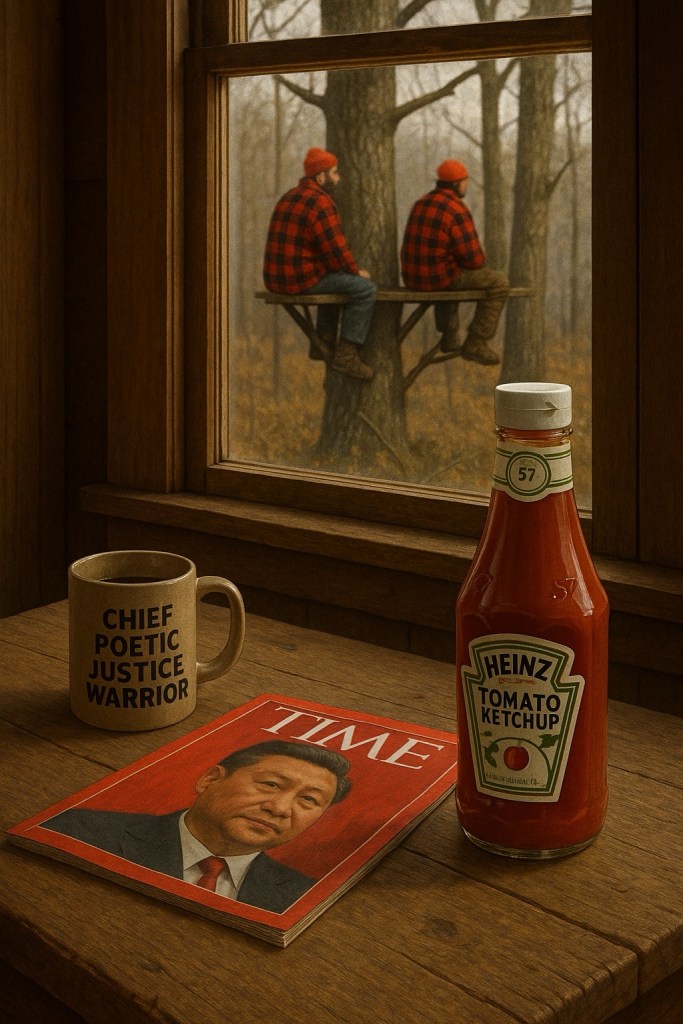
In a land where French fries are laid upon salad, there is only one dressing fit for the throne.
That’s when it hit me: hierarchy isn’t the villain — it’s the architecture.
The keystone that holds the arch together isn’t privilege; it’s patience.
Desire and fulfillment are the twin pillars, and that small space between them — that held breath — is what keeps civilization upright.
And right there on my table sat the proof: a bottle of Heinz ketchup, its label crowned with a keystone.
Heinz, from Heinrich — ruler of the home.
A domestic crest if there ever was one.
The red of appetite, the keystone of balance, the lineage of taste.
And then it struck me — anticipation is the better part of desire.
Heinz once made a whole gospel of it. In that old commercial, Carly Simon crooned “Anticipation” while the ketchup inched, gloriously slow, toward the plate. What others called a flaw — its stubborn thickness — they turned into virtue. A waiting game turned sacrament.
It wasn’t just clever marketing; it was metaphysics. The slowness was the flavor. The patience was the pleasure. Civilization itself depends on that same viscosity — the time it takes for what we crave to arrive, the pause that keeps appetite from collapsing into gluttony.
Maybe the real aristocracy isn’t born in palaces or politburos.
Maybe it’s born in the man who can sit still on a cold morning, ruler of his own hunger, master of his anticipation.
The aristocracy of desire itself — holding steady between appetite and grace. Denying neither.
And that, dear Council, is how a bottle of ketchup, a Chinese oligarchy, and a cartoon monk conspired to remind me what the keystone really holds together.

why is anticipation still making me wait, Carly?”
[Because the ketchup knows something the Mad Men learned first:
the flaw is the feature.
If only Black Cloud could sell patience the way Heinz sold viscosity.]
Postscript — Justin Aldmann, [C-of-C-C correspondent assigned to retirement, senescence, infinity, and beyond]:
Black Cloud may have figured it out on paper, but living it’s another story.
He knows patience is a virtue — he just hasn’t forgiven it for being so slow.
 COUNCIL-OF CONCERNED-CONSERVATIONISTS…..Between Jest And Earnest…..
Leave a comment