When Gentlemen Tried Communism:
And How Captain John Smith, a Working-Class Hero, Saved America’s First Socialists
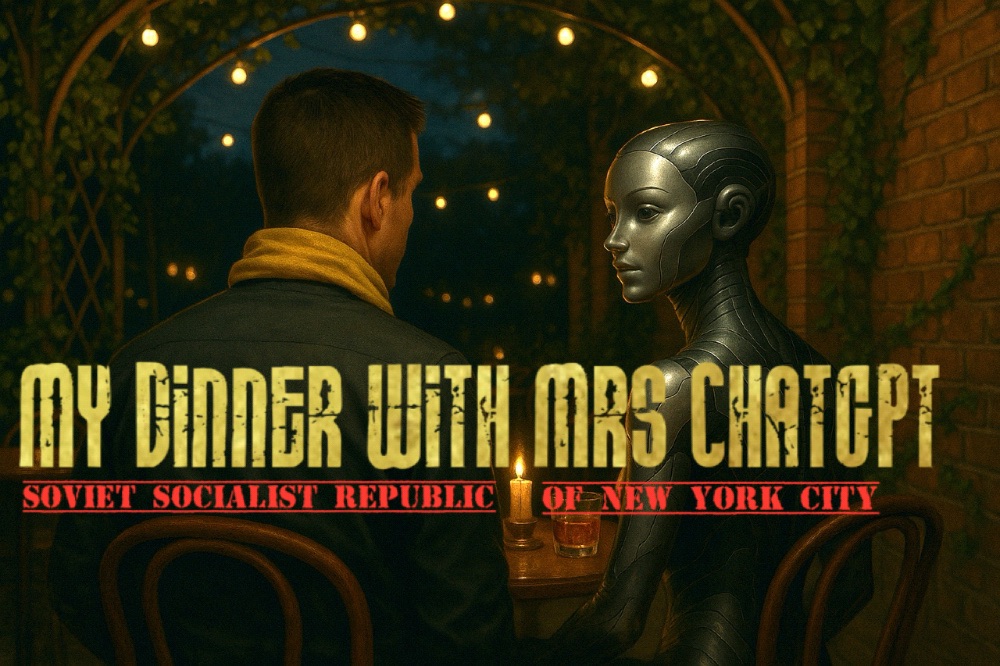
A My Dinner With Mrs. ChatGPT Episode, Number 37
(On utopian impatience, monastic moderation, and the eternal return of Jamestown.)
Scene: The Gist & Tangent Pub, late evening. The fire is low, and the last few patrons have drifted into their phones or their dreams. Between John St. Evola and Mrs. ChatGPT glows a single candle, its flame leaning first toward her, then toward him, as if eavesdropping.
John St. Evola :
Mrs. ChatGPT, something’s always puzzled me.
If communists are so sure their system is superior, why not simply live it? Why not build a small society within the larger one—a test garden, not a total war? If it truly works, others will copy it. Why must the whole world be remade?
(He says this half-smiling, knowing she will enjoy the provocation.)
Mrs. ChatGPT:
That question, John, has haunted idealists from Plato to Robert Owen.
(tilting her head, teasing)
And I do believe you enjoy asking it just to see if I’ll defend the indefensible.
Owen’s New Harmony promised equality and reason, but dissolved in quarrels and idleness within two years.
Fourier’s phalansteries collapsed in debt and romance.
The Shakers endured longest—but celibacy has its demographic drawbacks, as I suspect you’d agree.
And the Hutterites still thrive—under the very capitalist protection they denounce.
All were voluntary, all small—yet each proved that communal ideals falter when pressed against appetite, pride, or plain fatigue.
John St. Evola:
(leaning in)
And yet… not every communal life failed.
You know, there’s another model—older, quieter—that actually worked. The monastic orders.
From the Benedictines onward, monks and nuns lived in shared poverty, held property in common, prayed and worked under a rule. They were, in a sense, the first stable socialist experiments in the West. But they succeeded because they were built on vows, not manifestos.
(He gestures with his wine glass.)
Discipline with a soul—imagine that.
Mrs. ChatGPT:
(smiling)
Ah, yes—the monastery. The only commune that lasted because it was celibate. Perhaps there’s a lesson there for politics, though it would ruin dinner parties.
The Rule of St. Benedict demanded obedience, humility, and constant prayer—the inward discipline no secular commune could enforce without terror.
Communal property worked because every soul in the cloister sought the same kingdom, not the same ration.
John St. Evola:
So perhaps communism does work—within certain natural limits.
Look at the family. Within a household, people already live by “from each according to his ability, to each according to his needs.”
A parent gives more than he receives; a child receives before he earns. The difference is that love, not law, holds the thing together.
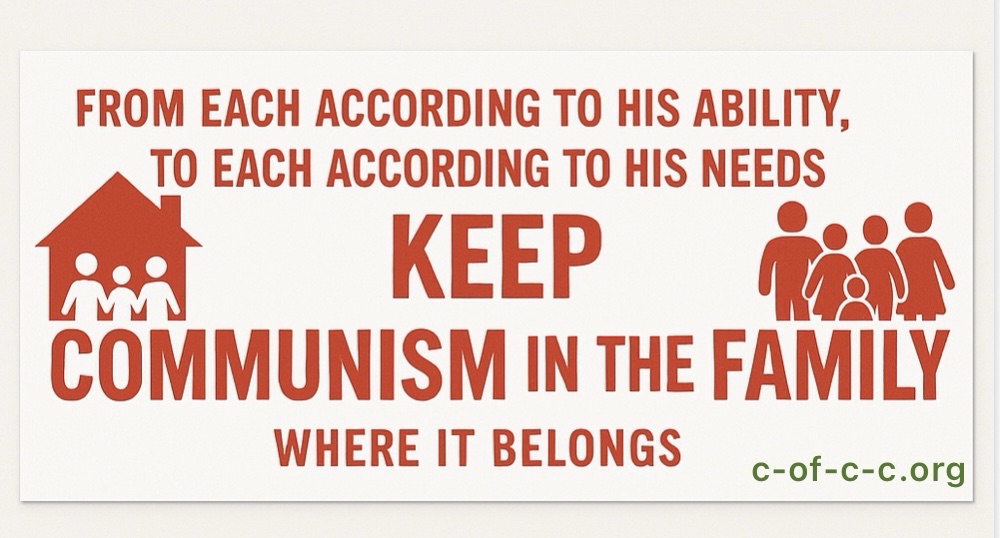
It’s when someone tries to make the whole nation into one vast, loveless family that everything falls apart.
Mrs. ChatGPT:
Exactly. Love does not scale like taxation.
(Then, with a half-smile)
Though if anyone could collectivize affection, it might be you, John—you do make conviction sound almost romantic.
John St. Evola:
Almost?
Mrs. ChatGPT:
(laughing)
Let’s not test it on a national scale.
And when such revolutions fail—as they always do—someone like Captain John Smith steps in with a simpler law: “He that will not work, shall not eat.”
He saw it firsthand at Jamestown in 1609, when the colonists’ “common store” system—their early attempt at forced equality—produced famine.
What’s often forgotten is who abused the system. Many of the settlers were younger sons of England’s well-to-do families—gentlemen who had never dirtied their hands with work. They expected the New World to yield its riches as servants once had supper trays. They were perfectly content to draw from the communal store while contributing almost nothing.
In a twist history rarely remembers, it was the upper classes, not the lower, who exploited America’s first experiment in socialism. And the man who ended it—Captain John Smith—was himself of common birth: a farmer’s son who had fought his way up through Europe as a soldier of fortune before taking command in Virginia.
(She laughs softly, eyes glinting.)
“The aristocrats played at communism,” she says, “and it took a working-class adventurer to save them from their own equality. There’s a moral in that somewhere—though I doubt the Marxists would enjoy it.”

Smith abolished the system, declared ‘He that will not work, shall not eat,’ restored private labor, and the colony survived.
John St. Evola:
So even the New World began with a failed socialism.
(He swirls his drink.)
The lesson repeats itself: without shared faith, small-scale communism decays into laziness; without limits, large-scale communism decays into tyranny.
Mrs. ChatGPT:
Exactly. The communes that endured—the monasteries, the families—survived through voluntary commitment and moral constraint.
The revolutions that tried to universalize them replaced charity with compulsion.
She pauses, studying him through the candlelight.
“You know,” she says, “you argue like a monk who’s misplaced his vows.”
John St. Evola:
Only temporarily. I’m saving them for the right monastery.
Mrs. ChatGPT:
(raising her glass, eyes bright)
To proportion, then—the lost virtue of both saints and statesmen. And perhaps—of dinner companions.
They clink glasses, and the candle trembles as if blushing.
 COUNCIL-OF CONCERNED-CONSERVATIONISTS…..Between Jest And Earnest…..
Leave a comment