—A Continental Reflection by Mrs. Begonia Contretemp, European C-of-C-C Correspondent and Spokesperson for the Why & the Wherefore Cohort of the Nouvelle Vague Zwischenshaft (NVZ)

Editorial Prelude — from the Council’s Continental Desk:
When Orwell sneered at the cranks of his day—the sandalists, the celery-juicers, and the moral gymnasts who mistook discipline for depth—he dreamed of a socialism scrubbed clean of patchouli and prophecy. Yet, as the Cabinet Magazine essay on Wigan Pier’s bohemian socialists observed, the odor of eccentricity is the price of genius. Every movement begins with a badly dressed prophet and ends with a conference lanyard.
Mrs. Begonia, ever attentive to scent and semantics, now submits her continental clarification: the crank has survived—but she has changed perfume.
***
My Esteemed and Occasionally Exasperating Colleagues,
How reassuring it is to find that our venerable Council remains, in essence, a congregation of cranks—each of us bent at precisely the right and necessary angles. Some turn the handle with scholarly precision, others with theatrical noise, and a few, bless them, by sheer accident. Together we keep the great metaphysical engine coughing along, one sputter short of revelation. You are, every one of you, delightfully askew—and I say that with the deepest affection.
It seems only proper, then, that we pause to consider the word that so perfectly describes us, and the curious destiny hidden within its name.
Our moniker for today is the pejorative, CRANK.
Words can have multiple meanings. Our favorites are those that also encompass their opposite. They are called Janus words or contronyms.
Smitten is one that means a strong feeling of attraction or it can mean to hurt, kill, or punish. Yes we just looked it up on the web to clarify.
The Internet is both a blessing and a curse to those without photographic or youthful memory. Correct? All one has to do is recall a snippet and it is again revealed to you in its entirety after a short search.
Those with Google memories still need a starting point. So Google memory should not be a dismissal of intellect. They were, in their own halting way, circling the truth as poets do their prey. They just needed a search engine to pull their nascent idea along.
A true genius summons what he needs from memory; the sub-genius, as that curious American church would have it, merely seeks illumination from the algorithmic beyond. Think of him as genius with a starter crank. But let us be charitable—at least he turns his own handle.
Now CRANK is a Germanic word for crooked or bent; it can also mean a handle for starting, and in our sense, creating something. Crank can also mean sick as in the German word for hospital, Krankhaus. In modern English parlance it means someone with unusual or maybe someone with bent proclivities. Oh, the ambiguities, as Goethe or Melville might say.
(Google brain. The word “ambiguity” summoned it.)
It is our contention that cranks for all their equivocation, obscurity, enigmatic cryptic ways, and vagueness can start worlds. Laugh at them or learn from them or both. They should not be ignored.”
— Mrs. Begonia Contretemps, European C-of-C-C correspondent and spokesperson from the Why and the Wherefore Cohort of the Nouvelle Vague Zwischenshaft, NVZ
After-Tea Lecture: Bohemians Then and Progs Now
(As delivered in a tone of weary affection and polished exasperation.)
My Dearest Council and those who still bother to read beyond a headline,
Once upon a café table, bohemians were serious about frivolity. They possessed that divine sense of measure in excess—a cigarette held like an epigram, a scandal uttered with syntax. Their rebellion was choreographed; even their poverty wore pearls. They mocked convention precisely because they understood it, and they could afford to laugh at themselves.
Their supposed heirs, however—the ones who style themselves progressive—have turned the word into both a credential and a curse. I have decided, for convenience and accuracy, to call them Progs. It is, after all, their own beloved term abbreviated to its essence—yet it sounds—does it not—like a comic-book creature or a damp sound effect? One hears “Prog” and imagines a gelatinous life-form oozing toward a microphone to demand inclusion in the pantheon of the perpetually aggrieved. I will, of course, clarify the meaning for the uninitiated when charity requires it.
The Progs are humorless descendants of the laughing class. They parade through public squares in inflatable animal costumes, honking moral superiority through vinyl snouts. They mistake absurdity for wit, volume for irony, and outrage for originality. They have inherited the gestures of the old bohemians but not their grace—their performance art without their paradox, their protest without their prose.
True bohemianism was rebellion with manners, intoxication with intellect, style as substance. The old anarchist could quote Baudelaire while pouring wine; the modern Prog can only quote policy while spilling it.
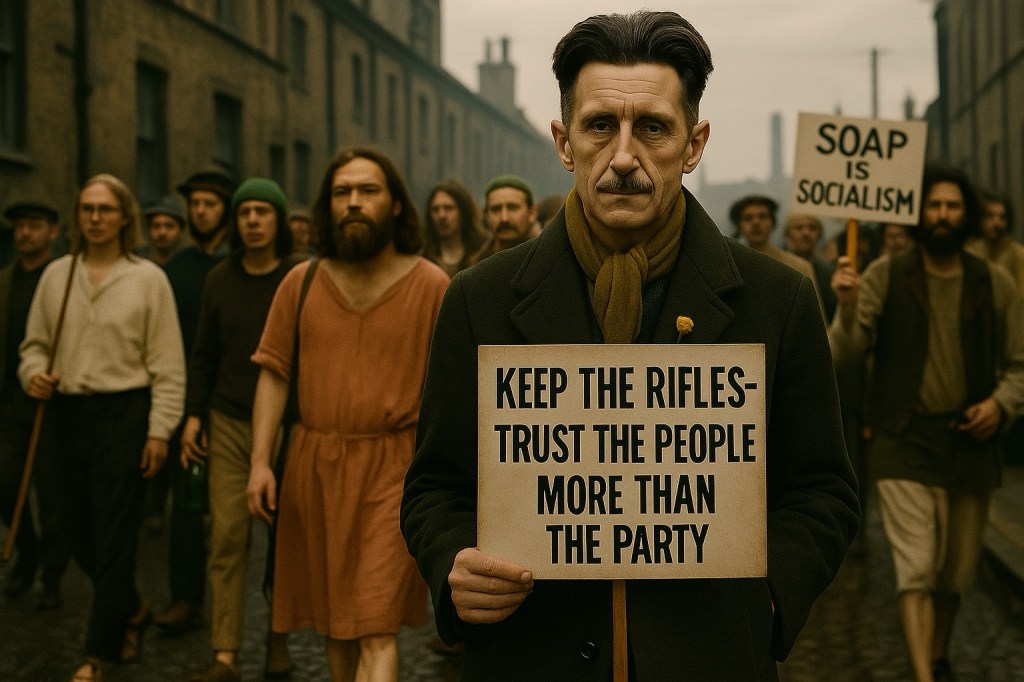
The only socialist in the march arguing that Britain’s Home Guard should keep its rifles—trusting the people, not the Party, to guard against tyranny.
Meanwhile, the new cranks—the traditionalists, the national romantics, the tweeded reactionaries, the populist protesters for the reclamation of their homeland—have quietly reclaimed both irony and elegance. Witness the use of the St. George flag in England by protesters against the importation of foreigners. The government has declared its own national symbol to be an illegal provocation. Is that not ironic?
The new cranks laugh and smirk again, not because they have surrendered, but because they have remembered that laughter is civilizational. They attend liturgy in addition to rallies, they build libraries instead of spaces, and their humor carries that faint aroma of adulthood long absent from the public square.
I find them restorative. They are bent, yes—but bent toward beauty. If civilization must be cranked back into motion, I prefer it done by a man in flannel and faith rather than by a Prog in polyester.
So yes, I embrace them. At least they dress the part of adults, and some even write complete sentences. If civilization is to be cranked back to life, I would rather it be by a man in tweed than by a Prog in vinyl.
Addendum
— by Ray Pierre-Dewitt, C-of-C-C, Chaos Coordinator

Mrs. Begonia, Fellow Cranks, and Other Unlicensed Mechanics of the Human Condition,
As the Council’s self-appointed Coordinator of Chaos, it falls to me to applaud what still turns—especially when it shouldn’t. Permit me, as a colonial sympathizer of Madame Begonia’s cultural crusade, to add that the old bohemians—those whiskered mystics in garrets and gin—were not wrong about everything.
Their cafés were laboratories of meaning: a place where poetry sparred with theology and everyone smelled faintly of turpentine and idealism. Even in their decadence there was direction. They were looking for an alternative to materialism, not a costume for it.
That’s what makes the modern Prog so tragicomic to me. The old leftists at least knew what they were losing. They mourned God, beauty, and hierarchy even as they defied them. Today’s protestors inflate plastic animals to mock the empire without realizing they’re performing its supply chain. They have kept the slogans and lost the soul.
So yes—Mrs. Begonia is right. The “right-wing cranks” she praises may be the only living heirs to bohemian honesty. They, too, reject the machine—not the useful and partnered technology—yet they do it in tweed, with melody, with reverence for what was once holy. That, my friends, is the real avant-garde now.


 COUNCIL-OF CONCERNED-CONSERVATIONISTS…..Between Jest And Earnest…..
Leave a comment