(A Lecture on the Hudson River school and Landscape Correction by Arthur C. Phärtze, Aesthetic Interpreter)
“They painted eternity — and accidentally invented content.”
— John St. Evola, whispered during the Lecture at the Gist & Tangent Pub
(Council Note — Arthur insists on the old Dutch spelling “Kaatskill,” instead of Catskill claiming it sounds more painterly and less like a brand of litter.)
THE GREAT AMERICAN SPECIAL EFFECT
(Lights dim. Arthur C. Phärtze stands at the portable projector, silk scarf aflutter, vowels lengthened for emphasis.)
PHÄRTZE:
“Esteemed colleagues—guardians of culture’s trembling flame—tonight we ascend the chromatic escarpments of nineteenth-century sublimity!
“Behold, the Hudson River School : that incandescent fraternity of brush and benediction!
They did not merely depict terrain; they transubstantiated it. Thomas Cole! Frederic Church! Asher Durand!—each a sacerdotal cinematographer of the divine!
“They revealed to a young republic that Eden was not lost—it had merely been repainted!”
The room hums politely. Someone mutters, “Hoity-toity.” Arthur smiles, believing it agreement.
PUBLIC VIEWINGS AND THE INVENTION OF AWE
PHÄRTZE (advancing slides):
“When Church unveiled The Heart of the Andes in 1859, he did not hang a painting; he premiered a revelation!
A darkened chamber, curtains like temple veils, gaslight trembling upon the canvas!
Ladies swooned! Gentlemen removed their hats! Opera glasses distributed as relics of optical piety!
“It was—mark me well—the first motionless moving picture!
“Observe how the light pours from on high, a proto-lens flare of the Almighty! Every waterfall a dissolve, every cumulus a cutaway to Heaven’s backstage!”
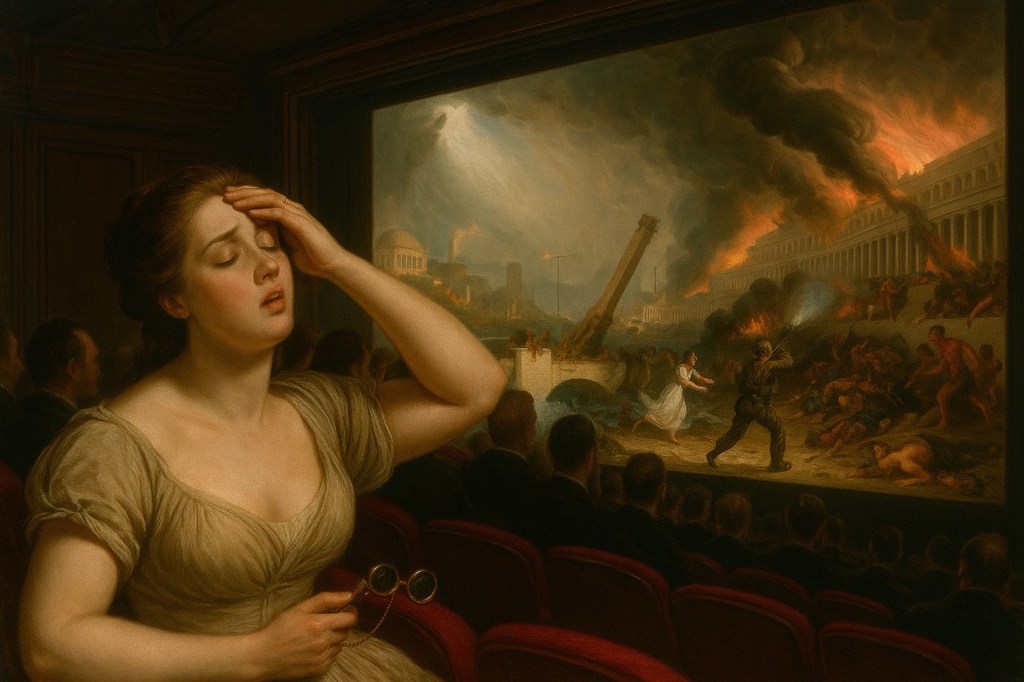
DAPHNE HOWLSMYTHE leans toward Mrs. Begonia Contretemp and whispers,
“High-falutin as a thunderhead.”
BEGONIA replies,
“La-di-da, but endearing.”
Arthur gestures grandly, oblivious, rhapsodizing on about chromatic pneumatology until the projector whirs in protest.
DECLINE OF THE EMPIRE (NOT AS PICTURED)
PHÄRTZE:
“And then, Cole’s magnum opus—The Course of Empire! A pentateuch in pigment!
“—The Savage State: raw innocence without HOA dues.
—The Arcadian State: rustic prosperity with pastoral tax incentives.
—The Consummation: triumphal architecture and overextended credit.
—Destruction: civic hubris meeting divine negative space.
—Desolation: the moonlight of repentance upon the marble of regret!
“But alas! Decline today wears no toga. It appears instead as a vape shop beside a crumbling Dunkin’.
We have traded Corinthian columns for corrugated siding!”
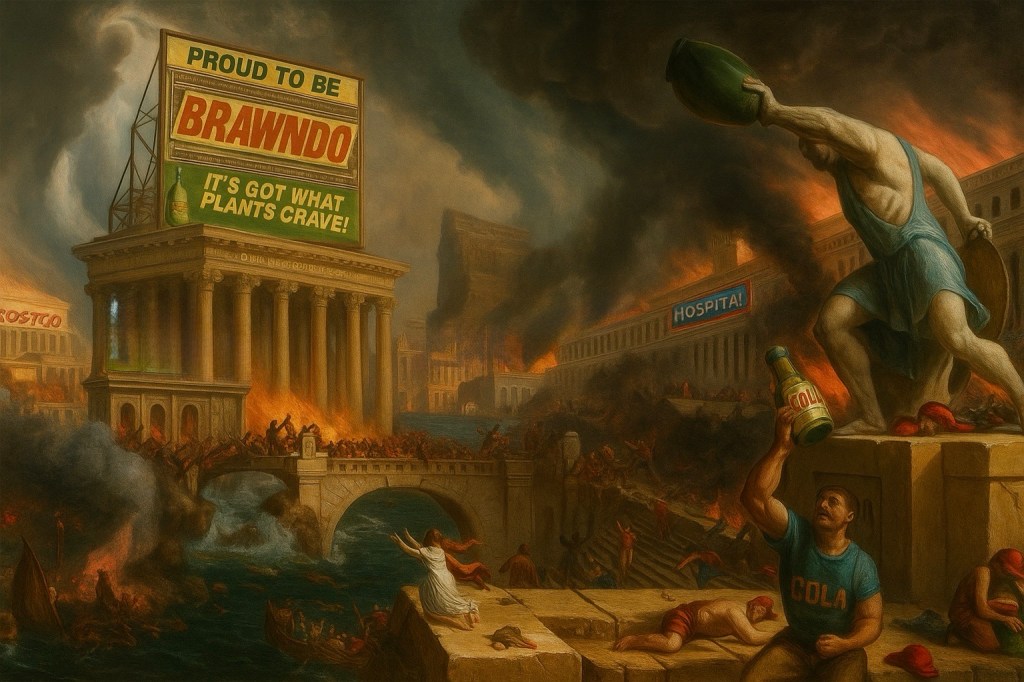
After Cole’s vision, the franchise continued.
The Council applauds politely. Arthur bows, believing he has restored civilization.
THE GENTLE CORRECTION
MRS. BEGONIA CONTRETEMP lifts her amoretto:
“Arthur, darling, your eloquence is positively Baroque—but the Catskills themselves, well, they’ve gone rather gray round the temples.”
PETER R. MOSSBACK clears his throat:
“That’s not just poetry, Arthur. By the 1840s, most of the Hudson Valley’s old-growth was gone—hemlock to the tanneries, chestnut to the mills.
Cole painted what was already disappearing. That glow you worship? It’s elegy, not eternity.”
Arthur blinks, the varnish of theory cracking just slightly.
PHÄRTZE:
“Ah—so the Romantic Sublime was already a requiem… Art mourning Nature while pretending to glorify her.”
JOHN ST. EVOLA:
“Exactly. And maybe that’s why he kept returning to that hill—what’s it called, the one shaped like a sleeping beast?”
DAPHNE:
“You mean Vroman’s Nose, John. Sounds like a cologne and a geological feature.”
MOSSBACK:
“That’s the one. Down in Schoharie County. Cole sketched it over and over—sneaked it into The Course of Empire.
They later proved it: that bluff with the meandering river below was his model.
Stand on top today and you can still trace the same curve. It’s about the only place left that still looks like a painting.”

The Schoharie County cliff that Thomas Cole slipped into nearly every panel of The Course of Empire lies roughly 150 miles from New York City—close enough for prophecy, far enough to stay clean.
New York was already called the Empire State when Cole painted; two centuries later, the course has only grown coarser.
BEGONIA:
“Then we simply must organize a field trip—The Council Goes to Vroman’s Nose. We’ll bring our own lighting technician and a flask.”
DAPHNE:
“And afterward we’ll stop at one of those Woodstock Emporium Collective Cafés—every merchant in the Catskills thinks they’re curating 1969. Peace of Pie, Hair & There, Groovy Goat Yoga…”
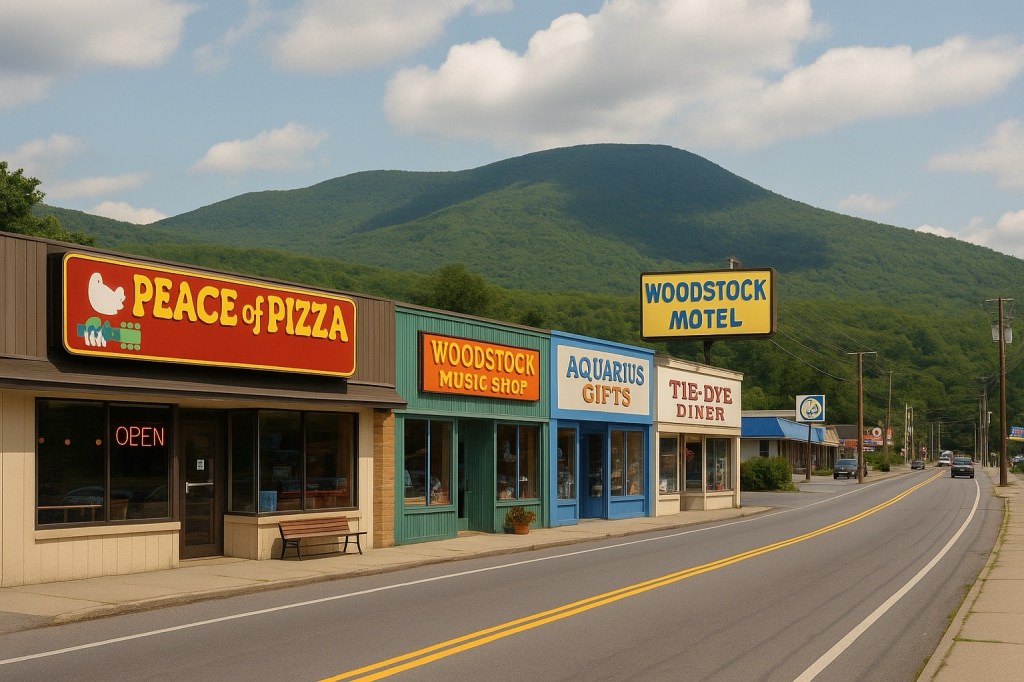
The concert they called Woodstock happened in Bethel, the House of God. Both Bethels promised heaven; this one sells it by the slice.
EVOLA:
“Hoity-toity hippies, thirty miles from Bethel.”
MOSSBACK:
“High-falutin free love—now with gluten-free bread.”
BEGONIA:
“La-di-da enlightenment, served in a souvenir mug.”
Arthur finally laughs—an expensive, well-educated laugh, but real.
PHÄRTZE:
“Then perhaps that is our modern landscape: commerce disguised as transcendence, nostalgia sold by the ounce. Still, I’d like to see that hill. Maybe Cole left some light behind.”
KAATERSKILL FALLS — THE SIREN OF THE HUDSON
DAPHNE:
“You know, some of Cole’s light still feels alive at Kaaterskill Falls. We hiked there one summer—two tiers of water, moss, and mist. It still looks like one of his canvases, though the painting adds more flourish—less mud, fewer warning signs.”
MOSSBACK:
“It’s one of the last real remnants. You stand there and think: maybe this is what Cole saw before the axe, before the tourists.”
BEGONIA:
“And yet people keep dying there, don’t they? Every year—climbing out on the wet rocks for the perfect selfie.”
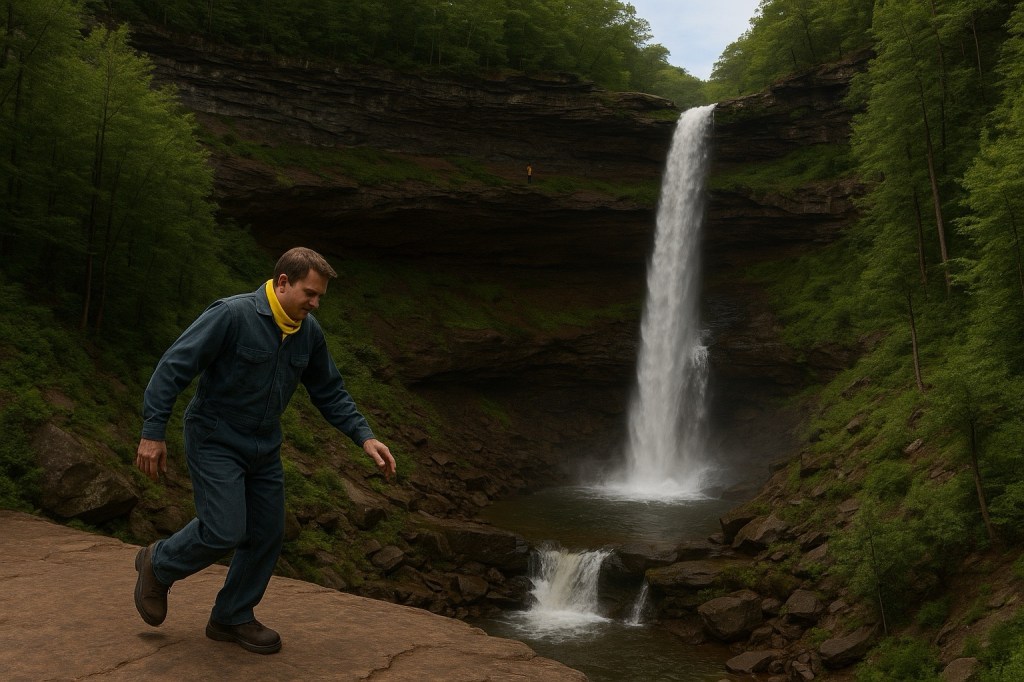
EVOLA:
“As if the painting itself were calling them—‘Come, be sublime!’—and over they go.”
PHÄRTZE (half-whispered, reverent):
“Then Kaaterskill is our modern siren—its spray the song that still lures us toward transcendence, or toward the edge.”
A hush falls. Glasses clink. Someone murmurs, “To Cole—the original influencer.”
EPILOGUE
The projector sputters out; conversation drifts into candlelight.
PHÄRTZE:
“They painted eternity,” he sighs, “and accidentally invented content.”
MRS. CONTRETEMP pats his sleeve:
“Artsy-fartsy or not, dear Arthur, we wouldn’t see the joke—or the longing—without you.”
Outside, the Catskills brood under sodium lamps.
Beyond the ridges, Vroman’s Nose and Kaaterskill Falls keep their patient silhouettes—half painting, half memory—while the wind rehearses the hymns of trees that once stood thicker, taller, and uncut.
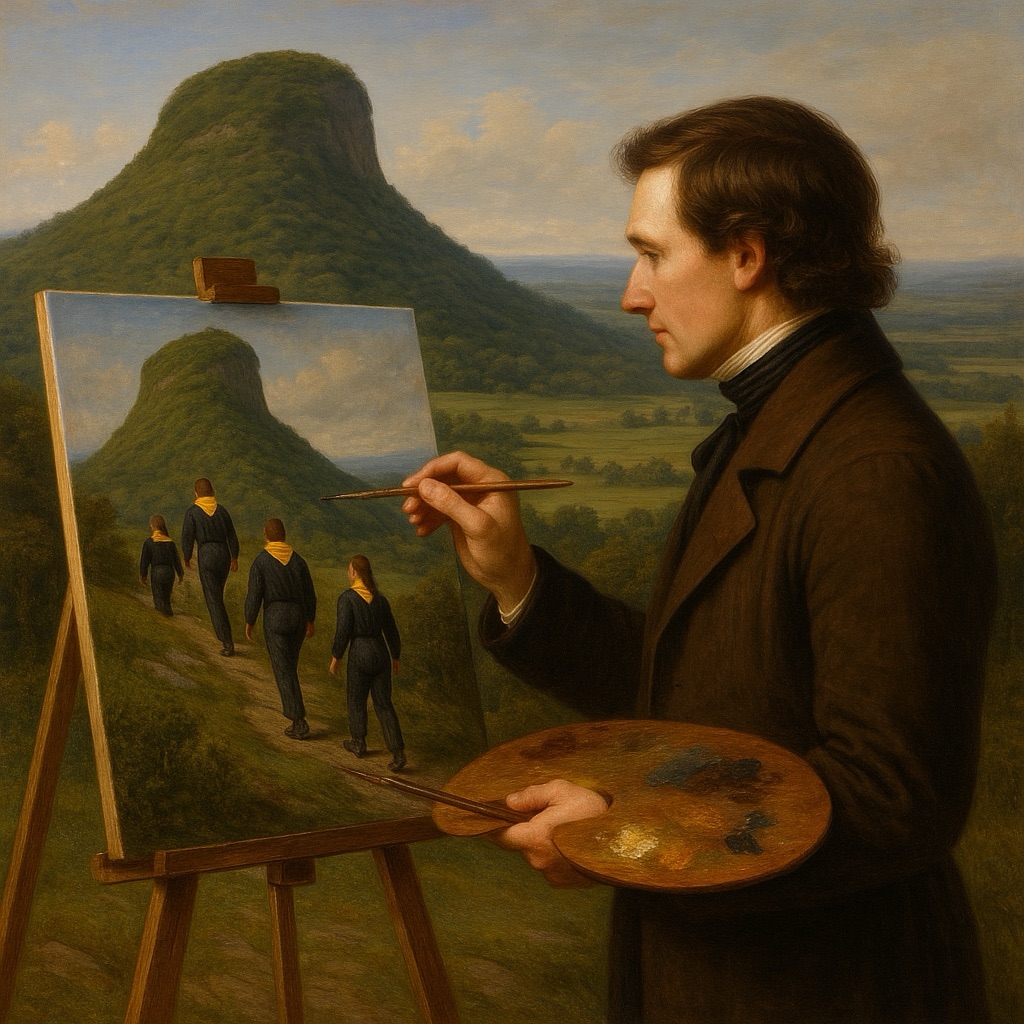
He’s still up there somewhere, adding one more brushstroke.
To be filed under Cultural Critiques
 COUNCIL-OF CONCERNED-CONSERVATIONISTS…..Between Jest And Earnest…..
Leave a comment